

Archive position — measured, not model output
0 likes on Devpost
2,263 of the 7,850 archived projects have more likes, and 5,587 share exactly 0 — so this project's #5,706 place in the like-ranked listing is a tie-break inside that group, not a ranking.
Projects (log scale)
Likes on Devpost. ▲ marks this project's group.
Show the figures
| Likes | Projects | Share of archive |
|---|---|---|
| 0 | 5,587 | 71.2% |
| 1 | 1,758 | 22.4% |
| 2 | 284 | 3.6% |
| 3–4 | 132 | 1.7% |
| 5–9 | 75 | 1.0% |
| 10+ | 14 | 0.2% |
 User Stories BotA demo video on every pull request
Get a demo video on every new feature
GitHub App that watches your pull requests and records a narrated, captioned demo.
Save time on demo prep and make informed decisions faster with a video walkthrough of every new feature.
Executive Summary
What the company appears to be
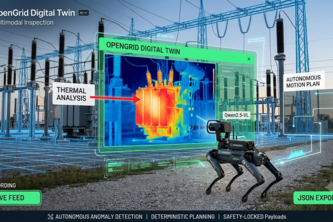
The project described by the caller is a self-reported proof-of-concept for an autonomous multimodal inspection system for electrical substations. It combines vision-language models (VLMs), reasoning AI, and digital twin technology to detect anomalies in thermal infrared images and generate deterministic 3D motion plans for robotic or simulated inspection.
What changed
This is a hackathon submission that describes a prototype pipeline built with open-weight models and serverless infrastructure. The author states it was developed with $0.88 total spend, using tools like Modal, OpenAI, Qwen, and Codex.
Single most important open question
Is there any evidence of real-world deployment, traction, or commercial viability beyond this single hackathon project?
Note
This analysis is based entirely on the self-reported, unverified description provided by the author. No external verification or historical data is available. All claims are labeled as “the description states” and treated as unverified.
What The Product Actually Is
The description states that OpenGrid Digital Twin is an end-to-end multimodal inspection pipeline designed to:
- Ingest thermal infrared images of electrical substation components.
- Detect overheating, insulation faults, or component anomalies using serverless Vision-Language Models (VLMs).
- Translate visual observations into structured 3D spatial target coordinates via reasoning models.
- Generate deterministic, safety-locked JSON payloads for digital twin inspection and actuation.
It also includes:
- A read-only dashboard built with Hugging Face Space and Gradio to display inspection runs.
- Integration of Codex CLI for orchestration and environment auditing.
- Use of Modal infrastructure for serverless GPU endpoints and OpenAI reasoning models.
Inference The system appears to be a prototype digital twin pipeline that bridges perception, reasoning, and actuation in a closed-loop structure. It is not described as a commercial product or platform but rather a proof-of-concept demonstration.
Positioning & Claim Evolution
The author positions OpenGrid Digital Twin as:
- A unified Physical AI Digital Twin pipeline.
- Capable of continuous, deterministic, and safe grid inspection.
- Bridging multimodal visual perception with reasoning-driven autonomous motion planning.
It is described as:
- An alternative to manual human oversight or rigid single-purpose computer vision models.
- Designed for use in high-voltage infrastructure where undetected failures can cause catastrophic outages or worker hazards.
Inference The positioning suggests a move toward automation and AI-driven safety in critical infrastructure. However, the description does not indicate any prior commercialization, customer feedback, or product-market fit beyond this hackathon submission.
Target Customer & ICP
The description states that the system is intended for:
- Electrical substations.
- Use cases involving high-voltage infrastructure where component failures can lead to power outages or safety hazards.
Inference The target customer appears to be utility companies or industrial operators managing electrical infrastructure. However, no specific customer names, use cases, or market segments are mentioned beyond the general domain of substation inspection.
Business Model & Pricing Evidence
There is no evidence in the description of:
- A pricing model.
- Revenue streams.
- Monetization strategy.
- Customer acquisition or retention mechanisms.
The project was built with $0.88 total spend, but this does not imply a business model or pricing structure.
Inference No commercial business model is evident from the description. The system is described as a prototype, not a product for sale.
Technical & Delivery Signals
The description states:
- Perception engine built with open-weight VLMs (Qwen2.5-VL-7B-Instruct) on Modal infrastructure.
- Reasoning and planning powered by OpenAI models (gpt-5.6-sol).
- Digital twin execution orchestrated via Codex CLI.
- Interactive dashboard built using Hugging Face Space and Gradio.
- Challenges included ensuring deterministic JSON outputs and balancing latency vs. cost.
Inference The technical stack is described as leveraging open-source or open-weight models, serverless compute, and structured data pipelines. The system is designed for low-latency, high-throughput processing with safety interlocks.
Traction & Maturity Signals
There is no evidence of:
- Customers.
- Revenue.
- Product adoption.
- Deployment in real-world settings.
- Iteration or versioning beyond this single submission.
The description states that the entire development and testing suite was completed for $0.88, but this does not indicate traction or market readiness.
Inference This is a prototype project with no demonstrated traction or maturity beyond a hackathon submission.
Competitive Context
No information in the description indicates:
- Direct competitors.
- Market size.
- Existing solutions in the space of multimodal inspection for electrical infrastructure.
- Competitive advantages or differentiation.
The author does not reference any prior work, market analysis, or competitive positioning.
Inference There is no evidence of competitive awareness or positioning within a broader market context.
Open Questions & Risks
Key risks and open questions based on the description:
- Unproven commercial viability: The system is described only as a hackathon prototype.
- No customer or revenue data: No evidence of traction, adoption, or monetization.
- Limited scope: The project is not described as scalable or production-ready.
- Dependency on external tools: Heavy reliance on OpenAI and Modal infrastructure may pose risks for long-term sustainability.
- Unverified claims: All technical and business claims are self-reported and unverified.
Inference The project lacks evidence of commercial readiness, scalability, or market validation. It is not a product but a proof-of-concept.
Questions the description leaves open
- What specific use cases or customers have you identified for this system beyond the hackathon?
- Have you tested this system in any real-world substation environments?
- What are your plans to scale beyond the $0.88 prototype, including compute, data, and infrastructure costs?
- How do you plan to integrate with existing industrial systems or standards (e.g., ROS2, ISO/IEC 27001)?
- Are there any partnerships or pilot programs in progress?
- What is the roadmap for moving from a prototype to a deployable product?
Overall Assessment
Not evidenced.
The description does not provide sufficient evidence of:
- Revenue.
- Customers.
- Product-market fit.
- Commercial traction.
- Scalability or long-term viability.
This is a hackathon submission, not a commercial product or platform. The author states that the entire system was built for $0.88, which suggests no investment or commercialization has occurred beyond this prototype.
Inference There is insufficient evidence to support an investment or partnership decision at this time. This project appears to be a proof-of-concept with no demonstrated path to commercialization or market traction.
User Stories BotA demo video on every pull request
Get a demo video on every new feature
GitHub App that watches your pull requests and records a narrated, captioned demo.
Save time on demo prep and make informed decisions faster with a video walkthrough of every new feature.
Source
Submitted to the OpenAI 2026 hackathon on Devpost. Project home on Devpost. Back to the full gallery on Devpost.
This competitive analysis was produced by top-founders.com (opens in a new tab)
Generated by a language model from this project's public Devpost page — its tagline, the author's own write-up and any built-with tags listed there — as captured in August 2026. Short quotations are the author's words. It is an opinion on the idea as a business, not on the people behind it, and it reflects the description as published then. If the project has moved on, request a correction below. The analysis is not independent research and contains no verified traction, revenue or customer data.
An independent guide by KFG International LLC — not affiliated with, endorsed by, or connected to Devpost or OpenAI.