

Archive position — measured, not model output
0 likes on Devpost
2,263 of the 7,850 archived projects have more likes, and 5,587 share exactly 0 — so this project's #5,688 place in the like-ranked listing is a tie-break inside that group, not a ranking.
Projects (log scale)
Likes on Devpost. ▲ marks this project's group.
Show the figures
| Likes | Projects | Share of archive |
|---|---|---|
| 0 | 5,587 | 71.2% |
| 1 | 1,758 | 22.4% |
| 2 | 284 | 3.6% |
| 3–4 | 132 | 1.7% |
| 5–9 | 75 | 1.0% |
| 10+ | 14 | 0.2% |
 User Stories BotA demo video on every pull request
Get a demo video on every new feature
GitHub App that watches your pull requests and records a narrated, captioned demo.
Save time on demo prep and make informed decisions faster with a video walkthrough of every new feature.
Executive Summary
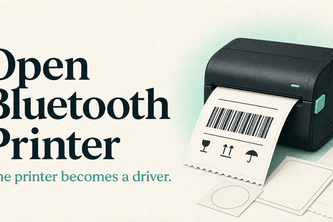
What the company appears to be: A self-reported open-source project that uses AI (Codex) to reverse-engineer Bluetooth printer protocols and generate reusable open-source drivers. The author states this is a hackathon submission with no revenue or customer data.
What changed: The description reports a shift from individual reverse-engineering experiments to building an extensible framework for community-driven protocol discovery, using AI-assisted tools like Codex.
Single most important open question: Does the project have any evidence of traction, adoption, or commercial viability beyond its hackathon submission?
What The Product Actually Is
The description states that Open Bluetooth Printer is:
- An open-source app and framework for communicating directly with portable Bluetooth printers
- Designed to work without proprietary apps or cloud services
- A platform where printer protocols can be added as modular drivers
- Built using Codex, GPT, TypeScript, and other tools
It is described as a "framework" that separates reusable workflow components from device-specific protocol details. The author notes it began with one working integration and evolved into a reusable platform.
Evidence: Self-reported by the author.
Confidence: Low — no independent verification of functionality or codebase.
Positioning & Claim Evolution
The project is positioned as:
- A privacy-focused alternative to closed-source printer apps
- An open-source solution for users who want to print without cloud dependencies
- A tool that democratizes reverse-engineering through AI (Codex)
- A community-driven platform for building reusable printer drivers
The claim evolution shows a progression from:
- Individual reverse-engineering of one device
- To a reusable framework
- To a scalable model where each discovery benefits future contributors
Evidence: Self-reported by the author.
Confidence: Low — no external validation or market positioning data.
Target Customer & ICP
The description states:
- The primary users are individuals who own portable Bluetooth printers
- Users concerned about privacy and data handling in closed apps
- Contributors to open-source projects who want to add support for new hardware
- Developers or hobbyists interested in reverse-engineering consumer devices
It does not specify a formal ICP or customer segmentation beyond these general user types.
Evidence: Self-reported by the author.
Confidence: Low — no evidence of actual customers, personas, or market research.
Business Model & Pricing Evidence
The project is described as:
- Open-source
- Not monetized in any way
- A hackathon submission with no revenue model mentioned
There is no mention of pricing, licensing, or commercialization plans.
Evidence: Self-reported by the author.
Confidence: Very low — no evidence of business model or monetization strategy.
Technical & Delivery Signals
The project is built with:
- Codex and GPT tools
- TypeScript
- Bluetooth protocol analysis
- Modular driver architecture
It includes:
- A framework for discovering printers
- Connection and communication components
- Image-processing and user-interface components
- Tools to capture and analyze Bluetooth traffic
- Documentation and test data as part of the contribution process
The author notes that the project was designed with contributor workflows in mind, aiming for reproducibility and ease of use.
Evidence: Self-reported by the author.
Confidence: Low — no independent code review or delivery evidence.
Traction & Maturity Signals
The description states:
- It started as a single-device experiment
- Has evolved into a reusable platform
- Aims to support more printer families and improve rendering
- Plans for Codex-assisted workflows and contributor tools
However, there is no evidence of:
- User adoption or downloads
- Community contributions or engagement
- Product usage metrics
- Version history or release notes
- Any form of traction beyond the hackathon submission
Evidence: Self-reported by the author.
Confidence: Very low — no evidence of product maturity or user traction.
Competitive Context
The description does not mention:
- Competitors in the Bluetooth printer or reverse-engineering space
- Existing open-source projects or tools for similar use cases
- Market dynamics or competitive positioning
No comparison to other solutions is made.
Evidence: Self-reported by the author.
Confidence: Very low — no evidence of competitive analysis or market context.
Open Questions & Risks
Key risks and open questions include:
- Unproven traction: No evidence of adoption, usage, or community engagement
- No revenue model: The project is open-source and not monetized
- Unclear scalability: The vision of a community-maintained library is aspirational but unproven
- AI dependency: Reliance on Codex/GPT tools may be fragile or non-reproducible
- Hackathon origin: The project is a hackathon submission, suggesting early-stage development
Evidence: Self-reported by the author.
Confidence: Low to moderate — based on absence of evidence and stated limitations.
Questions the description leaves open
- What is the actual codebase like? Is it available for review?
- Have you received any feedback from users or contributors beyond the hackathon?
- How do you plan to scale this beyond a single developer’s effort?
- Are there any existing open-source printer projects that this builds upon or competes with?
- What are the technical limitations of using Codex for protocol discovery?
- Is there any intention to monetize or commercialize this project in the future?
Evidence: Based on self-reported description.
Confidence: Low — these are speculative questions without prior evidence.
Overall Assessment
The project is described as a hackathon submission with no revenue, customers, or traction. It is an open-source initiative that uses AI to reverse-engineer printer protocols and build reusable drivers. The author states it began as a single-device experiment but evolved into a framework for community-driven development.
There is no evidence of:
- Revenue
- Customers
- Product adoption
- Commercial viability
- Market traction
The project is positioned as a privacy-focused, open-source alternative to closed apps, but lacks any demonstration of real-world usage or impact.
Assessment: Not evidenced — no basis for investment or partnership consideration at this stage. This appears to be an early-stage idea with potential, but without evidence of progress or traction, it cannot be evaluated for commercial viability.
Confidence: Very low — the description is self-reported and unverified, with no third-party corroboration or data on performance or adoption.
User Stories BotA demo video on every pull request
Get a demo video on every new feature
GitHub App that watches your pull requests and records a narrated, captioned demo.
Save time on demo prep and make informed decisions faster with a video walkthrough of every new feature.
Source
Submitted to the OpenAI 2026 hackathon on Devpost. Project home on Devpost. Back to the full gallery on Devpost.
This competitive analysis was produced by top-founders.com (opens in a new tab)
Generated by a language model from this project's public Devpost page — its tagline, the author's own write-up and any built-with tags listed there — as captured in August 2026. Short quotations are the author's words. It is an opinion on the idea as a business, not on the people behind it, and it reflects the description as published then. If the project has moved on, request a correction below. The analysis is not independent research and contains no verified traction, revenue or customer data.
An independent guide by KFG International LLC — not affiliated with, endorsed by, or connected to Devpost or OpenAI.