

Archive position — measured, not model output
0 likes on Devpost
2,263 of the 7,850 archived projects have more likes, and 5,587 share exactly 0 — so this project's #5,687 place in the like-ranked listing is a tie-break inside that group, not a ranking.
Projects (log scale)
Likes on Devpost. ▲ marks this project's group.
Show the figures
| Likes | Projects | Share of archive |
|---|---|---|
| 0 | 5,587 | 71.2% |
| 1 | 1,758 | 22.4% |
| 2 | 284 | 3.6% |
| 3–4 | 132 | 1.7% |
| 5–9 | 75 | 1.0% |
| 10+ | 14 | 0.2% |
 User Stories BotA demo video on every pull request
Get a demo video on every new feature
GitHub App that watches your pull requests and records a narrated, captioned demo.
Save time on demo prep and make informed decisions faster with a video walkthrough of every new feature.
Executive Summary
What the company appears to be
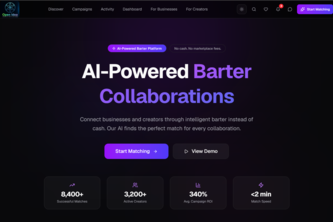
Open Barter is an AI-powered marketplace for creators and businesses to collaborate without cash, using a barter model. The platform matches users based on intelligent recommendations that value products, services, and content.
What changed
The project was submitted to the OpenAI 2026 hackathon, indicating it is in early development or prototype stage. No evidence of product-market fit, revenue, or customer traction exists.
Single most important open question
Is there a viable path from prototype to scalable marketplace with real user adoption and monetization?
What The Product Actually Is
The description states: “An AI-powered Instagram barter marketplace that matches creators and businesses for fair, cash-free collaborations by valuing products, services, and content with intelligent recommendations.”
- Product type: Marketplace platform
- Core function: Matching creators and businesses for barter-based collaborations
- Technology stack: Includes AI/LLM (Gemini), Next.js, React, Supabase, Vercel, Tailwind, TypeScript
- Platform focus: Instagram integration
Not evidenced:
- Specific features or workflows beyond matching
- Whether the platform is web-based, mobile-first, or desktop-focused
- The actual barter valuation mechanism or how it works in practice
Positioning & Claim Evolution
The author states: “An AI-powered Instagram barter marketplace that matches creators and businesses for fair, cash-free collaborations by valuing products, services, and content with intelligent recommendations.”
- Positioning: A platform to facilitate non-monetary collaboration between creators and businesses
- Differentiator: Use of AI/LLM for intelligent matching and valuation
- Value proposition: Fair, cash-free barter model
Not evidenced:
- How this differs from existing platforms like Instagram’s creator tools or influencer marketplaces
- Whether the platform is a new category or a reimagining of an existing one
- Any claims about fairness, scalability, or impact on creator economy
Target Customer & ICP
The description states: “matches creators and businesses for fair, cash-free collaborations”
- Primary customer segments: Creators (Instagram influencers) and businesses
- ICP inferred: Small to mid-sized businesses looking for influencer collaboration without monetary exchange; content creators seeking non-cash value exchanges
Not evidenced:
- Specific buyer personas or segmentation criteria
- Customer acquisition strategy or user onboarding process
- Whether the platform targets specific industries or niches
Business Model & Pricing Evidence
The description states: “matches creators and businesses for fair, cash-free collaborations by valuing products, services, and content with intelligent recommendations.”
Not evidenced:
- Revenue model (e.g., commission, subscription, freemium)
- Pricing structure or monetization strategy
- Any indication of how the platform intends to make money
Technical & Delivery Signals
The author-declared tech stack includes:
- AI/LLM (Gemini)
- Next.js, React, TypeScript
- Supabase, Vercel
- Tailwind CSS, shadcn/ui
Not evidenced:
- Whether this is a working prototype or a proof of concept
- Technical architecture or scalability assumptions
- Any delivery timeline or roadmap
Traction & Maturity Signals
The description states: “This project was submitted to the OpenAI 2026 hackathon on Devpost.”
- Maturity stage: Hackathon submission — early prototype or idea
- Traction: None evidenced
- User base: Not evident
- Customer validation: Not evident
Not evidenced:
- Any user feedback, usage metrics, or adoption data
- Whether the platform has been tested with real users or businesses
- Any product iteration history or versioning
Competitive Context
The description states: “matches creators and businesses for fair, cash-free collaborations”
Not evidenced:
- Direct competitors in the barter or creator collaboration space
- Market size or growth trends in influencer marketplace platforms
- How this platform compares to existing tools like AspireIQ, Influencer.co, or Instagram’s own creator tools
Open Questions & Risks
Inferences based on limited evidence:
- Unproven market need: No evidence of customer demand or validation.
- Technical feasibility: Use of AI/LLM for valuation and matching is speculative without demonstration.
- Business model uncertainty: No indication of how the platform will monetize or sustain itself.
- Prototype stage: Submitted to a hackathon, suggesting early-stage development with no traction.
Questions the description leaves open
- What specific problem are you solving, and how does your solution differ from existing platforms?
- How do you plan to validate the barter model with real users or businesses?
- What is your path to monetization, and what revenue model are you considering?
- Can you demonstrate any early user feedback or prototype testing?
- How do you intend to scale beyond a hackathon project?
Overall Assessment
Not evidenced:
- No financials, traction, or customer data
- No indication of product-market fit or scalability
- No evidence of team execution capability beyond hackathon submission
Assessment This is an early-stage idea submitted to a hackathon. The description does not provide sufficient evidence to assess commercial viability, traction, or investment potential. It is a speculative project with no demonstrated market need or business model. Further due diligence would require access to prototype, user data, and founder execution history.
User Stories BotA demo video on every pull request
Get a demo video on every new feature
GitHub App that watches your pull requests and records a narrated, captioned demo.
Save time on demo prep and make informed decisions faster with a video walkthrough of every new feature.
Source
Submitted to the OpenAI 2026 hackathon on Devpost. Project home on Devpost. Back to the full gallery on Devpost.
This competitive analysis was produced by top-founders.com (opens in a new tab)
Generated by a language model from this project's public Devpost page — its tagline and any built-with tags listed there, since the author published no write-up — as captured in August 2026. Short quotations are the author's words. It is an opinion on the idea as a business, not on the people behind it, and it reflects the description as published then. If the project has moved on, request a correction below. The analysis is not independent research and contains no verified traction, revenue or customer data.
An independent guide by KFG International LLC — not affiliated with, endorsed by, or connected to Devpost or OpenAI.