

Archive position — measured, not model output
0 likes on Devpost
2,263 of the 7,850 archived projects have more likes, and 5,587 share exactly 0 — so this project's #7,386 place in the like-ranked listing is a tie-break inside that group, not a ranking.
Projects (log scale)
Likes on Devpost. ▲ marks this project's group.
Show the figures
| Likes | Projects | Share of archive |
|---|---|---|
| 0 | 5,587 | 71.2% |
| 1 | 1,758 | 22.4% |
| 2 | 284 | 3.6% |
| 3–4 | 132 | 1.7% |
| 5–9 | 75 | 1.0% |
| 10+ | 14 | 0.2% |
 User Stories BotA demo video on every pull request
Get a demo video on every new feature
GitHub App that watches your pull requests and records a narrated, captioned demo.
Save time on demo prep and make informed decisions faster with a video walkthrough of every new feature.
Executive Summary
Company: TRIAGRE
Self-reported purpose: An AI-powered incident response system that mimics a senior SRE’s approach to diagnosing production outages using specialized agents for triage, diagnosis, fix, and postmortem. Built with GPT-5.6 + Codex.
Key change: The project claims to compress the first 20–30 minutes of incident response time by automating log analysis, metric querying, and dependency mapping through a multi-agent AI pipeline.
Single most important open question: Does the system actually execute real tool calls (e.g., log search, metrics queries) or does it simulate them in a demo?
This is an author-reported, unverified description of a hackathon project submitted to the OpenAI 2026 Build Week. No evidence exists for revenue, customers, traction, or actual deployment. The system is described as a multi-agent pipeline built with FastAPI and GPT-5.6, but there is no verification that it functions beyond a demo.
What The Product Actually Is
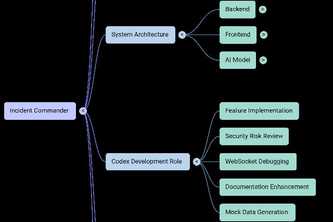
The description states that TRIAGRE is an AI-powered incident response tool designed to mimic how a senior SRE would investigate production outages. It operates through a 4-stage pipeline:
- Triage
- Diagnosis
- Fix
- Postmortem
Each stage is handled by a specialized AI agent that performs actions like searching logs, querying metrics, mapping dependencies, and consulting runbooks.
The system uses GPT-5.6 with OpenAI function-calling, and each agent executes a loop of tool calling, result reading, and reasoning before concluding.
It includes a FastAPI backend with WebSocket streaming for real-time updates to the frontend, and uses structured outputs (JSON schemas) to ensure predictable results across stages.
The system is described as being built with Codex, which assisted in implementing the multi-agent pipeline, fixing vulnerabilities, and improving documentation.
Not evidenced:
- Whether any of the agents actually call real tools or just simulate them.
- Whether the tool integrations (e.g., Datadog, Prometheus) are functional or mock.
- The actual architecture or data flow beyond the high-level description.
Positioning & Claim Evolution
The author states that TRIAGRE aims to compress the first 20–30 minutes of incident response time — a key pain point for on-call engineers. It positions itself as an AI that investigates outages like a senior SRE, not just answering support tickets.
It claims to be evidence-based, with each conclusion tied to a confidence score and visible evidence chain, so engineers can see why the AI reached its diagnosis.
The system is built with GPT-5.6 + Codex, and uses multi-agent systems and function-calling to simulate human investigation behavior.
Inference: The positioning implies that TRIAGRE is a developer tool for SREs or DevOps teams, targeting incident response automation in production environments.
Target Customer & ICP
The description states that the system targets on-call engineers who spend 20–30 minutes just figuring out what’s broken during an outage. It is designed to reduce time spent on triage and diagnosis by automating these steps.
It is built for SREs, DevOps engineers, and teams managing production systems where incident response speed matters.
The system is described as being built with SRE, DevOps, and AI agent technologies, suggesting a technical audience familiar with logs, metrics, and service maps.
Not evidenced:
- Specific customer segments or personas beyond “on-call engineers.”
- Whether the product has been tested in real-world environments.
- Any evidence of market demand or feedback from target users.
Business Model & Pricing Evidence
The description does not mention any pricing model, business model, monetization strategy, or revenue streams.
Not evidenced:
- How the tool would be sold or licensed.
- Whether it is intended for internal use only or as a SaaS offering.
- Any indication of customer acquisition or retention plans.
Technical & Delivery Signals
The system is built with:
- FastAPI
- WebSocket streaming
- GPT-5.6 with OpenAI function-calling
- Structured outputs (JSON schemas)
- Codex for development assistance
- Multi-agent pipeline architecture
It includes a frontend and backend, with the frontend designed to degrade gracefully in offline mode.
The system is described as having:
- A tool-calling loop that allows agents to search logs, query metrics, and map dependencies.
- A live host-metrics tool (via psutil) included in the demo for credibility.
Inference: The architecture suggests a real-time, agent-based AI system, but there is no evidence of actual deployment or integration with real tools beyond the demo.
Traction & Maturity Signals
The project was submitted to the OpenAI 2026 Build Week hackathon, and is described as a demo-level prototype built in a short timeframe.
There is no evidence of:
- Revenue
- Customers
- Product usage or adoption
- Deployment in production environments
- Any traction beyond the author’s own account
Not evidenced:
- Any metrics, user feedback, or real-world testing.
- Whether the system has been used by teams outside of the hackathon.
Competitive Context
The description does not mention any competitors or direct market context.
It is implied that TRIAGRE is in a space related to:
- AI-powered incident response
- SRE automation tools
- DevOps and monitoring platforms
However, no comparison or positioning against existing tools is provided.
Not evidenced:
- Any competitive landscape or market analysis.
- Whether similar tools already exist (e.g., PagerDuty, Datadog, Moogsoft).
Open Questions & Risks
- Demo vs. Real System: The system is described as a demo-level prototype with mock integrations. There is no evidence that it actually calls real tools or integrates with production systems.
- Unverified Tooling Claims: The use of GPT-5.6, Codex, and function-calling is self-reported — there is no verification of these technologies being used in a real system.
- No Evidence of Real Data Sources: While the demo includes live host metrics, it's unclear whether other data sources (logs, dashboards, etc.) are real or simulated.
- Single Founder: The team size is listed as 1, which raises questions about execution capacity and scalability.
Questions the description leaves open
- What tools are actually being called in the system? Are they real integrations or simulations?
- How does the system handle errors or failures in tool calls?
- Has the system been tested with real SREs or DevOps teams?
- What is the plan for scaling beyond a hackathon demo?
- Is there any intention to monetize this product, and how?
Overall Assessment
Not evidenced:
- No revenue, customers, traction, or market validation.
This is a self-reported hackathon prototype, not a product in the market. The system is described as a multi-agent AI pipeline built with GPT-5.6 and FastAPI, but there is no evidence that it functions beyond a demo or integrates with real tools.
Confidence: Low
Assessment: Not ready for investment or partnership at this stage. This is a concept with potential, but lacks any commercial due-diligence signals. The system’s maturity, traction, and actual functionality remain unverified.
User Stories BotA demo video on every pull request
Get a demo video on every new feature
GitHub App that watches your pull requests and records a narrated, captioned demo.
Save time on demo prep and make informed decisions faster with a video walkthrough of every new feature.
Source
Submitted to the OpenAI 2026 hackathon on Devpost. Project home on Devpost. Back to the full gallery on Devpost.
This competitive analysis was produced by top-founders.com (opens in a new tab)
Generated by a language model from this project's public Devpost page — its tagline, the author's own write-up and any built-with tags listed there — as captured in August 2026. Short quotations are the author's words. It is an opinion on the idea as a business, not on the people behind it, and it reflects the description as published then. If the project has moved on, request a correction below. The analysis is not independent research and contains no verified traction, revenue or customer data.
An independent guide by KFG International LLC — not affiliated with, endorsed by, or connected to Devpost or OpenAI.