

Archive position — measured, not model output
0 likes on Devpost
2,263 of the 7,850 archived projects have more likes, and 5,587 share exactly 0 — so this project's #5,682 place in the like-ranked listing is a tie-break inside that group, not a ranking.
Projects (log scale)
Likes on Devpost. ▲ marks this project's group.
Show the figures
| Likes | Projects | Share of archive |
|---|---|---|
| 0 | 5,587 | 71.2% |
| 1 | 1,758 | 22.4% |
| 2 | 284 | 3.6% |
| 3–4 | 132 | 1.7% |
| 5–9 | 75 | 1.0% |
| 10+ | 14 | 0.2% |
 User Stories BotA demo video on every pull request
Get a demo video on every new feature
GitHub App that watches your pull requests and records a narrated, captioned demo.
Save time on demo prep and make informed decisions faster with a video walkthrough of every new feature.
Executive Summary
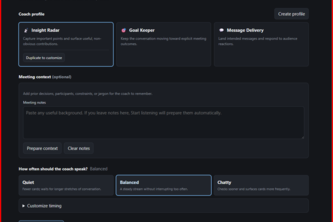
The description states that Online Meeting Advisor (OMA) is a desktop app for Mac/Windows that listens to online meetings in real time, transcribing speech on-device and surfacing AI-generated insight cards during the call. The author describes it as a personal coach that helps users reach meeting goals, with configurable "coach profiles" such as Insight Radar, Goal Keeper, and Message Delivery. OMA uses a two-tier GPT engine (GPT 5.4 Mini and GPT 5.6 Sol) and operates entirely on-device with no data leaving the machine. The project was submitted to the OpenAI 2026 hackathon by a single founder, Paul-Andrei Zehan.
The most important open question is whether OMA can meaningfully improve meeting effectiveness in practice — the author claims this, but there is no evidence of actual user testing or impact data. The product appears to be an early-stage prototype with no commercial traction, revenue, or customer validation.
What The Product Actually Is
The description states that OMA is a desktop application (Mac/Windows) designed for online meetings. It captures audio from both the user’s microphone and the call's system audio, transcribes speech on-device using Whisper, and displays real-time insight cards during the meeting. These cards include a headline, priority level (minor/major/critical), and context. The app is described as operating entirely locally with no data leaving the machine.
The product uses a two-tier AI engine:
- A GPT 5.4 Mini "salience gate" that decides whether to trigger deeper analysis
- A GPT 5.6 Sol model for generating insights when the gate fires
It also includes a browser UI streamed via Server-Sent Events, with features like pin/export functionality and adaptive pacing to avoid noise.
Positioning & Claim Evolution
The description states that OMA positions itself as a real-time coach during meetings, unlike existing tools that only provide post-call summaries. It claims to offer "live insights and coaching" during the conversation, with configurable profiles for different meeting types (Insight Radar, Goal Keeper, Message Delivery). The author emphasizes that it helps users achieve specific goals and tracks progress in real time.
The claim evolution shows a shift from general meeting improvement to specific, actionable coaching. It moves from describing a tool that listens to a tool that guides — but the description does not indicate any prior version or iteration of this positioning.
Target Customer & ICP
The description states that OMA is aimed at individuals who participate in online meetings and want real-time coaching to improve their effectiveness. The app supports different meeting types through customizable profiles, suggesting it targets professionals with varying needs — those seeking insight discovery, goal achievement, or message delivery.
There is no explicit segmentation beyond the general user of online meetings. No specific job function, industry, or company size is mentioned.
Business Model & Pricing Evidence
The description does not state a business model or pricing structure. It describes the technical implementation and features but does not mention monetization, subscription tiers, or any commercial framework.
Technical & Delivery Signals
The description states that OMA is built as a desktop app for Mac/Windows using JavaScript, Python, OpenAI, OpenRouter, and Whisper. It uses dual on-device audio pipelines (microphone + system loopback), local transcription with Whisper, and a two-tier GPT engine. The UI is delivered via Server-Sent Events over a live browser interface.
The technical approach includes:
- Voice activity segmentation
- On-device processing to avoid data leakage
- Prompt caching for cost efficiency
- Structured outputs using tool schemas
Traction & Maturity Signals
The description states that this project was submitted to the OpenAI 2026 hackathon and is described as a prototype. No evidence of revenue, customers, or adoption is provided. The team size is listed as one person (Paul-Andrei Zehan), indicating early-stage development.
Competitive Context
The description does not provide any information about competitors or the competitive landscape. It focuses on what OMA does rather than how it compares to existing tools in the market.
Open Questions & Risks
- The project is a hackathon submission with no commercial traction.
- No evidence of user testing, feedback, or impact data.
- The author claims 10x effectiveness improvement but provides no metrics or validation.
- The app is described as a desktop application, which may limit scalability and adoption.
- The use of specific GPT versions (5.4 Mini, 5.6 Sol) is not verified; these are likely placeholders or self-reported model names.
Questions the description leaves open
- What specific user problems does OMA solve that existing tools don't?
- How do you plan to validate the effectiveness of real-time coaching in meetings?
- What is your path to market and customer acquisition strategy?
- Are there any early users or pilot programs?
- How do you intend to monetize this product, and what pricing model are you considering?
Overall Assessment
The description states that OMA is a hackathon submission by one founder, with no evidence of commercial traction, revenue, or customer validation. It is described as an early-stage prototype focused on real-time coaching during meetings.
Given the lack of any evidence for product-market fit, user adoption, or business model, there is insufficient basis to recommend investment or partnership at this stage. The claims about effectiveness and impact are unverified, and the project appears to be in a very early phase of development.
User Stories BotA demo video on every pull request
Get a demo video on every new feature
GitHub App that watches your pull requests and records a narrated, captioned demo.
Save time on demo prep and make informed decisions faster with a video walkthrough of every new feature.
Source
Submitted to the OpenAI 2026 hackathon on Devpost. Project home on Devpost. Back to the full gallery on Devpost.
This competitive analysis was produced by top-founders.com (opens in a new tab)
Generated by a language model from this project's public Devpost page — its tagline, the author's own write-up and any built-with tags listed there — as captured in August 2026. Short quotations are the author's words. It is an opinion on the idea as a business, not on the people behind it, and it reflects the description as published then. If the project has moved on, request a correction below. The analysis is not independent research and contains no verified traction, revenue or customer data.
An independent guide by KFG International LLC — not affiliated with, endorsed by, or connected to Devpost or OpenAI.