

Archive position — measured, not model output
0 likes on Devpost
2,263 of the 7,850 archived projects have more likes, and 5,587 share exactly 0 — so this project's #7,645 place in the like-ranked listing is a tie-break inside that group, not a ranking.
Projects (log scale)
Likes on Devpost. ▲ marks this project's group.
Show the figures
| Likes | Projects | Share of archive |
|---|---|---|
| 0 | 5,587 | 71.2% |
| 1 | 1,758 | 22.4% |
| 2 | 284 | 3.6% |
| 3–4 | 132 | 1.7% |
| 5–9 | 75 | 1.0% |
| 10+ | 14 | 0.2% |
 User Stories BotA demo video on every pull request
Get a demo video on every new feature
GitHub App that watches your pull requests and records a narrated, captioned demo.
Save time on demo prep and make informed decisions faster with a video walkthrough of every new feature.
Executive Summary
What the company appears to be
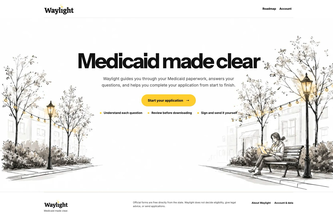
Waylight is a self-reported AI-powered tool designed to guide individuals through the Medicaid application process in the U.S., with an initial focus on Indiana. It uses AI to explain terms, extract information from documents, and fill out applications based on state-specific official sources.
What changed
The project was built as part of a hackathon submission (OpenAI 2026) and is described as a prototype or MVP. It includes functionality for an interview-style application process, document extraction, and PDF generation — all powered by AI and open-source tools like GPT-5.6, Codex, React, and Firebase.
Single most important open question
Is there any evidence of real-world usage, user feedback, or traction beyond the hackathon submission? The description does not indicate whether Waylight has been used by individuals, tested with real Medicaid applicants, or validated in a production environment.
What The Product Actually Is
The description states that Waylight is an AI-guided tool for applying for Medicaid. It allows users to answer questions one at a time and receive help from an AI assistant during the process. The system:
- Uses state-specific official Medicaid materials as its source of truth.
- Extracts information from documents provided by users.
- Fills out applications automatically.
- Generates full application packets for review and submission.
It is built with React, TypeScript, Firebase, Vercel, and uses AI models like GPT-5.6 and Codex for research, validation, and conversation logic.
Inference The product appears to be a web-based digital assistant that combines AI with structured form-filling logic to simplify Medicaid applications.
Positioning & Claim Evolution
The author states that Waylight was inspired by personal experience helping a home care agency. It positions itself as a tool to make the Medicaid process easier for individuals, families, and caregivers who struggle with understanding or navigating the system.
It claims to be:
- AI-powered.
- Based on official state Medicaid materials.
- Capable of generating complete application packets.
- Designed to reduce confusion and errors in the process.
Inference The positioning is that Waylight is a consumer-facing digital assistant for a complex public benefit process, aiming to democratize access to Medicaid by reducing friction and increasing clarity.
Target Customer & ICP
The description states that Waylight helps individuals apply for Medicaid, understand the process, and stay covered. It also mentions that it targets families, caregivers, and home-care organizations.
It was initially built with Indiana’s Medicaid application in mind, but the authors claim to have researched all 50 states and Washington, D.C., suggesting a potential nationwide scope.
Inference The primary customer is likely an individual applying for Medicaid — particularly those who are unfamiliar with the process or lack support. Secondary users may include caregivers and home-care agencies that assist applicants.
Business Model & Pricing Evidence
The description does not provide any information about pricing, monetization, or business model. It only describes the tool’s functionality and how it was built.
Not evidenced.
Technical & Delivery Signals
Waylight is described as a React/TypeScript web app deployed on Vercel. It uses:
- AI models (GPT-5.6, Codex)
- Firebase for authentication and data storage
- PDF.js and Tesseract.js for document handling
- Zod for validation
- JSON definitions to control application logic
It supports browser-based PDF generation and extraction, passwordless sign-in via Firebase, and uses Vercel AI SDK for AI interactions.
Inference The technical stack suggests a modern, web-first approach with strong integration of AI, document processing, and cloud infrastructure. It is designed to be self-contained in the browser for performance and privacy.
Traction & Maturity Signals
The description states that Waylight currently supports Indiana’s Medicaid application fully, including all 35 sections and 635 fields. It also mentions research into all 50 states and Washington, D.C., as a foundation for expansion.
It was built as part of a hackathon submission and is described as a prototype or MVP. There is no mention of real users, usage metrics, or feedback from actual applicants.
Not evidenced.
Competitive Context
The description does not provide any information about competitors or the broader marketplace for Medicaid assistance tools. It does not reference existing platforms or services that might offer similar functionality.
Not evidenced.
Open Questions & Risks
- No real-world usage: The tool is described as a hackathon project with no evidence of actual users or adoption.
- AI grounding concerns: While the system claims to be grounded in official sources, there’s no indication that this grounding has been validated or audited for accuracy.
- Scalability assumptions: The authors claim they can add new states by mapping fields — but there is no evidence of how this would scale or whether such mapping has been tested.
- No revenue or monetization model: There is no indication of how Waylight will generate value or sustain itself beyond the initial prototype.
Questions the description leaves open
- Has Waylight been tested with real Medicaid applicants? What feedback have you received?
- How do you ensure that AI responses are accurate and aligned with current state regulations?
- What is your plan for expanding to additional states beyond Indiana?
- Do you have any partnerships or relationships with Medicaid offices, home-care agencies, or advocacy groups?
- Are there any legal or compliance risks associated with providing automated Medicaid guidance?
Overall Assessment
Not evidenced.
The description is entirely self-reported and unverified. There is no evidence of revenue, customers, traction, or a clear path to monetization. The project appears to be an early-stage prototype built for a hackathon. Without further data on usage, validation, or business model, it is not possible to assess its viability for investment or partnership.
The author states that Waylight supports Indiana’s Medicaid application and has researched all 50 states — but this does not constitute traction or commercial readiness. The tool remains in the concept/prototype phase, with no indication of real-world deployment or user engagement.
User Stories BotA demo video on every pull request
Get a demo video on every new feature
GitHub App that watches your pull requests and records a narrated, captioned demo.
Save time on demo prep and make informed decisions faster with a video walkthrough of every new feature.
Source
Submitted to the OpenAI 2026 hackathon on Devpost. Project home on Devpost. Back to the full gallery on Devpost.
This competitive analysis was produced by top-founders.com (opens in a new tab)
Generated by a language model from this project's public Devpost page — its tagline, the author's own write-up and any built-with tags listed there — as captured in August 2026. Short quotations are the author's words. It is an opinion on the idea as a business, not on the people behind it, and it reflects the description as published then. If the project has moved on, request a correction below. The analysis is not independent research and contains no verified traction, revenue or customer data.
An independent guide by KFG International LLC — not affiliated with, endorsed by, or connected to Devpost or OpenAI.