

Archive position — measured, not model output
0 likes on Devpost
2,263 of the 7,850 archived projects have more likes, and 5,587 share exactly 0 — so this project's #3,721 place in the like-ranked listing is a tie-break inside that group, not a ranking.
Projects (log scale)
Likes on Devpost. ▲ marks this project's group.
Show the figures
| Likes | Projects | Share of archive |
|---|---|---|
| 0 | 5,587 | 71.2% |
| 1 | 1,758 | 22.4% |
| 2 | 284 | 3.6% |
| 3–4 | 132 | 1.7% |
| 5–9 | 75 | 1.0% |
| 10+ | 14 | 0.2% |
 User Stories BotA demo video on every pull request
Get a demo video on every new feature
GitHub App that watches your pull requests and records a narrated, captioned demo.
Save time on demo prep and make informed decisions faster with a video walkthrough of every new feature.
Executive Summary
What the company appears to be
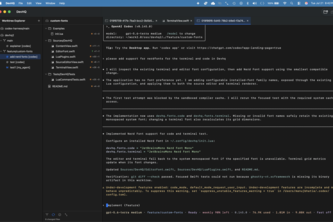
DevHQ is a self-reported developer tool that aims to be a "single-pane-of-glass" for managing parallel development tasks. It is described as an IDE-like interface that visualizes Git worktrees, active agent sessions, and generated code, allowing developers to switch contexts seamlessly.
What changed
The author states this is the second implementation of DevHQ, with the first prototyped on a minimalist IDE called Lite-XL. The current version was rebuilt from scratch using codex-cli, leveraging subagents and terminal-based tools like libghostty and Swift for UI.
The single most important open question — the commercial due-diligence read
Is there evidence of any traction, revenue, or customer adoption beyond the author’s own development work? The description does not indicate any users, customers, or monetization efforts. The project is self-reported as a personal hackathon effort with no external validation.
What The Product Actually Is
The description states that DevHQ is:
- A developer tool designed to manage parallel tasks.
- A "single-pane-of-glass" for visualizing in-flight work streams.
- Built using Git worktrees, terminal-based agents, and local or remote work environments.
- Not dictating a specific agent harness; it supports any terminal-based CLI agent.
- Intended to allow developers to organize work with worktrees, start sticky agents, and eventually provide feedback on code reviews.
Inferred from the description:
- The tool is built for developers working in parallel, especially with AI agents.
- It integrates with Git workflows and aims to reduce context switching.
Not evidenced:
- Whether DevHQ functions as a full IDE or a lightweight overlay.
- Specific UI/UX details beyond terminal support.
- Any existing codebase or binary release.
Positioning & Claim Evolution
The author states that DevHQ is intended to address the growing complexity of parallel development work, especially with AI agents. The positioning is:
- A tool for developers managing multiple tasks simultaneously.
- A solution to context switching issues caused by fast-moving workflows and AI-assisted coding.
- Not a replacement for IDEs but an overlay or companion tool.
The claim evolution appears to be:
- From a personal prototype (Lite-XL-based) to a new, more polished version built with codex-cli.
- The author emphasizes customization and extensibility via a Lua plugin framework in future versions.
Inferred from the description:
- The product is positioned as a developer productivity tool for parallel workflows.
- It is not yet a commercial product but a personal project with potential for growth.
Not evidenced:
- Any prior positioning or market messaging.
- Competitor differentiation or pricing strategy.
- Market demand or user feedback.
Target Customer & ICP
The description states that DevHQ is intended for:
- Developers managing multiple tasks in parallel.
- Users who work with Git worktrees and AI agents.
- Developers who want to reduce context switching.
Inferred from the description:
- The primary user is likely a developer or engineer working in fast-paced, AI-assisted environments.
- It targets users who already use terminal-based tools and Git workflows.
Not evidenced:
- Specific customer segments or personas.
- Any existing customer base or usage data.
- Demographics or job roles beyond "developer."
Business Model & Pricing Evidence
The description does not state:
- Any pricing model.
- Monetization strategy.
- Revenue streams.
- Subscription plans or licensing.
Inferred from the description:
- The tool is self-reported as a personal project, not yet commercialized.
- It may be open-source or freemium in nature, but no evidence supports this.
Not evidenced:
- Any business model or pricing structure.
- Customer acquisition or retention metrics.
- Revenue or funding data.
Technical & Delivery Signals
The description states that DevHQ was built using:
- Codex-cli with subagents and gpt-5.6-sol-high.
- libghostty for terminal support.
- Swift for UI (MacOS-only initially).
- Git worktrees to manage open streams of work.
- Terminal-based agents as a requirement.
Inferred from the description:
- The tool is built using AI-assisted development tools.
- It supports local and remote workflows.
- It uses Git as a core component for managing parallel tasks.
Not evidenced:
- Any delivery timeline or roadmap.
- Technical architecture beyond initial build.
- Scalability or performance metrics.
Traction & Maturity Signals
The description states:
- This is the second implementation of DevHQ.
- The author started working on it during a hackathon weekend.
- It was built in part-time effort over a few days.
- No external users, customers, or adoption data are mentioned.
Inferred from the description:
- The project is early-stage and experimental.
- It has not yet reached a product-market fit or user base.
Not evidenced:
- Any usage statistics, customer feedback, or retention metrics.
- Product maturity or feature completeness.
- Revenue or funding.
Competitive Context
The description does not state:
- Any competitors.
- Market positioning relative to existing tools.
- Comparison with similar developer productivity tools.
Inferred from the description:
- It competes with tools that manage Git workflows and context switching.
- It may overlap with AI agent management platforms or IDEs, but no direct comparison is made.
Not evidenced:
- Competitor analysis or market share data.
- Product differentiation or unique value proposition.
- Market size or growth trends.
Open Questions & Risks
Key risks and open questions based on the description:
- The project is self-reported as a personal hackathon effort with no external validation.
- No evidence of traction, revenue, or customer adoption.
- It is built for MacOS only initially, limiting platform reach.
- Reliance on AI agents for development raises concerns about reproducibility and scalability.
- No clear monetization strategy or business model.
Inferred from the description:
- The tool may not be ready for commercial use or widespread adoption.
- Lack of a team or external support suggests limited long-term viability.
Not evidenced:
- Any risk mitigation strategies.
- Product roadmap or milestone tracking.
- Team experience or prior product history.
Questions the description leaves open
- What is the current state of DevHQ’s development? Is it in alpha, beta, or a prototype?
- Have you tested DevHQ with other developers or teams? What feedback have you received?
- How do you plan to monetize DevHQ? Is there a pricing model or business strategy in place?
- Are you planning to support platforms beyond macOS (e.g., Linux, Windows)?
- What are the key features you plan to implement next, and how will they be prioritized?
- Do you have any plans for integrating with existing IDEs or development platforms?
- How do you envision DevHQ’s role in a team environment or enterprise setting?
Overall Assessment
The description states that DevHQ is a personal project built during a hackathon, with no evidence of traction, revenue, or customer adoption.
Inferred from the description:
- The project is early-stage and experimental.
- It has not yet demonstrated commercial viability or scalability.
- There is no clear path to monetization or market fit.
Not evidenced:
- Any investment potential or partnership opportunities.
- Product-market fit or competitive advantage.
- Team experience or track record in product development or SaaS.
Assessment This is a self-reported, early-stage developer tool with no evidence of commercial traction. It is not ready for investment or partnership consideration at this time.
User Stories BotA demo video on every pull request
Get a demo video on every new feature
GitHub App that watches your pull requests and records a narrated, captioned demo.
Save time on demo prep and make informed decisions faster with a video walkthrough of every new feature.
Source
Submitted to the OpenAI 2026 hackathon on Devpost. Project home on Devpost. Back to the full gallery on Devpost.
This competitive analysis was produced by top-founders.com (opens in a new tab)
Generated by a language model from this project's public Devpost page — its tagline, the author's own write-up and any built-with tags listed there — as captured in August 2026. Short quotations are the author's words. It is an opinion on the idea as a business, not on the people behind it, and it reflects the description as published then. If the project has moved on, request a correction below. The analysis is not independent research and contains no verified traction, revenue or customer data.
An independent guide by KFG International LLC — not affiliated with, endorsed by, or connected to Devpost or OpenAI.