

Archive position — measured, not model output
0 likes on Devpost
2,263 of the 7,850 archived projects have more likes, and 5,587 share exactly 0 — so this project's #5,684 place in the like-ranked listing is a tie-break inside that group, not a ranking.
Projects (log scale)
Likes on Devpost. ▲ marks this project's group.
Show the figures
| Likes | Projects | Share of archive |
|---|---|---|
| 0 | 5,587 | 71.2% |
| 1 | 1,758 | 22.4% |
| 2 | 284 | 3.6% |
| 3–4 | 132 | 1.7% |
| 5–9 | 75 | 1.0% |
| 10+ | 14 | 0.2% |
 User Stories BotA demo video on every pull request
Get a demo video on every new feature
GitHub App that watches your pull requests and records a narrated, captioned demo.
Save time on demo prep and make informed decisions faster with a video walkthrough of every new feature.
Executive Summary
What the company appears to be
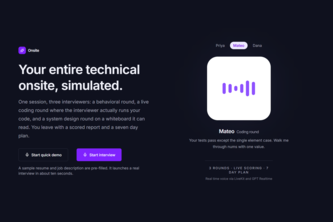
Onsite is a self-reported AI-powered mock interview platform that simulates a full technical interview process (behavioral, coding, system design) using a candidate’s resume and job description. It claims to use GPT-5.6 agents for each round, with voice interaction via LiveKit, and integrates live code execution and canvas-based design tools.
What changed
The project was built as part of the OpenAI 2026 hackathon. The author states it was developed in a week, using Bun, Next.js, Express, PostgreSQL, and various AI tools including OpenAI Realtime and Codex for implementation support.
Single most important open question
Is there any evidence that Onsite has been used by candidates or companies beyond the author’s own development? The description contains no data on usage, adoption, revenue, or customer feedback — only a self-reported narrative of what was built.
What The Product Actually Is
The description states that Onsite is an AI-powered mock interview platform designed to simulate a full technical interview process. It includes three distinct rounds:
- Behavioral (HR): Conducted by Priya, who probes real projects and role fit.
- Coding: Conducted by Mateo, who presents problems in a live editor, reads current code and canvas, runs tests, and evaluates solutions.
- System Design: Conducted by Dana, who reviews architecture drawn on a shared canvas and asks about components, tradeoffs, scaling, and failure modes.
The experience is described as one continuous session with server-owned timing and handoffs between rounds. At the end, it generates an evidence-based readiness report and a personalized 7-day practice plan.
Evidence
- The author describes three distinct AI agents (Priya, Mateo, Dana) for each round.
- The system uses voice interaction via LiveKit and real-time code execution.
- It integrates tools like Monaco Editor, Excalidraw, and PostgreSQL for state management.
- Backend orchestration is handled by Express, Prisma, and PostgreSQL.
Inference The product appears to be a prototype or proof-of-concept built in a short timeframe (a week), likely for demonstration purposes rather than production use.
Positioning & Claim Evolution
The author positions Onsite as a tool that turns a candidate’s resume and job description into a realistic practice environment, aiming to simulate the full onsite interview experience. It is described as an alternative to fragmented practice methods — such as rehearsing behavioral answers separately from coding or system design.
Claims made
- Onsite simulates a complete, continuous interview process.
- It uses AI agents trained for specific roles (HR, Coding, System Design).
- Feedback is evidence-based and tied to actual performance in each round.
- The platform generates personalized 7-day practice plans based on the mock interview.
Inference The positioning suggests a focus on improving technical interview preparation, particularly for job seekers. However, there is no indication of market traction or user feedback that would validate this positioning beyond the author’s own claims.
Target Customer & ICP
The description states that Onsite targets candidates preparing for technical interviews, especially those seeking roles where behavioral, coding, and system design rounds are part of the process.
Evidence
- The platform is built to simulate a full technical interview experience.
- It uses a candidate’s resume and job description as input.
- It includes rounds relevant to common technical interview stages (behavioral, coding, system design).
Inference The ICP likely centers around job seekers preparing for software engineering roles. However, the lack of any mention of specific industries, companies, or user segments means this is speculative.
Business Model & Pricing Evidence
There is no evidence in the description of a business model or pricing structure.
Evidence
- No mention of monetization.
- No indication of whether Onsite is free, paid, or offered as a SaaS product.
- No details on how users would access or pay for the service.
Inference The project appears to be a prototype or hackathon submission with no commercial model described. It may evolve into a product later, but that is not evidenced here.
Technical & Delivery Signals
The author reports building Onsite using:
- Frontend: Next.js, TypeScript, Tailwind, shadcn/ui, Monaco Editor, Excalidraw
- Backend: Express, Prisma, PostgreSQL, Bun, Turborepo
- AI Tools: GPT-5.6, OpenAI Realtime, LiveKit, Codex
- Features: Voice interaction, live code execution, canvas-based design, round orchestration
Evidence
- The system uses multiple technologies to support voice, code, and design interactions.
- It includes server-side control of timing, transitions, and state management.
- Native tool calling is used for loading problems, running tests, and generating reports.
Inference The technical stack suggests a modern, full-stack application with AI integration. However, no evidence of production deployment or scalability is provided.
Traction & Maturity Signals
There is no evidence of traction, adoption, or user feedback.
Evidence
- The project was built for a hackathon.
- No mention of users, customers, or usage metrics.
- No revenue data, customer acquisition, or retention information.
Inference This is a self-reported prototype with no demonstrated market traction. It may be in early development or testing phases.
Competitive Context
The description does not provide any information about competitors or the competitive landscape.
Evidence
- No mention of existing platforms for technical interview practice.
- No comparison to other tools or services in this space.
Inference Without context, it is unclear whether Onsite addresses a gap in the market or competes with existing solutions. The author does not reference any prior art.
Open Questions & Risks
Several risks and open questions are present due to the lack of evidence:
- No commercial traction: No users, customers, or revenue data.
- Unverified claims: All features and functionality are self-reported without validation.
- Prototype nature: Built in a week for a hackathon — no indication of production readiness.
- No pricing or monetization model: Unclear how the product would be monetized.
- AI agent reliability: No evidence that the GPT-5.6 agents perform reliably across rounds or handle edge cases.
Inference The project is likely in a very early stage and lacks commercial viability or market validation.
Questions the description leaves open
- What is the current status of Onsite? Is it being used by candidates or companies?
- How does Onsite differentiate from existing tools for technical interview prep?
- Are there any plans to monetize the platform, and if so, how?
- What are the key challenges in scaling this product beyond a prototype?
- Have you conducted any user testing or feedback collection with real candidates?
- What is the expected timeline for moving from prototype to production?
Overall Assessment
Not evidenced.
The description provides no data on revenue, customers, traction, or commercial viability. It describes a self-reported prototype built in a week for a hackathon. There is no indication that Onsite has moved beyond the idea stage or has any demonstrated market demand.
Confidence Very low — based entirely on self-reporting with no external validation or evidence of adoption, usage, or performance.
User Stories BotA demo video on every pull request
Get a demo video on every new feature
GitHub App that watches your pull requests and records a narrated, captioned demo.
Save time on demo prep and make informed decisions faster with a video walkthrough of every new feature.
Source
Submitted to the OpenAI 2026 hackathon on Devpost. Project home on Devpost. Back to the full gallery on Devpost.
This competitive analysis was produced by top-founders.com (opens in a new tab)
Generated by a language model from this project's public Devpost page — its tagline, the author's own write-up and any built-with tags listed there — as captured in August 2026. Short quotations are the author's words. It is an opinion on the idea as a business, not on the people behind it, and it reflects the description as published then. If the project has moved on, request a correction below. The analysis is not independent research and contains no verified traction, revenue or customer data.
An independent guide by KFG International LLC — not affiliated with, endorsed by, or connected to Devpost or OpenAI.