

Archive position — measured, not model output
1 like on Devpost
505 of the 7,850 archived projects have more likes, and 1,758 share exactly 1 — so this project's #1,760 place in the like-ranked listing is a tie-break inside that group, not a ranking.
Projects (log scale)
Likes on Devpost. ▲ marks this project's group.
Show the figures
| Likes | Projects | Share of archive |
|---|---|---|
| 0 | 5,587 | 71.2% |
| 1 | 1,758 | 22.4% |
| 2 | 284 | 3.6% |
| 3–4 | 132 | 1.7% |
| 5–9 | 75 | 1.0% |
| 10+ | 14 | 0.2% |
 User Stories BotA demo video on every pull request
Get a demo video on every new feature
GitHub App that watches your pull requests and records a narrated, captioned demo.
Save time on demo prep and make informed decisions faster with a video walkthrough of every new feature.
Executive Summary
Company: Quarrylings
Self-reported basis: The description is entirely self-reported and unverified, based on an author's own submission to the OpenAI 2026 hackathon on Devpost. No external corroboration or historical data available.
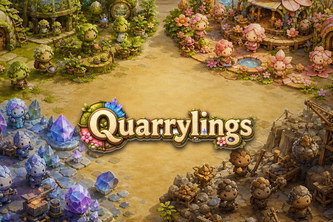
What the company appears to be: Quarrylings is a mixed-reality AR game for Meta Quest headsets that allows players to cultivate and manage a colony of tiny creatures (Quarrylings) in a persistent, simulated world within their real physical space. The game uses AI to generate group goals for colonies, but maintains deterministic control over simulation state.
What changed: The project was extended using Codex and GPT-5.6 Sol during the OpenAI Build Week, adding refinements to gameplay loops, expanding colony housing, improving 3D assets, and investigating a mobile AR path.
Single most important open question: Is there evidence of any commercial traction, revenue, or customer adoption beyond the author's own development work?
What The Product Actually Is
The description states that Quarrylings is a Quest-first passthrough AR creature-colony game. It allows players to plant a world seed and raise families of creatures in a persistent settlement. The player shrinks down to experience the settlement at creature scale.
It uses Unreal Engine 5.8, C++, Meta XR, OpenXR, and hand-first interaction. The game communicates with an Azure Functions broker that uses Azure-hosted OpenAI models for structured group-brain decisions and Azure AI Content Safety for safety checks.
The author notes that the current single-player route uses GPT-4.1 mini by default, with GPT-5.4 mini for escalation, GPT-4.1 for vision-capable work, o4-mini for bounded reasoning, and text-embedding-3-large where embeddings are needed.
The game is built to support deterministic fallback behavior when cloud access is unavailable, and the Unreal engine remains authoritative in validating responses, presenting goals for player approval or retry, and saving results locally.
Inference: The product appears to be a mixed-reality simulation game with AI-assisted group decision-making, but not an AI-driven world generation system. It is built for single-player experience, with persistent colony simulation and AI-generated goals that are validated by the player or Unreal engine.
Positioning & Claim Evolution
The author states that Quarrylings turns a real space into the home of a tiny society that grows, works, builds, and remembers. It is positioned as a mixed-reality game that goes beyond placing objects in a room — it creates an alive settlement.
The project was submitted to the OpenAI 2026 hackathon, and the author notes that it existed before the submission period but was extended using Codex and GPT-5.6 Sol during Build Week.
Claim: The game is a passthrough AR creature-colony simulation where AI helps generate group goals, but the player or Unreal engine controls outcomes.
Inference: The positioning has evolved from an initial prototype to a more polished version with expanded features, including mobile AR exploration and higher-fidelity art assets. However, no evidence of market positioning or commercial intent beyond the hackathon submission is provided.
Target Customer & ICP
The description does not state any specific customer segments or target personas. It only describes the gameplay experience: players plant a world seed, raise families, manage resources, and shrinks down to experience the settlement at creature scale.
Inference: The likely target is mixed-reality enthusiasts, AR game developers, or simulator hobbyists who are interested in persistent, AI-assisted simulations within physical spaces. However, no evidence of actual user personas or market segmentation exists.
Business Model & Pricing Evidence
There is no evidence of a business model or pricing structure in the description. The project is described as a single-player AR game, and there is no mention of monetization, subscriptions, in-app purchases, or any commercial revenue streams.
Inference: If the product were to be commercialized, it would likely follow a one-time purchase or freemium model, but this is not stated. No pricing data, user acquisition costs, or monetization strategy are provided.
Technical & Delivery Signals
The project is built using:
- Unreal Engine 5.8
- C++
- Meta XR
- OpenXR
- Azure Functions
- Azure-hosted OpenAI models (GPT-4.1 mini, GPT-5.4 mini, GPT-4.1 for vision, o4-mini, text-embedding-3-large)
- Codex with GPT-5.6 Sol for development during Build Week
The system includes:
- Unreal client that communicates with an Azure Functions broker
- AI models used for structured group-brain decisions
- Azure AI Content Safety for safety checks
- Deterministic fallback behavior when cloud access is unavailable
- Player approval/retry UX
Inference: The technical stack suggests a hybrid cloud-local architecture, with AI models used for bounded, goal-generating tasks. The system is built to be resilient and safe, with clear separation between AI-generated content and authoritative simulation control.
Traction & Maturity Signals
The description states:
- A signed Quest Alpha build
- An Unreal-to-Azure group-brain client
- A deployed and smoke-tested broker
- Persistent colony-brain records
- Player approval/retry UX
- Deterministic offline fallback
- A code-first public repository with a durable validation workflow
The project was submitted to the OpenAI 2026 hackathon, and the author notes that it existed before the submission period but was extended during Build Week.
Inference: The product is at an early development stage, likely in Alpha testing. There is no evidence of user adoption, revenue, or market traction beyond the internal development work.
Competitive Context
The description does not mention any competitors. It is a self-contained AR simulation game, and there is no indication of existing products in the same space.
Inference: The competitive landscape is unclear. It may be competing with other mixed-reality simulation games or AR creature-colony games, but no evidence of such competition is provided.
Open Questions & Risks
- No commercial traction or revenue data: The project appears to be in early development, with no evidence of monetization or user adoption.
- Single-person team: The project is built by one person (Chris Zavadil), which may limit scalability and long-term development capacity.
- Unverified claims: All information is self-reported and unverified. No third-party validation or external data exists.
- AI dependency without clear control: While the system uses AI for bounded group goals, it is unclear how this balances with player agency or long-term simulation integrity.
Questions the description leaves open
- What is the current stage of development beyond the Alpha build?
- Are there any plans to monetize the product, and if so, what model are you considering?
- How do you plan to scale beyond a single developer?
- Have you tested the game with real users or focus groups?
- What are your long-term goals for the AI integration in the simulation?
- Is there any intention to expand beyond Quest headsets or into mobile AR?
Overall Assessment
Not evidenced: There is no evidence of revenue, customers, or commercial traction. The project is described as a single-developer hackathon submission, with an Alpha build and development work completed during Build Week.
Confidence level: Low — the description is self-reported, unverified, and lacks any data on user adoption, monetization, or market validation.
Assessment: This is an early-stage prototype with no demonstrated commercial viability. It may be of interest for strategic partnerships or early-stage investment, but only if further development and traction are demonstrated. The lack of evidence for any business model or customer base makes it a high-risk, speculative opportunity.
User Stories BotA demo video on every pull request
Get a demo video on every new feature
GitHub App that watches your pull requests and records a narrated, captioned demo.
Save time on demo prep and make informed decisions faster with a video walkthrough of every new feature.
Source
Submitted to the OpenAI 2026 hackathon on Devpost. Project home on Devpost. Back to the full gallery on Devpost.
This competitive analysis was produced by top-founders.com (opens in a new tab)
Generated by a language model from this project's public Devpost page — its tagline, the author's own write-up and any built-with tags listed there — as captured in August 2026. Short quotations are the author's words. It is an opinion on the idea as a business, not on the people behind it, and it reflects the description as published then. If the project has moved on, request a correction below. The analysis is not independent research and contains no verified traction, revenue or customer data.
An independent guide by KFG International LLC — not affiliated with, endorsed by, or connected to Devpost or OpenAI.