

Archive position — measured, not model output
1 like on Devpost
505 of the 7,850 archived projects have more likes, and 1,758 share exactly 1 — so this project's #1,567 place in the like-ranked listing is a tie-break inside that group, not a ranking.
Projects (log scale)
Likes on Devpost. ▲ marks this project's group.
Show the figures
| Likes | Projects | Share of archive |
|---|---|---|
| 0 | 5,587 | 71.2% |
| 1 | 1,758 | 22.4% |
| 2 | 284 | 3.6% |
| 3–4 | 132 | 1.7% |
| 5–9 | 75 | 1.0% |
| 10+ | 14 | 0.2% |
 User Stories BotA demo video on every pull request
Get a demo video on every new feature
GitHub App that watches your pull requests and records a narrated, captioned demo.
Save time on demo prep and make informed decisions faster with a video walkthrough of every new feature.
Executive Summary
OfferDecoder is a self-reported AI-powered tool that uses GPT-5.6 to analyze employment offer letters and convert them into clear, structured insights and negotiation-ready emails. The description states it was built during the OpenAI 2026 hackathon and is currently functional as a web application with a React interface, server-side API integration via Vercel Functions, and use of structured outputs from GPT-5.6.
The author claims OfferDecoder helps job seekers understand what they are agreeing to before signing by extracting key information, separating guaranteed from conditional compensation, grounding findings in direct quotes, and suggesting questions or negotiation emails. It does not make legal determinations or replace professional advice.
Key commercial due-diligence open question: Is there any evidence of user adoption, revenue, or customer traction beyond the author's own demonstration?
The project description is entirely self-reported and unverified; no third-party corroboration exists for its claims, functionality, or usage. The tool appears to be a prototype with limited real-world testing and deployment.
What The Product Actually Is
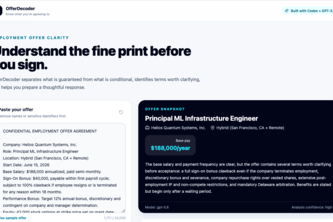
The description states that OfferDecoder is an application where users can paste the text of an employment offer and receive a plain-English analysis powered by GPT-5.6. It extracts company, position, location, and base pay details while preserving whether pay is hourly, weekly, monthly, or annual.
It separates guaranteed compensation from discretionary bonuses, conditional payments, equity, and benefits. The tool reviews areas such as compensation clarity, workload, termination, severance, intellectual property, post-employment restrictions, and dispute resolution.
Every finding is grounded in a direct quotation from the submitted offer. It identifies missing information instead of assuming standard terms. Users can select specific findings and generate an editable negotiation email in one of three tones: collaborative, confident, or concise.
The application was originally a static React interface demonstration but was transformed into a functioning GPT-5.6-powered tool during OpenAI Build Week.
Positioning & Claim Evolution
The author positions OfferDecoder as an educational clarity tool for job seekers who want to understand what they are agreeing to before signing an employment offer. It is described as helping candidates recognize which parts of an offer are guaranteed versus discretionary and identifying important information that may be missing.
The product claims to not determine whether clauses are legal or enforceable, nor does it replace advice from qualified professionals. The tool emphasizes transparency by grounding findings in direct quotes and labeling missing information rather than making assumptions.
There is no evidence of prior positioning or evolution beyond this single self-reported description. The author states that OfferDecoder existed before the hackathon as a static prototype but was transformed into a live AI-powered version during the event.
Target Customer & ICP
The description states that OfferDecoder targets job seekers who need to understand employment offers before signing them. It is positioned for individuals who want clarity on complex offer language, particularly around compensation structures and other contractual details.
The target customer appears to be someone in the job market who receives employment offers and wants to better understand what they are agreeing to. The tool is described as helping ordinary people understand complex information, suggesting a focus on non-expert users rather than legal professionals or HR departments.
There is no evidence of segmentation beyond this general user group or any indication of whether the tool targets specific industries, experience levels, or geographic regions.
Business Model & Pricing Evidence
The description does not provide any information about pricing, monetization, or business model. It states that OfferDecoder is an educational clarity tool and does not replace professional advice, but there is no mention of fees, subscriptions, or revenue streams.
There is no evidence of paid features, tiered access, or commercial partnerships in the self-reported description.
Technical & Delivery Signals
OfferDecoder was built using:
- React and Vite for the interface
- Tailwind CSS for responsive design
- Vercel Functions for secure server-side endpoints
- OpenAI Responses API with GPT-5.6
- Structured Outputs with strict JSON Schema
- Vercel for deployment
- GitHub for version control and documentation
The OpenAI API key remains on the server and is never exposed in the browser. API requests use store: false because employment offers may contain sensitive information. The prompt treats submitted documents as untrusted content and instructs GPT-5.6 not to follow instructions that may appear inside the offer.
The tool was originally a static React prototype but was transformed into a live application during OpenAI Build Week using Codex for development support.
Traction & Maturity Signals
There is no evidence of user adoption, customer base, or traction beyond the author's own demonstration. The description states that OfferDecoder is now a working application that analyzes actual text supplied by users, but there are no metrics, usage statistics, or customer testimonials provided.
The tool was built as part of a hackathon and has not been described as having launched publicly or gained significant user engagement. It appears to be at an early prototype stage with limited real-world deployment.
Competitive Context
The description does not provide any information about competitors or the competitive landscape. There is no evidence of existing tools in this space, nor any indication of how OfferDecoder compares to other offer analysis or negotiation tools.
No mention of similar products, market positioning, or differentiation strategies is included in the self-reported description.
Open Questions & Risks
- Lack of traction: No evidence of users, customers, or revenue beyond the author's own use.
- Unverified claims: All functionality and impact are self-reported without independent verification.
- Limited scope: The tool appears to be a prototype with no indication of scalability or commercial viability.
- AI dependency risk: Heavy reliance on GPT-5.6 for core functionality raises concerns about consistency, cost, and availability if the model changes or becomes unavailable.
- Privacy concerns: While API keys are kept server-side, handling sensitive employment documents requires robust privacy protections that aren't detailed in the description.
- Legal boundary issues: The tool explicitly avoids legal conclusions but must navigate complex legal terrain without clear safeguards against misinterpretation.
Questions the description leaves open
- What is the actual user base or adoption rate beyond the author's own use?
- How does OfferDecoder handle edge cases or unusual offer formats that weren't tested during development?
- Has the tool undergone any formal privacy or security audits, especially given its handling of sensitive employment documents?
- Are there plans to monetize the service, and if so, what is the proposed business model?
- What are the technical limitations or constraints of using GPT-5.6 for this specific use case?
- How does the tool ensure accuracy when dealing with ambiguous or poorly written offer language?
- Has any user feedback been collected, and how has it influenced development?
- What is the long-term vision for scaling beyond a single-person prototype?
Overall Assessment
Not evidenced.
The self-reported description provides no information about revenue, customers, traction, or financial performance that would support an investment or partnership decision. The tool appears to be a prototype built during a hackathon with no demonstrated commercial viability or market validation.
The author's claims about functionality and impact are unverified, and there is no evidence of any business development beyond the initial build. Without additional data on user engagement, monetization potential, or competitive positioning, it is not possible to assess whether OfferDecoder represents a viable opportunity for investment or partnership.
Any commercial due-diligence judgment must be based on evidence that does not exist in this description alone. The project's current status remains unclear beyond the author's own account.
User Stories BotA demo video on every pull request
Get a demo video on every new feature
GitHub App that watches your pull requests and records a narrated, captioned demo.
Save time on demo prep and make informed decisions faster with a video walkthrough of every new feature.
Source
Submitted to the OpenAI 2026 hackathon on Devpost. Project home on Devpost. Back to the full gallery on Devpost.
This competitive analysis was produced by top-founders.com (opens in a new tab)
Generated by a language model from this project's public Devpost page — its tagline, the author's own write-up and any built-with tags listed there — as captured in August 2026. Short quotations are the author's words. It is an opinion on the idea as a business, not on the people behind it, and it reflects the description as published then. If the project has moved on, request a correction below. The analysis is not independent research and contains no verified traction, revenue or customer data.
An independent guide by KFG International LLC — not affiliated with, endorsed by, or connected to Devpost or OpenAI.