

Archive position — measured, not model output
0 likes on Devpost
2,263 of the 7,850 archived projects have more likes, and 5,587 share exactly 0 — so this project's #5,619 place in the like-ranked listing is a tie-break inside that group, not a ranking.
Projects (log scale)
Likes on Devpost. ▲ marks this project's group.
Show the figures
| Likes | Projects | Share of archive |
|---|---|---|
| 0 | 5,587 | 71.2% |
| 1 | 1,758 | 22.4% |
| 2 | 284 | 3.6% |
| 3–4 | 132 | 1.7% |
| 5–9 | 75 | 1.0% |
| 10+ | 14 | 0.2% |
 User Stories BotA demo video on every pull request
Get a demo video on every new feature
GitHub App that watches your pull requests and records a narrated, captioned demo.
Save time on demo prep and make informed decisions faster with a video walkthrough of every new feature.
Executive Summary
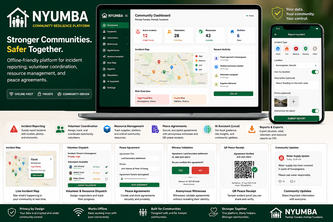
Nyumba is a self-reported offline-first community resilience platform for Kenyan communities, designed to support incident reporting, volunteer coordination, and peace agreement documentation in low-connectivity environments. The project was submitted by a single founder (Fawcett Simiyu) as part of the OpenAI 2026 hackathon. It claims to offer encrypted witness-verified peace agreements, QR-enabled receipts with tamper-evident hash-chains, and local-first data storage using SQLite and FastAPI.
The description states that Nyumba is built for use in conflict zones or during disruptions like flooding or shortages, where reliable internet access is limited. The platform includes mapping capabilities, volunteer dispatch tools, and a mobile-first PWA interface. It uses AI-style recommendations via a deterministic local CommunityAI service to avoid live-data claims, and leverages GPT-5.6-powered Codex for development acceleration.
Key commercial due-diligence read: The author describes Nyumba as a tool for community resilience in Kenya, but there is no evidence of revenue, customers, or adoption beyond the single-person development effort and hackathon submission. The platform's positioning appears to be a local tech solution for peacekeeping and emergency coordination, but its actual utility, scalability, and viability as a commercial product remain unproven.
Most important open question: Is there any evidence that Nyumba has been tested or used in real-world conditions beyond the demo environment? If not, what is the path to traction?
What The Product Actually Is
The description states that Nyumba is an offline-friendly community resilience platform for Kenyan communities, supporting:
- Incident reporting with Kenya’s location hierarchy
- Mapping of incidents and response resources
- Volunteer and supply coordination
- Encrypted peace agreement documentation
- Witness-verified agreements using anonymous votes
- QR-enabled peace receipts with tamper-evident local hash-chains
It is described as a mobile-first progressive web app (PWA), built with:
- FastAPI backend
- SQLite for local-first storage, with optional Postgres support
- Leaflet and OpenStreetMap for mapping
- A deterministic local CommunityAI service for guidance (not live AI)
- GPT-5.6-powered Codex for development
The platform is designed to function without an internet connection, and the author emphasizes that AI recommendations are labeled as guidance, not emergency intelligence.
Inference: The product appears to be a prototype or proof-of-concept built in a hackathon setting, with no evidence of production deployment or user feedback.
Positioning & Claim Evolution
The description states that Nyumba was inspired by a question about how communities can coordinate during local conflict, flooding, shortages, or disruptions when connectivity is unreliable and trust matters as much as information. The platform is positioned to help community leaders, volunteers, responders, and mediators.
It claims to be a practical place for coordination, with features like:
- PeaceTech ledger
- Encrypted agreement verification
- Anonymous witness voting
- Tamper-evident receipts
The author also notes that the platform was built with a focus on safety, trust, and offline-first operation.
Inference: The positioning is rooted in humanitarian tech and peacekeeping use cases. It is not described as a commercial product or scalable SaaS offering, but rather a tool for local resilience.
Target Customer & ICP
The description states that Nyumba is intended for Kenyan communities, specifically:
- Community leaders
- Volunteers
- Responders
- Mediators
It is designed to be used in environments with unreliable connectivity and where trust and information integrity are critical.
Inference: The ICP appears to be local community actors in Kenya, particularly those involved in emergency response or peacekeeping. There is no evidence of segmentation beyond this.
Business Model & Pricing Evidence
The description does not state any business model or pricing strategy. It is unclear whether Nyumba intends to be a freemium service, a donation-based tool, or a paid solution for government or NGO use.
Inference: No commercial model is described or evidenced. The project appears to be a prototype with no indication of monetization plans.
Technical & Delivery Signals
The platform is built using:
- FastAPI (backend)
- SQLite (local-first storage, optional Postgres support)
- Mobile-first PWA interface
- Leaflet and OpenStreetMap for mapping
- A deterministic local CommunityAI service to avoid live-data claims
- GPT-5.6-powered Codex for development
The author emphasizes that the system is designed to work offline, with AI recommendations clearly labeled as guidance, not emergency intelligence.
Inference: The technical stack suggests a lightweight, local-first approach suitable for low-connectivity environments. However, there is no evidence of scalability or production deployment.
Traction & Maturity Signals
The project was submitted by a single developer (Fawcett Simiyu) to the OpenAI 2026 hackathon. There is no evidence of:
- Revenue
- Customers
- Users
- Adoption
- Product-market fit
- Deployment or live usage
The author notes that this was a demo experience, and that the platform was built with a focus on safety, trust, and offline capability.
Inference: No traction or maturity signals are evident. The project is at a very early stage, likely a prototype or proof-of-concept.
Competitive Context
There is no evidence of competitors mentioned in the description. The author does not reference any existing tools or platforms for community resilience, incident coordination, or peacekeeping in Kenya or elsewhere.
Inference: No competitive landscape is described or evidenced. It is unclear whether similar tools exist or if this is a unique solution.
Open Questions & Risks
- No evidence of real-world use or testing beyond the demo
- Single-person development effort, with no team or external validation
- Unproven scalability for broader deployment or adoption
- No commercial model or monetization strategy
- No mention of partnerships, government support, or NGO engagement
- Self-reported claims without independent verification
Inference: The project is a prototype with no demonstrated traction or commercial viability. It may be a useful idea, but there is no evidence it has moved beyond the concept stage.
Questions the description leaves open
- Has Nyumba been tested in real-world conditions beyond the hackathon?
- What are the plans for scaling or deploying the platform beyond a demo?
- Are there any partnerships with local NGOs, government bodies, or community groups?
- How is the peace agreement verification process intended to be validated or audited?
- Is there any plan to monetize or sustain the platform beyond the initial development?
- What are the risks of deploying such a system in conflict zones or sensitive environments?
Overall Assessment
The description states that Nyumba is a prototype built for a hackathon, with no evidence of revenue, customers, or adoption.
Inference: At this stage, there is no commercial due-diligence case to make. The project is a concept with potential humanitarian utility but lacks any signs of traction, scalability, or viability as an investment or partnership opportunity.
Assessment: Not evidenced for investment or partnership. A proof-of-concept with no demonstrated path to market or user adoption.
User Stories BotA demo video on every pull request
Get a demo video on every new feature
GitHub App that watches your pull requests and records a narrated, captioned demo.
Save time on demo prep and make informed decisions faster with a video walkthrough of every new feature.
Source
Submitted to the OpenAI 2026 hackathon on Devpost. Project home on Devpost. Back to the full gallery on Devpost.
This competitive analysis was produced by top-founders.com (opens in a new tab)
Generated by a language model from this project's public Devpost page — its tagline, the author's own write-up and any built-with tags listed there — as captured in August 2026. Short quotations are the author's words. It is an opinion on the idea as a business, not on the people behind it, and it reflects the description as published then. If the project has moved on, request a correction below. The analysis is not independent research and contains no verified traction, revenue or customer data.
An independent guide by KFG International LLC — not affiliated with, endorsed by, or connected to Devpost or OpenAI.