

Archive position — measured, not model output
0 likes on Devpost
2,263 of the 7,850 archived projects have more likes, and 5,587 share exactly 0 — so this project's #5,598 place in the like-ranked listing is a tie-break inside that group, not a ranking.
Projects (log scale)
Likes on Devpost. ▲ marks this project's group.
Show the figures
| Likes | Projects | Share of archive |
|---|---|---|
| 0 | 5,587 | 71.2% |
| 1 | 1,758 | 22.4% |
| 2 | 284 | 3.6% |
| 3–4 | 132 | 1.7% |
| 5–9 | 75 | 1.0% |
| 10+ | 14 | 0.2% |
 User Stories BotA demo video on every pull request
Get a demo video on every new feature
GitHub App that watches your pull requests and records a narrated, captioned demo.
Save time on demo prep and make informed decisions faster with a video walkthrough of every new feature.
Executive Summary
What the company appears to be
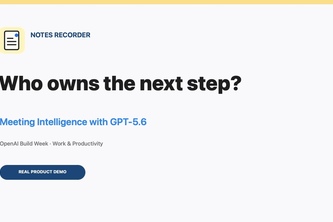
Notes Recorder — Meeting Intelligence is a self-reported full-stack product built for the OpenAI 2026 hackathon. The author states it extends an existing meeting recording and transcription tool with AI-powered intelligence extraction, aiming to turn meeting transcripts into structured, evidence-backed action items.
What changed
The project description indicates that, as of July 18, 2026, the author extended an existing Notes Recorder product with a new feature called “Meeting Intelligence.” This extension uses GPT-5.6 and structured output to extract decisions, owners, risks, questions, and follow-up messages from meeting transcripts.
The single most important open question
Is there any evidence of traction, revenue, or customer adoption beyond the author’s own development and demonstration?
What The Product Actually Is
The description states that Notes Recorder — Meeting Intelligence is an extension to an existing product named “Notes Recorder,” which records, transcribes, and organizes meetings. On July 18, 2026, the author added a new feature called “Meeting Intelligence” using AI tools (specifically GPT-5.6) to extract structured information from meeting transcripts.
This extension includes:
- Key decisions with confidence.
- Commitments with owners and timing.
- Risks and transcript-supported mitigations.
- Open questions.
- A concise meeting pulse.
- A send-ready follow-up message.
- Exact transcript line references supporting every extracted claim.
The system is described as a full-stack workflow that integrates with an existing Notes Recorder application, using an authenticated endpoint for signed-in users and a public judge fixture for evaluation without exposing private data.
Evidence
- The author states this is an extension to an existing Notes Recorder product.
- It uses GPT-5.6 via the OpenAI Responses API.
- The feature requires a signed-in account for normal use.
- A deterministic public fixture allows evaluation without private data exposure.
- The frontend calls
POST /api/intelligence/analyze. - Server-side validation ensures evidence line references are checked.
Inference The product is described as a developer-focused tool, likely aimed at teams or individuals using Notes Recorder and seeking to automate or improve their meeting intelligence extraction process.
Positioning & Claim Evolution
The author positions Notes Recorder — Meeting Intelligence as an enhancement to existing meeting note-taking tools. It claims to go beyond generic summaries by generating actionable briefs with evidence-backed claims, owners, risks, and follow-ups.
Key Claims
- Turns meeting transcripts into structured, trustworthy operating briefs.
- Extracts decisions, commitments, risks, open questions, and a send-ready follow-up.
- Provides exact transcript line references to support each claim.
- Uses AI (GPT-5.6) with structured output and server-side validation for trustworthiness.
Evidence
- The author states the tool “goes beyond generating another meeting summary.”
- It includes a “deterministic public judge fixture” for evaluation.
- The system is described as using “structured output,” “explicit evidence requirements,” and “server-side validation.”
Inference The positioning implies a shift from passive note-taking to active decision-making support. However, the description does not indicate any market positioning beyond the hackathon context.
Target Customer & ICP
The author does not explicitly define a target customer or ideal customer profile (ICP). The product is described as extending an existing Notes Recorder tool, which suggests it may be aimed at users of that platform.
Evidence
- The extension is built for an existing Notes Recorder application.
- It requires a signed-in account to function normally.
- A public fixture allows evaluation without exposing private data.
Inference The target audience likely includes teams or individuals who already use Notes Recorder and want more structured, actionable outputs from their meetings. However, no explicit customer segment is defined.
Business Model & Pricing Evidence
There is no evidence of a business model or pricing structure in the description. The author only describes the technical implementation and features of the extension.
Evidence
- No mention of monetization.
- No indication of pricing tiers or subscription models.
- The product is described as part of a hackathon submission.
Inference The project appears to be a proof-of-concept or prototype, not yet a commercial offering. There is no evidence of any revenue-generating mechanism.
Technical & Delivery Signals
The author describes the technical architecture and implementation details:
- Built with codex, CSS, GPT-5.6, HTML, JavaScript, Node.js, OpenAI, and responses.
- Uses structured output from GPT-5.6 via OpenAI Responses API.
- Server-side validation ensures transcript line references are accurate.
- A public judge fixture allows evaluation without exposing private data.
- The frontend calls
POST /api/intelligence/analyze. - Implementation commits are referenced (ae9b23e, c718b6c, 59f82fb).
Evidence
- The product is described as a full-stack workflow.
- It integrates with an existing Notes Recorder application.
- Uses Codex and GPT-5.6 for development.
- Includes server-side validation and deterministic testing.
Inference The technical approach suggests a developer-oriented tool, likely built with AI-assisted development tools. The use of structured output and validation implies attention to trustworthiness and accuracy.
Traction & Maturity Signals
There is no evidence of traction or maturity beyond the author’s own development and demonstration. The project was submitted for an OpenAI hackathon and has no stated customers, revenue, or usage data.
Evidence
- The product is described as a hackathon submission.
- No mention of users, customers, or adoption metrics.
- No revenue or monetization data provided.
Inference The project is in early development and lacks any evidence of real-world traction or commercial viability.
Competitive Context
There is no evidence of competitive analysis or market positioning beyond the author’s own claims. The description does not mention competitors or similar tools in the meeting intelligence space.
Evidence
- No mention of existing products or competitors.
- No indication of how this compares to other solutions in the market.
Inference The project is self-contained and appears to be a standalone innovation, with no context provided about its place in the broader marketplace.
Open Questions & Risks
- No commercial traction or revenue evidence: The product is described as a hackathon submission with no signs of adoption or monetization.
- Unverified claims: All features and functionality are self-reported without independent verification.
- Limited scope: No indication of long-term roadmap, scalability, or integration beyond the demo.
- Developer-focused prototype: The tool appears to be a proof-of-concept rather than a production-ready product.
Evidence
- The project is described as a hackathon submission.
- No evidence of users, customers, or monetization.
- No mention of long-term development plans or scalability.
Questions the description leaves open
- What is the current status of Notes Recorder — Meeting Intelligence beyond the hackathon?
- Has there been any user feedback or testing with real teams?
- Is there a plan to monetize this product, and if so, how?
- How does the system handle edge cases in transcript quality or ambiguity?
- What is the long-term vision for this tool beyond the demo?
Overall Assessment
Not evidenced.
The description provides no evidence of traction, revenue, customers, or commercial viability. It is a self-reported hackathon submission with no indication of product-market fit, scalability, or business model.
This project appears to be an early-stage prototype or proof-of-concept, not yet a viable investment or partnership opportunity. Any further diligence would require evidence of real-world usage, adoption, and monetization beyond the author’s own development work.
User Stories BotA demo video on every pull request
Get a demo video on every new feature
GitHub App that watches your pull requests and records a narrated, captioned demo.
Save time on demo prep and make informed decisions faster with a video walkthrough of every new feature.
Source
Submitted to the OpenAI 2026 hackathon on Devpost. Project home on Devpost. Back to the full gallery on Devpost.
This competitive analysis was produced by top-founders.com (opens in a new tab)
Generated by a language model from this project's public Devpost page — its tagline, the author's own write-up and any built-with tags listed there — as captured in August 2026. Short quotations are the author's words. It is an opinion on the idea as a business, not on the people behind it, and it reflects the description as published then. If the project has moved on, request a correction below. The analysis is not independent research and contains no verified traction, revenue or customer data.
An independent guide by KFG International LLC — not affiliated with, endorsed by, or connected to Devpost or OpenAI.