

Archive position — measured, not model output
0 likes on Devpost
2,263 of the 7,850 archived projects have more likes, and 5,587 share exactly 0 — so this project's #7,561 place in the like-ranked listing is a tie-break inside that group, not a ranking.
Projects (log scale)
Likes on Devpost. ▲ marks this project's group.
Show the figures
| Likes | Projects | Share of archive |
|---|---|---|
| 0 | 5,587 | 71.2% |
| 1 | 1,758 | 22.4% |
| 2 | 284 | 3.6% |
| 3–4 | 132 | 1.7% |
| 5–9 | 75 | 1.0% |
| 10+ | 14 | 0.2% |
 User Stories BotA demo video on every pull request
Get a demo video on every new feature
GitHub App that watches your pull requests and records a narrated, captioned demo.
Save time on demo prep and make informed decisions faster with a video walkthrough of every new feature.
Executive Summary
What the company appears to be: The project described as "Vigil" (also referred to as ZMT) is a self-reported passive network monitoring tool built on Zeek telemetry. It aims to provide real-time visibility into network activity by learning normal behavior and flagging anomalies, with optional AI-powered explanations.
What changed: The author states they used AI tools like Codex and GPT-5.6 throughout development to help build an end-to-end system, design a lightweight ML approach, make the product demonstrable, add responsible AI features, and improve delivery quality.
Single most important open question: Is there any evidence of actual deployment or usage beyond the author's own demonstration setup?
What The Product Actually Is
The description states that Vigil (ZMT) is:
- A passive monitoring tool for networks the user owns or is authorized to observe
- Built using Zeek conn.log metadata
- Streaming telemetry via FastAPI receiver with WebSocket ingestion
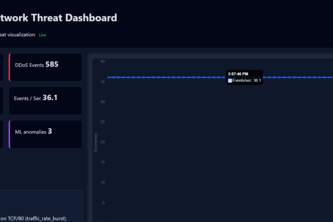
- Maintaining live metrics and displaying activity in a browser dashboard
- Learning a lightweight baseline from time of day, destination port, byte volume, and protocol
- Combining that score with transparent rules for unseen source/port combinations and traffic-rate bursts
- Providing explanations for flagged events through optional OpenAI integration
The system architecture includes:
- Zeek sensor -> Python sender (tails conn.log) -> WebSocket ingestion endpoint
- Bounded async queue -> parser + GeoIP enrichment + online usage model
- Live metrics / event broadcast / dashboard
- Optional OpenAI explanation endpoint
Evidence: The author's own write-up describes the tool's functionality and architecture in detail.
Inference: This appears to be a proof-of-concept or prototype rather than a commercial product, based on the single-member team and demo-only nature described.
Positioning & Claim Evolution
The description states:
- The tool aims to make network visibility understandable for small teams and home-lab operators
- It addresses problems with raw connection data being difficult to interpret
- Existing security tools are described as expensive, noisy, or specialist-focused
- The solution provides "explainable" anomaly detection without requiring a full security operations center
- It shows why an event was flagged and suggests next investigation steps
Evidence: Self-reported claims about problem/solution fit and positioning.
Inference: The positioning appears to be toward non-specialist users seeking basic network monitoring capabilities, but lacks evidence of market traction or customer validation.
Target Customer & ICP
The description states:
- Small teams and home-lab operators
- Users who own or are authorized to observe networks
- Those who can collect network logs but struggle with interpretation
Evidence: The author's own description of target users.
Inference: No evidence provided about specific customer segments, personas, or actual user base.
Business Model & Pricing Evidence
The description does not contain any information about:
- Revenue model
- Pricing structure
- Monetization strategy
- Customer acquisition costs
- Unit economics
Evidence: Not evidenced.
Technical & Delivery Signals
The description states:
- Built with JavaScript, Python, Zeek
- Uses FastAPI WebSocket receiver with separate sender and dashboard routes
- Bounded ingestion queue and asynchronous processing
- Zeek sender that tracks file position and handles log rotation
- Dependency-light online Gaussian baseline using incremental running statistics
- Explainable anomaly fields: model score, confidence, burst/novelty reason, normal-versus-suspicious label
- Optional GeoIP map, reconnecting frontend, and deterministic showcase scenario
- API-key gate, origin allowlist, and server-side secret handling
- OpenAI integration with constrained prompt design
Evidence: The author's own technical description of the system.
Traction & Maturity Signals
The description states:
- Single-member team (Gaurav Sharma)
- Demo mode that creates synthetic traffic for evaluation
- No mention of customers, revenue, or adoption
- Project submitted to OpenAI 2026 hackathon
- Future development plans include persistence, evaluation against labeled data, alert routing, etc.
Evidence: The author's own account of project maturity and future roadmap.
Inference: No evidence of traction, revenue, or customer base beyond the author's own use case.
Competitive Context
The description does not contain any information about:
- Competitors
- Market size
- Competitive advantages
- Differentiation from existing tools
Evidence: Not evidenced.
Open Questions & Risks
Key risks identified from the self-reported description:
- Single-person team - No evidence of scaling capability or dedicated support
- Demo-only functionality - No evidence of real-world deployment or production use
- No revenue or customer data - No traction signals beyond author's own demonstration
- AI integration risks - Optional OpenAI feature raises questions about data handling and liability
- Limited scope - Focus on passive monitoring only, no indication of broader security platform ambitions
- Unverified claims - All descriptions are self-reported without external validation
Evidence: Self-reported account of project scope and limitations.
Questions the description leaves open
- What is the actual usage context for this tool beyond the demo?
- Are there any real-world deployments or pilot programs currently running?
- How does the team plan to scale from a single developer to support broader market needs?
- What are the specific use cases where customers would pay for this functionality?
- How do you plan to handle data privacy and compliance issues with network monitoring?
- What is the roadmap for moving beyond demo mode to production-ready features?
- Are there any partnerships or integrations planned with existing security tools?
Overall Assessment
Confidence Level: Low - Based entirely on self-reported information without external validation.
Assessment: This appears to be a prototype or proof-of-concept tool developed by one person for a hackathon submission. There is no evidence of commercial traction, revenue, customers, or market validation. The project description indicates it's designed as a demonstration rather than a production-ready product. No clear business model or monetization strategy is evident from the provided information.
Key Findings:
- Single developer team
- Demo-only functionality
- No revenue or customer data
- Self-reported claims only
- Prototype nature
Recommendation: Further due diligence would require evidence of actual deployment, user feedback, and commercial viability beyond the author's own demonstration setup.
User Stories BotA demo video on every pull request
Get a demo video on every new feature
GitHub App that watches your pull requests and records a narrated, captioned demo.
Save time on demo prep and make informed decisions faster with a video walkthrough of every new feature.
Source
Submitted to the OpenAI 2026 hackathon on Devpost. Project home on Devpost. Back to the full gallery on Devpost.
This competitive analysis was produced by top-founders.com (opens in a new tab)
Generated by a language model from this project's public Devpost page — its tagline, the author's own write-up and any built-with tags listed there — as captured in August 2026. Short quotations are the author's words. It is an opinion on the idea as a business, not on the people behind it, and it reflects the description as published then. If the project has moved on, request a correction below. The analysis is not independent research and contains no verified traction, revenue or customer data.
An independent guide by KFG International LLC — not affiliated with, endorsed by, or connected to Devpost or OpenAI.