

Archive position — measured, not model output
0 likes on Devpost
2,263 of the 7,850 archived projects have more likes, and 5,587 share exactly 0 — so this project's #5,599 place in the like-ranked listing is a tie-break inside that group, not a ranking.
Projects (log scale)
Likes on Devpost. ▲ marks this project's group.
Show the figures
| Likes | Projects | Share of archive |
|---|---|---|
| 0 | 5,587 | 71.2% |
| 1 | 1,758 | 22.4% |
| 2 | 284 | 3.6% |
| 3–4 | 132 | 1.7% |
| 5–9 | 75 | 1.0% |
| 10+ | 14 | 0.2% |
 User Stories BotA demo video on every pull request
Get a demo video on every new feature
GitHub App that watches your pull requests and records a narrated, captioned demo.
Save time on demo prep and make informed decisions faster with a video walkthrough of every new feature.
Executive Summary
What the company appears to be
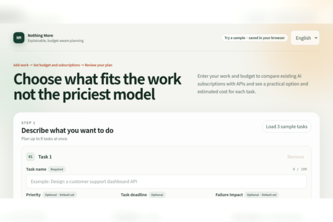
Nothing More is a self-reported personal budgeting tool aimed at individuals who use AI subscriptions and APIs, with a focus on helping users understand and control their spending. The project was built by one person (ParkBomJun ParkBumJun) as part of an OpenAI 2026 hackathon submission.
What changed
The author reports that the initial version had usability issues and complex language, but after iterative development involving AI and human input, it became simpler and more user-friendly. The final version emphasizes clarity in UI/UX and privacy handling.
Single most important open question
Is there any evidence of actual user adoption or revenue generation beyond the author’s own use case?
What The Product Actually Is
The description states that Nothing More is a tool designed to help users manage personal AI work, subscriptions, and API choices by turning them into an explainable budget plan. It targets ordinary people, office workers who code, and those with side-hustle coding activities.
It was built using technologies such as Codex, GPT-5.6, Next.js, Node.js, React, TailwindCSS, TypeScript, Vercel, Vitest, Zod, and OpenAI Responses API.
The author claims the app uses everyday language to make it easy for anyone to understand how to use it right away.
Inference The product appears to be a web-based personal finance dashboard or tool that aggregates and visualizes AI-related expenses, possibly through integration with various APIs or subscription services.
Positioning & Claim Evolution
The author states that the inspiration came from their own experience of paying for unused AI subscriptions. They describe the goal as helping users avoid wasting money on unnecessary services.
They also mention that the UI/UX was simplified to be more accessible, and that they prioritized privacy by ensuring API keys never go to the browser.
Inference The positioning evolved from a personal solution to a broader tool for managing AI-related spending. However, there is no evidence of how this evolved into a commercial offering or whether it has moved beyond a prototype.
Target Customer & ICP
The description states that the target users are:
- Ordinary people
- Office workers who code
- People who already pay for AI subscriptions
- People who do vibe coding as a side hustle or hobby
Inference The ICP seems to be individuals with some technical knowledge but not necessarily deep expertise in finance or subscription management. It is unclear whether this includes enterprise customers or if the tool is strictly personal.
Business Model & Pricing Evidence
There is no mention of pricing, monetization strategy, or business model in the provided description.
Not evidenced.
Technical & Delivery Signals
The project was built using:
- Codex
- GPT-5.6
- Next.js
- Node.js
- React
- TailwindCSS
- TypeScript
- Vercel
- Vitest
- Zod
- OpenAI Responses API
The author reports that they used AI to assist in building the app, but also emphasized human involvement in refining design and functionality.
Privacy was a key concern, with decisions made to keep API keys local and only send necessary information to OpenAI.
Inference The technical stack suggests a modern frontend/backend architecture with AI integration. However, there is no evidence of scalability, performance metrics, or production deployment beyond the hackathon prototype.
Traction & Maturity Signals
The author mentions that the app was built over three full days during a hackathon and that early versions had usability issues.
They note improvements made in UI/UX and privacy handling, but there is no evidence of:
- User base
- Revenue
- Customer feedback
- Product usage data
- Market traction
Not evidenced.
Competitive Context
No mention of competitors or market positioning in the description.
Not evidenced.
Open Questions & Risks
- Lack of commercial evidence: No revenue, customers, or adoption data.
- Single-person team: The entire project was built by one individual; no indication of team expansion or support structure.
- Prototype nature: Built for a hackathon, not intended for production use.
- Unverified claims: All statements are self-reported and unverified.
- No pricing model: No indication of how the product would monetize.
- AI dependency risk: Heavy reliance on AI tools raises questions about long-term viability and control.
Questions the description leaves open
- How did you validate that users actually need this tool?
- What is your plan for scaling beyond a single-person development model?
- Are there any existing users or early adopters?
- What are the technical limitations of integrating with various AI and API services?
- How do you intend to monetize the product?
- What are the risks associated with relying heavily on AI tools like Codex and GPT-5.6?
Overall Assessment
Not evidenced.
The description provides no evidence of traction, revenue, or customer adoption. It is a self-reported hackathon project built by one person without any indication of commercial viability or scalability.
This is a pre-product concept with no demonstrated market need or business model. Any investment or partnership would require further validation and proof of concept beyond the author's own experience.
User Stories BotA demo video on every pull request
Get a demo video on every new feature
GitHub App that watches your pull requests and records a narrated, captioned demo.
Save time on demo prep and make informed decisions faster with a video walkthrough of every new feature.
Source
Submitted to the OpenAI 2026 hackathon on Devpost. Project home on Devpost. Back to the full gallery on Devpost.
This competitive analysis was produced by top-founders.com (opens in a new tab)
Generated by a language model from this project's public Devpost page — its tagline, the author's own write-up and any built-with tags listed there — as captured in August 2026. Short quotations are the author's words. It is an opinion on the idea as a business, not on the people behind it, and it reflects the description as published then. If the project has moved on, request a correction below. The analysis is not independent research and contains no verified traction, revenue or customer data.
An independent guide by KFG International LLC — not affiliated with, endorsed by, or connected to Devpost or OpenAI.