

Archive position — measured, not model output
0 likes on Devpost
2,263 of the 7,850 archived projects have more likes, and 5,587 share exactly 0 — so this project's #5,597 place in the like-ranked listing is a tie-break inside that group, not a ranking.
Projects (log scale)
Likes on Devpost. ▲ marks this project's group.
Show the figures
| Likes | Projects | Share of archive |
|---|---|---|
| 0 | 5,587 | 71.2% |
| 1 | 1,758 | 22.4% |
| 2 | 284 | 3.6% |
| 3–4 | 132 | 1.7% |
| 5–9 | 75 | 1.0% |
| 10+ | 14 | 0.2% |
 User Stories BotA demo video on every pull request
Get a demo video on every new feature
GitHub App that watches your pull requests and records a narrated, captioned demo.
Save time on demo prep and make informed decisions faster with a video walkthrough of every new feature.
Executive Summary
What the company appears to be
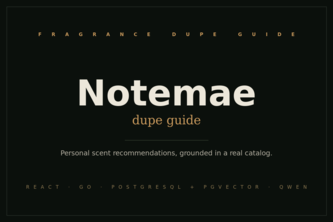
Notemae is a self-reported fragrance recommendation platform that uses AI and catalog data to provide personalized scent suggestions based on user preferences such as personality, climate, occasion, and budget. It presents itself as an editorial, bilingual web app with four connected experiences: a fragrance catalog, a dupe guide, an AI consultant, and grounded answers.
What changed
The project description indicates that Notemae was built for the OpenAI 2026 hackathon. The authors describe a complete end-to-end system including frontend, backend, recommendation agent, retrieval engine, ingestion pipeline, and evaluation framework. It includes technical details about architecture, tools used (e.g., Go, Python, React, PostgreSQL), and engineering decisions made during development.
Single most important open question
Is there any evidence of real user engagement or traction beyond the hackathon submission? The description is entirely self-reported with no mention of revenue, customers, or adoption metrics.
What The Product Actually Is
The description states that Notemae is a bilingual (English and Indonesian) web app with four connected experiences:
- A fragrance catalog you can browse and filter.
- A dupe guide built around three steps: pick the original perfume, read a similarity score computed from shared catalog notes rather than ad claims, then compare candidates side by side.
- An AI consultant that accepts requests in everyday language and turns them into typed preference profiles, returning recommendations over server-sent events.
- A system designed to never invent products, only reorder and explain existing entries in a PostgreSQL catalog.
It is described as an editorial experience, using technologies like React 19 + TypeScript, Express SSR, Go backend, Python FastAPI agent, Qwen LLM via DashScope, pgvector for vector retrieval, and Docker Compose for deployment.
Evidence
- The project write-up describes the product’s structure and functionality.
- Technical stack is listed in detail, including tools like Caddy, React, Express.js, Go, FastAPI, Qwen, pgvector, Redis, etc.
Inference The system appears to be a hybrid of deterministic logic and LLM-based reranking, where constraints are enforced before model use, and explanations come only from existing catalog data.
Positioning & Claim Evolution
The description states that Notemae aims to be a "guide that listens like a friend who is deep into fragrance, but only ever answers from a real catalog it can show you."
It positions itself as:
- A personal scent consultant.
- An editorial, bilingual web app.
- A dupe guide that uses similarity scores based on shared notes rather than marketing claims.
- A grounded AI assistant, never inventing products or performance claims.
The authors also note they were inspired by the difficulty of buying fragrances online and wanted to bridge the gap between human language and fragrance catalog data.
Evidence
- The elevator pitch and project story clearly articulate the positioning.
- The claim that it avoids “inventing products” is explicitly stated.
Inference The product evolved from a simple idea (bridging language gaps) into a full-stack system with AI, catalog, and user interface components. It reflects an attempt to create a trustworthy, data-driven recommendation tool.
Target Customer & ICP
The description does not clearly define the target customer or Ideal Customer Profile (ICP).
It implies that users are people looking for fragrance recommendations based on:
- Personality traits
- Climate conditions
- Occasions
- Budget constraints
However, there is no explicit segmentation or persona definition beyond general descriptions like “someone who wants to buy a fragrance online.”
Evidence
- The AI consultant accepts requests in everyday language such as:
"Saya pria, kerja kantoran di Jakarta, budget 1,2 juta, suka citrus dan cedar, tidak suka manis"
(I am male, work in an office in Jakarta, budget 1.2 million rupiah, like citrus and cedar, don’t like sweet)
Inference Users likely fall into a niche market of fragrance enthusiasts or casual buyers seeking personalized advice.
Business Model & Pricing Evidence
There is no evidence provided regarding the business model or pricing strategy.
The description does not mention:
- Revenue streams
- Monetization plans
- Subscription tiers
- Paid features
- Licensing models
- Retail partnerships
Evidence
- No financial data, pricing info, or monetization strategy mentioned.
Inference Given the hackathon context and lack of traction evidence, it is unclear whether Notemae intends to operate as a freemium service, a marketplace, or a B2B tool for retailers.
Technical & Delivery Signals
The project includes detailed technical architecture:
- Frontend: React 19 + TypeScript SPA served by Express with SSR.
- Backend: Go-based clean architecture using pgx and standard library HTTP stack.
- Recommendation Agent: Python + FastAPI service with Qwen reranking, Borda count, and diversity control.
- Retrieval Engine: PostgreSQL 16 with pgvector for vector search.
- Ingestion Pipeline: Scheduled worker pulling from approved sources (e.g., Open Beauty Facts), normalized and enriched by Qwen.
- Deployment: Docker Compose setup.
Key engineering decisions:
- Rewrote backend from FastAPI to Go, ensuring byte-for-byte parity.
- Used deterministic constraint enforcement before LLM calls.
- Built evaluation harness for stochastic reranker.
- Implemented SSR without breaking JSX transformation.
Evidence
- Full technical breakdown provided in the write-up.
- Specific tools and frameworks listed (e.g., Caddy, Qwen, pgvector).
Inference The system shows strong engineering maturity for a hackathon project. It demonstrates careful attention to correctness, scalability, and maintainability.
Traction & Maturity Signals
There is no evidence of traction or user adoption beyond the hackathon submission.
The description states:
- This was submitted to the OpenAI 2026 hackathon.
- No revenue, customer, or usage data is available.
- The authors mention offline A/B testing results but do not present production metrics.
Evidence
- No mention of users, customers, or real-world performance.
- No indication of monetization or business growth.
Inference This is a prototype or proof-of-concept built for a competition. There is no evidence of product-market fit or commercial viability at this stage.
Competitive Context
The description does not provide any information about competitors or market positioning relative to others in the fragrance or personal care space.
It does not reference:
- Existing fragrance recommendation platforms
- Similar AI-powered shopping tools
- Retailer or marketplace integrations
- Industry benchmarks or pricing models
Evidence
- No competitive analysis or comparison made.
Inference Notemae appears to be a new entrant in the niche of personalized fragrance guidance, potentially targeting users who struggle with online fragrance selection. Its uniqueness lies in its grounded AI approach and bilingual support.
Open Questions & Risks
Several risks and open questions are evident from the self-reported description:
- No traction or revenue: The project is described as a hackathon submission with no evidence of real-world usage.
- Limited scope: Only one team member (2 people) built it, suggesting limited scalability or long-term commitment.
- Unproven commercial viability: No business model or monetization strategy discussed.
- High technical complexity without validation: While the architecture is impressive, there’s no evidence that it works in production at scale.
- Dependency on external data sources: Reliance on Open Beauty Facts and licensed feeds may limit catalog completeness or introduce quality issues.
- Lack of product-market fit signal: No indication that users actually engage with the system beyond testing.
Evidence
- The project is explicitly labeled as a hackathon submission.
- No mention of real users, customers, or monetization.
Questions the description leaves open
- What is the current status of the product? Is it live or still in prototype phase?
- How many users are currently using Notemae, and what is their engagement level?
- Have you conducted any user research or usability testing beyond the hackathon?
- What are your plans for monetization and scaling the business?
- Are there any legal or licensing issues with the data sources used (e.g., Open Beauty Facts)?
- How do you plan to expand the fragrance catalog, especially for underrepresented regions or niche categories?
- What is the long-term roadmap beyond the current features?
- Can you share more about how the AI model was trained and validated?
Overall Assessment
Notemae is a technically impressive hackathon project with strong engineering foundations, but lacks any evidence of traction, revenue, or commercial viability.
It appears to be a proof-of-concept for a niche market (personalized fragrance guidance) that uses AI and catalog data in an innovative way. However, the absence of real-world usage, customer feedback, or monetization strategy makes it difficult to assess its potential as an investment or partnership opportunity.
Confidence Level Low
Reasoning
The entire description is self-reported and unverified. No third-party validation, no revenue, no customers, no market data — only a technical write-up of a prototype built in a short timeframe.
Conclusion
While the engineering work is commendable, the lack of commercial evidence means this project cannot be evaluated for investment or partnership value at this time. Further due diligence would require demonstrating real user engagement and business traction.
User Stories BotA demo video on every pull request
Get a demo video on every new feature
GitHub App that watches your pull requests and records a narrated, captioned demo.
Save time on demo prep and make informed decisions faster with a video walkthrough of every new feature.
Source
Submitted to the OpenAI 2026 hackathon on Devpost. Project home on Devpost. Back to the full gallery on Devpost.
This competitive analysis was produced by top-founders.com (opens in a new tab)
Generated by a language model from this project's public Devpost page — its tagline, the author's own write-up and any built-with tags listed there — as captured in August 2026. Short quotations are the author's words. It is an opinion on the idea as a business, not on the people behind it, and it reflects the description as published then. If the project has moved on, request a correction below. The analysis is not independent research and contains no verified traction, revenue or customer data.
An independent guide by KFG International LLC — not affiliated with, endorsed by, or connected to Devpost or OpenAI.