

Archive position — measured, not model output
0 likes on Devpost
2,263 of the 7,850 archived projects have more likes, and 5,587 share exactly 0 — so this project's #5,575 place in the like-ranked listing is a tie-break inside that group, not a ranking.
Projects (log scale)
Likes on Devpost. ▲ marks this project's group.
Show the figures
| Likes | Projects | Share of archive |
|---|---|---|
| 0 | 5,587 | 71.2% |
| 1 | 1,758 | 22.4% |
| 2 | 284 | 3.6% |
| 3–4 | 132 | 1.7% |
| 5–9 | 75 | 1.0% |
| 10+ | 14 | 0.2% |
 User Stories BotA demo video on every pull request
Get a demo video on every new feature
GitHub App that watches your pull requests and records a narrated, captioned demo.
Save time on demo prep and make informed decisions faster with a video walkthrough of every new feature.
Executive Summary
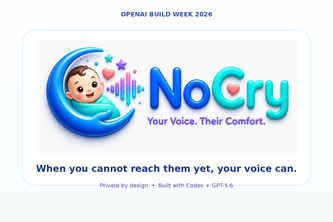
The company appears to be a solo developer project named NoCry, an Android app designed to detect sustained crying-like sounds and respond with a familiar caregiver's voice, keeping all processing local on the device. The product is described as privacy-first and built using AI-assisted development tools (ChatGPT, Codex, GPT-5.6) alongside Flutter, Dart, Kotlin, and Android SDKs.
What changed: The author reports building an installable Android application from a detailed specification, integrating complex audio state management and platform-specific behaviors while maintaining offline-first principles and caregiver control.
The single most important open question: Is there any evidence of real-world usage or user feedback beyond the developer's own testing and submission to a hackathon?
Note: This analysis is based entirely on self-reported information from the project description. No external verification, traction data, revenue figures, customer names, or independent sources are available.
What The Product Actually Is
The description states that NoCry is:
- A privacy-first Android comfort assistant
- Designed to detect sustained crying-like sounds
- Respond with a familiar caregiver voice, recorded by the user
- Keeps all core processing locally on the device
- Operates without uploading audio or recordings to cloud services
It is described as:
- An Android application built using Flutter, Dart, Kotlin, and native Android services
- A comfort-assistance application, not a medical device or emergency system
- Not intended to replace adult supervision or serve as a diagnostic tool
Inference: The product functions as an automated audio-triggered playback assistant for caregivers. It uses local processing and user-recorded content to provide reassurance during brief moments when physical response is delayed.
Positioning & Claim Evolution
The author positions NoCry as:
- A privacy-focused solution for families
- A tool that supports caregivers in responding more quickly to infant needs
- Built around the idea of “life’s first citizens” — babies and young children
Key claims include:
- The app helps familiar voices arrive sooner while caregivers respond
- All processing is kept local, avoiding cloud uploads
- It avoids treating its own playback as a new trigger
- Designed for caregiver control, not automation or replacement of human supervision
Claim vs Fact: These are self-stated intentions and design principles. There is no evidence provided about actual adoption, effectiveness, or user satisfaction.
Target Customer & ICP
The description states:
- The primary audience is families with babies or young children
- Specifically targets caregivers (mothers, fathers, grandparents)
- Aims to support those who may be feeding, recovering, preparing food, or caring for other children and cannot respond immediately to a baby’s cry
Inference: The ICP appears to be parents or caregivers in everyday situations where immediate physical response is not possible. However, the description does not specify demographic details, geographic scope, or whether it targets specific age groups or parenting styles.
Business Model & Pricing Evidence
Not evidenced.
The author does not describe any pricing model, monetization strategy, or business structure beyond the fact that it's a solo developer project submitted to a hackathon.
Absence of evidence: No mention of subscriptions, one-time purchases, freemium models, or commercial partnerships.
Technical & Delivery Signals
The description indicates:
- Built using Flutter and Dart for UI experience
- Native Kotlin and Android services for microphone handling, foreground monitoring, audio lifecycle, etc.
- Utilizes AI tools: ChatGPT, Codex, GPT-5.6 for product design, documentation, and implementation
- Final codebase includes dependency list, state machine, and build commands
- Delivered as an Android APK and App Bundle
Inference: The technical stack suggests a hybrid native + Flutter approach with AI-assisted development. The use of Codex implies some level of automated engineering within the repository.
Traction & Maturity Signals
Not evidenced.
There is no mention of:
- Users or downloads
- Customer feedback or testimonials
- Revenue or funding
- Product usage metrics
- Release history or updates beyond the initial build
Absence of evidence: No indication of traction, growth, or market validation.
Competitive Context
Not evidenced.
The description does not reference:
- Competitors in the baby monitor or caregiver-assistance space
- Similar products or platforms
- Market size or competitive positioning
Absence of evidence: No competitive landscape or differentiation analysis is provided.
Open Questions & Risks
Several potential risks and open questions are implied by the description:
- Solo developer project: One-person team may lack scalability, support, or long-term maintenance
- Hackathon submission: Not a commercial product but a prototype or proof-of-concept
- AI-assisted development: Reliance on AI tools raises questions about quality control and reproducibility
- No real-world testing: No evidence of actual user trials or feedback
- Privacy claims without verification: Claims about local processing and no cloud upload are self-reported, not independently audited
Inference: The project lacks commercial maturity, market validation, and independent verification of its privacy and functionality claims.
Questions the description leaves open
- What is the actual user experience like in real-world settings?
- Have you tested the app with actual caregivers or families?
- How do you plan to validate the accuracy of crying detection across different acoustic environments?
- Is there any intention to expand beyond Android (e.g., iOS)?
- What are your plans for long-term product maintenance and updates?
- Can you provide evidence of battery impact or performance under extended use?
- Are there any clinical, ethical, or safeguarding considerations that have been addressed?
Overall Assessment
Not evidenced.
There is no indication of:
- Funding rounds
- Investors or partners
- Commercial viability
- Strategic fit for potential acquirers or investors
Absence of evidence: No data to assess whether this project has investment or partnership potential beyond its current status as a hackathon submission.
User Stories BotA demo video on every pull request
Get a demo video on every new feature
GitHub App that watches your pull requests and records a narrated, captioned demo.
Save time on demo prep and make informed decisions faster with a video walkthrough of every new feature.
Source
Submitted to the OpenAI 2026 hackathon on Devpost. Project home on Devpost. Back to the full gallery on Devpost.
This competitive analysis was produced by top-founders.com (opens in a new tab)
Generated by a language model from this project's public Devpost page — its tagline, the author's own write-up and any built-with tags listed there — as captured in August 2026. Short quotations are the author's words. It is an opinion on the idea as a business, not on the people behind it, and it reflects the description as published then. If the project has moved on, request a correction below. The analysis is not independent research and contains no verified traction, revenue or customer data.
An independent guide by KFG International LLC — not affiliated with, endorsed by, or connected to Devpost or OpenAI.