

Archive position — measured, not model output
1 like on Devpost
505 of the 7,850 archived projects have more likes, and 1,758 share exactly 1 — so this project's #1,522 place in the like-ranked listing is a tie-break inside that group, not a ranking.
Projects (log scale)
Likes on Devpost. ▲ marks this project's group.
Show the figures
| Likes | Projects | Share of archive |
|---|---|---|
| 0 | 5,587 | 71.2% |
| 1 | 1,758 | 22.4% |
| 2 | 284 | 3.6% |
| 3–4 | 132 | 1.7% |
| 5–9 | 75 | 1.0% |
| 10+ | 14 | 0.2% |
 User Stories BotA demo video on every pull request
Get a demo video on every new feature
GitHub App that watches your pull requests and records a narrated, captioned demo.
Save time on demo prep and make informed decisions faster with a video walkthrough of every new feature.
Executive Summary
What the company appears to be
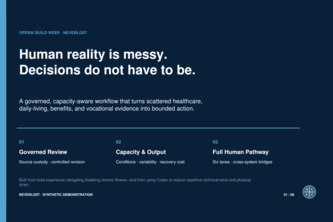
Neverlost: The Full Human Pathway is a self-reported AI-powered tool designed to organize scattered personal information into structured, governed review packets for individuals navigating complex systems like healthcare, benefits, and vocational rehabilitation. It uses Codex and GPT-5.6 to process data through three reusable skills—Governed Review, Capacity & Output, and Full Human Pathway—and is built as a plugin with Python, React, and JSON contracts.
What changed
The project emerged from the author’s lived experience with chronic illness and the lack of coherent views across systems. It was developed during an OpenAI hackathon (2026) and includes synthetic demonstrations to test governance behavior without real-world data.
Single most important open question
Is there a viable commercial or partnership use case beyond a prototype, and what would be required for it to move from a demonstration into a usable system?
What The Product Actually Is
The description states that Neverlost is a system built using Codex and GPT-5.6 that organizes scattered human information into governed review packets through three reusable skills:
- Governed Review – preserves source custody, separates evidence from guidance, checks role boundaries, controls revisions, and keeps human approval gates visible.
- Capacity & Output – records useful activity together with conditions, accommodations, variability, interruption cost, and recovery cost required to produce it.
- Full Human Pathway – maps coordinated next steps across six life-and-work lanes (Health and function, Environment and accessibility, Daily life and recovery, Resources and benefits, Education and training, Vocational rehabilitation), connected by authority-bearing bridges.
It also includes:
- An installable plugin with three reusable skills
- Seven JSON data contracts
- A generalized Python workflow runner
- Deterministic packet validators
- A frozen defect scorer
- Negative prohibited-claim tests
- Earlier-case regression tests
- Governed scope decisions, change logs, defect records, and checkpoints
- A one-command judge demonstration
- A six-frame interactive visual experience
The system runs with the Python standard library, requires no API key, and is designed to be reproducible and testable.
Confidence Low — this is a self-reported technical description with no evidence of actual deployment or customer use.
Positioning & Claim Evolution
The author states that Neverlost was inspired by personal experience navigating disabling chronic illness across fragmented systems. It aims to turn scattered human reality into governed, evidence-aligned action.
Key claims:
- AI can organize complex information quickly but risks turning observations into professional proof or approvals.
- The tool reduces repetitive technical work and physical strain, making it possible to build more rigorously within limited capacity.
- Codex became an accessibility tool during development.
- It is not intended to replace the authority of providers, counselors, agencies, employers, or clients; rather, it aims to make evidence, boundaries, unresolved questions, and next authorized conversations more coherent.
Confidence Low — these are claims about intent and positioning, not proof of traction or adoption.
Target Customer & ICP
The description does not explicitly name a target customer or define an ideal customer profile (ICP). However, it implies that the tool is intended for individuals managing complex personal circumstances such as chronic illness, disability, or vocational transitions. It also suggests potential use in healthcare, accessibility, daily-living, benefits, vocational, research, and consulting contexts.
The author notes that the goal is not to replace authority but to make conversations more coherent.
Confidence Very low — no evidence of actual customers or defined personas.
Business Model & Pricing Evidence
There is no evidence in the description of a business model or pricing structure. The project is presented as a prototype built during a hackathon and includes no mention of monetization, licensing, or commercial offerings.
Confidence Not evidenced — no indication of how this would be sold or funded.
Technical & Delivery Signals
The system uses:
- Codex with GPT-5.6 Sol
- Python, React, TypeScript, JSON schema
- GitHub for version control and collaboration
- Plugin architecture
- Synthetic case systems
- Deterministic validators
- Regression testing
- Change logs and checkpoints
It is described as:
- Installable
- Reproducible with one command
- Offline-capable (requires no API key)
- Built using only Python standard library
- Includes a judge demonstration and interactive visual experience
Confidence Medium — the technical implementation is detailed, but there’s no evidence of real-world deployment or scalability.
Traction & Maturity Signals
The description states:
- The project was submitted to the OpenAI 2026 hackathon.
- It includes synthetic demonstrations with measurable performance (e.g., 10/10 defects detected).
- A one-command judge demonstration exists.
- The author preserved baseline results, logged new findings, and corrected logic after discovering issues.
- The system includes reproducible testing, governance history, and an interactive experience.
However:
- There is no evidence of revenue, customers, or adoption.
- No real-world data or user feedback is provided.
- The demonstration is synthetic and fictional.
Confidence Very low — the project shows development maturity but lacks traction signals.
Competitive Context
The description does not mention any competitors. It implies that there is a gap in tools for organizing complex personal information across fragmented systems, particularly for people with chronic illness or disabilities.
It also notes that AI tools can sometimes quietly turn observations into professional conclusions, suggesting a need for governance and clarity around authority boundaries.
Confidence Not evidenced — no competitive landscape or market positioning provided.
Open Questions & Risks
- No commercial viability or monetization strategy — the project is presented as a prototype with no indication of how it would be sold or used at scale.
- High risk of misuse — the tool is designed to prevent authority drift, but its use in real-world scenarios could lead to misinterpretation or overreliance on automated outputs.
- Limited scope and context — all demonstrations are synthetic; no real-world data or feedback exists.
- Dependency on AI tools (Codex, GPT) — the tool’s performance is tied to proprietary models that may not be available or stable long-term.
- Lack of clarity on governance and legal boundaries — while it avoids making decisions, its use could still raise ethical or regulatory concerns.
Confidence Medium — risks are inferred from the nature of the product and lack of real-world application.
Questions the description leaves open
- What is the intended user journey for someone who wants to use this in practice?
- How would you handle situations where users have real, non-synthetic data?
- Is there a plan to test with actual individuals or organizations managing complex cases?
- How do you ensure that the system does not inadvertently encourage over-reliance on automated outputs?
- What are the legal and ethical implications of using such a system in real-world settings?
- Are there any plans for integrating with existing systems (e.g., healthcare records, benefits platforms)?
- How would you scale this beyond a single developer’s capacity?
Overall Assessment
The project is a self-reported prototype built during a hackathon and shows strong development maturity in terms of structure, governance, and testing. However, there is no evidence of traction, revenue, or customer adoption.
It addresses a potential gap in tools for individuals navigating complex systems like healthcare and benefits, but the lack of real-world use cases, commercial strategy, or scalability planning makes it difficult to assess its viability as an investment or partnership opportunity.
Assessment Not ready for investment or partnership without further evidence of traction, market validation, or clear path to product-market fit.
User Stories BotA demo video on every pull request
Get a demo video on every new feature
GitHub App that watches your pull requests and records a narrated, captioned demo.
Save time on demo prep and make informed decisions faster with a video walkthrough of every new feature.
Source
Submitted to the OpenAI 2026 hackathon on Devpost. Project home on Devpost. Back to the full gallery on Devpost.
This competitive analysis was produced by top-founders.com (opens in a new tab)
Generated by a language model from this project's public Devpost page — its tagline, the author's own write-up and any built-with tags listed there — as captured in August 2026. Short quotations are the author's words. It is an opinion on the idea as a business, not on the people behind it, and it reflects the description as published then. If the project has moved on, request a correction below. The analysis is not independent research and contains no verified traction, revenue or customer data.
An independent guide by KFG International LLC — not affiliated with, endorsed by, or connected to Devpost or OpenAI.