

Archive position — measured, not model output
0 likes on Devpost
2,263 of the 7,850 archived projects have more likes, and 5,587 share exactly 0 — so this project's #5,448 place in the like-ranked listing is a tie-break inside that group, not a ranking.
Projects (log scale)
Likes on Devpost. ▲ marks this project's group.
Show the figures
| Likes | Projects | Share of archive |
|---|---|---|
| 0 | 5,587 | 71.2% |
| 1 | 1,758 | 22.4% |
| 2 | 284 | 3.6% |
| 3–4 | 132 | 1.7% |
| 5–9 | 75 | 1.0% |
| 10+ | 14 | 0.2% |
 User Stories BotA demo video on every pull request
Get a demo video on every new feature
GitHub App that watches your pull requests and records a narrated, captioned demo.
Save time on demo prep and make informed decisions faster with a video walkthrough of every new feature.
Executive Summary
What the company appears to be: Mynah is an offline-first Augmentative and Alternative Communication (AAC) picture board for non-speaking or minimally speaking children aged 2–10. It uses AI to reshape suggestions, but not to speak for the child.
What changed: The project was submitted as a hackathon entry by one developer, Osho Kharbanda, with no evidence of prior traction, revenue, or customer data.
Single most important open question: Does the author’s self-reported technical and product design approach actually deliver on its stated safety rails and child-centered principles in real-world use?
Analysis basis: This report is based entirely on the self-reported project description provided by the author. It contains no verified financial, customer, or operational data. All claims are unverified and should be treated as assertions made by the author.
What The Product Actually Is
- The description states that Mynah is an offline-first AAC picture board for children aged 2–10 who do not speak or speak minimally.
- It includes:
- A fixed core board of 24 words, positioned consistently to support motor memory.
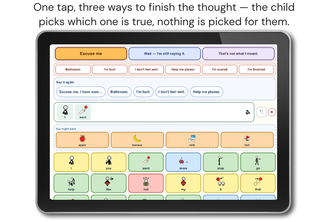
- "Say More" sentence strips that offer up to three complete, picture-only sentences after a single noun or verb.
- A predictive suggestion row for fringe and personal vocabulary, which ranks but does not reorder or replace core tiles.
- Conversation repair controls, such as “Excuse me, I have something to say,” to help children hold the floor or correct others.
- Tools for caregivers to add custom words using photos, emojis, or text with generated voice clips — all without an account or cloud storage.
- Every stock tile has a pre-generated offline voice clip, so no network is required.
- The AI is used in two narrow, constrained ways:
- To rank fringe and personal vocabulary candidates already present on the board.
- To reshape sentence suggestions using structured outputs from GPT-5.6, but never to generate new vocabulary or replace a child’s taps.
Inference: The product is built as a Progressive Web App (PWA), leveraging local storage via IndexedDB and service workers for offline functionality. It uses ARASAAC symbols and ElevenLabs speech generation.
Positioning & Claim Evolution
- The description states that Mynah aims to give back control to the child, treating each tap as a complete sentence rather than a hint.
- Key positioning claims:
- No onboarding or instructions are needed.
- AI reshapes suggestions but never speaks for the child.
- It works completely offline, including voice clips and sentence strips.
- Designed with safety rails around AI behavior to prevent over-automation.
- The author emphasizes that the core rule is: “no matter how good the model’s guess is, it never gets to speak for the child.”
- The project was submitted to the OpenAI 2026 hackathon, suggesting a focus on AI integration within a sensitive domain.
Claim vs Fact: These are self-reported claims about intent and design philosophy. There is no evidence of actual user testing or clinical validation beyond the author’s own account.
Target Customer & ICP
- The target customer is non-speaking or minimally speaking children aged 2–10.
- The primary users are:
- Children who rely on AAC tools for communication.
- Caregivers (parents, teachers, therapists) who support these children.
- The description does not name specific types of caregivers or institutions (e.g., schools, clinics).
- No evidence is provided about:
- Specific demographics or geographic markets.
- Whether the tool targets a particular type of speech-language pathology.
- Any segmentation strategy beyond age range.
Inference: Based on the product’s design and use case, it likely appeals to families, educators, and therapists working with AAC users. However, no explicit ICP is defined.
Business Model & Pricing Evidence
- The description does not mention any pricing model or monetization strategy.
- No evidence of:
- Revenue streams.
- Subscription plans.
- Paid features or freemium models.
- B2B vs B2C targeting.
- Licensing or distribution channels.
Not evidenced: There is no indication of how the product would be sold, licensed, or funded beyond its development as a hackathon submission.
Technical & Delivery Signals
- Mynah is built as a Next.js PWA with:
- Tailwind CSS
- React
- TypeScript
- Service workers for offline caching
- IndexedDB for local data storage
- ARASAAC symbols bundled locally
- Pre-generated ElevenLabs speech
- AI components are:
- Used in two narrow, constrained ways:
- Structured output API
/api/expandwith intent enum (request, comment, refusal, feeling, question) /api/boardfor ranking existing vocabulary only
- Structured output API
- GPT-5.6 is not used for generation or replacement of core tiles.
- Schema validation and staleness tokens prevent outdated responses.
- Deterministic fallbacks ensure offline reliability.
- Used in two narrow, constrained ways:
Inference: The architecture shows deliberate effort to isolate AI from core functionality, which aligns with stated safety principles.
Traction & Maturity Signals
- No evidence of:
- Revenue or ARR
- Customers or user base
- Product adoption metrics
- Market traction
- Product usage data
- Any form of pilot or clinical trial
- The project is described as a hackathon submission.
- The team size is listed as 1 person.
Not evidenced: There are no signs of product maturity, market validation, or commercial traction beyond the author’s own description.
Competitive Context
- The description does not reference:
- Competitors in the AAC space
- Existing tools or platforms used by children with communication challenges
- Market size or competitive positioning
- No mention of how Mynah differentiates from other AAC solutions.
- The focus on offline-first, AI reshaping, and child-centered safety rails suggests a niche within AAC, but no comparison is made.
Not evidenced: No competitive analysis or market context provided.
Open Questions & Risks
- Single-person team: The project was built by one developer; lack of team structure may limit scalability.
- Unverified clinical alignment: While the author claims to have worked with speech-language pathologists, no evidence is given that this work has been validated or tested in real-world settings.
- Licensing constraints: ARASAAC’s CC BY-NC-SA license means a commercial release would require different symbol rights — a potential legal and business risk.
- AI safety design complexity: The described AI controls (schema validation, staleness tokens) are complex to implement correctly; any failure could undermine the product's core promise.
- No monetization strategy: No evidence of how this tool will be funded or sold in the future.
Inference: These risks are based on the self-reported design and lack of external validation.
Questions the description leaves open
- What clinical or educational partners have you worked with to validate the product’s effectiveness?
- How do you plan to address the licensing constraints around ARASAAC symbols for a commercial release?
- Have you conducted any usability testing with children or caregivers?
- What are your plans for expanding beyond the current 2–10 age range?
- How will you scale the AI ranking system without compromising safety or accuracy?
- Are there any known limitations in offline performance or device compatibility?
- What is your long-term vision for monetization and distribution?
Overall Assessment
- Not evidenced: There is no evidence of revenue, customers, or traction to support an investment or partnership decision.
- The project is described as a hackathon submission with no prior commercial activity.
- The author’s design choices reflect a strong focus on safety and child-centered principles, but these are untested in real-world use.
- The technical architecture shows care and intentionality, especially around AI control and offline-first delivery.
Assessment: This is an early-stage idea, likely not ready for investment or partnership without further development, clinical validation, and market testing. It may be a promising concept, but the current evidence does not support a commercial due-diligence read beyond its conceptual stage.
User Stories BotA demo video on every pull request
Get a demo video on every new feature
GitHub App that watches your pull requests and records a narrated, captioned demo.
Save time on demo prep and make informed decisions faster with a video walkthrough of every new feature.
Source
Submitted to the OpenAI 2026 hackathon on Devpost. Project home on Devpost. Back to the full gallery on Devpost.
This competitive analysis was produced by top-founders.com (opens in a new tab)
Generated by a language model from this project's public Devpost page — its tagline, the author's own write-up and any built-with tags listed there — as captured in August 2026. Short quotations are the author's words. It is an opinion on the idea as a business, not on the people behind it, and it reflects the description as published then. If the project has moved on, request a correction below. The analysis is not independent research and contains no verified traction, revenue or customer data.
An independent guide by KFG International LLC — not affiliated with, endorsed by, or connected to Devpost or OpenAI.