

Archive position — measured, not model output
1 like on Devpost
505 of the 7,850 archived projects have more likes, and 1,758 share exactly 1 — so this project's #1,523 place in the like-ranked listing is a tie-break inside that group, not a ranking.
Projects (log scale)
Likes on Devpost. ▲ marks this project's group.
Show the figures
| Likes | Projects | Share of archive |
|---|---|---|
| 0 | 5,587 | 71.2% |
| 1 | 1,758 | 22.4% |
| 2 | 284 | 3.6% |
| 3–4 | 132 | 1.7% |
| 5–9 | 75 | 1.0% |
| 10+ | 14 | 0.2% |
 User Stories BotA demo video on every pull request
Get a demo video on every new feature
GitHub App that watches your pull requests and records a narrated, captioned demo.
Save time on demo prep and make informed decisions faster with a video walkthrough of every new feature.
Executive Summary
What the company appears to be
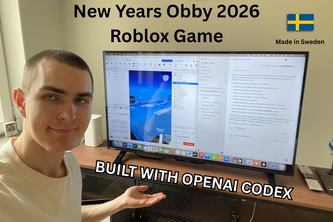
The project described by the author is a Roblox game titled New Years Obby 2026, built using OpenAI Codex and Luau in Roblox Studio. It is an interactive, multiplayer obstacle course (obby) that takes players through 12 countries representing each month of 2026, ending with a New Year 2027 celebration.
What changed
The author states they developed this as a personal project for the OpenAI 2026 hackathon. It evolved from a basic obby concept into a full experience with persistent progression, an economy (Shekels), shops, collectibles, and leaderboards.
Single most important open question — the commercial due-diligence read
There is no evidence of any commercial activity, revenue, or user base beyond the author’s own development. The project is self-reported as a hackathon submission with no indication of monetization, adoption, or traction. Is this a prototype or a product in development?
What The Product Actually Is
The description states that New Years Obby 2026 is a multiplayer Roblox game built using Luau scripting language, OpenAI Codex assistance, and tools like Roblox Studio, Rojo, and MCP. It is an interactive obstacle course (obby) where players traverse 12 countries, each corresponding to a month of 2026.
Key features include:
- Monthly progression through 12 countries
- Persistent gameplay systems (checkpoints, timers, deaths)
- Economy system with Shekels
- Shops for items, trails, power-ups
- Leaderboards and avatar podiums
- Mobile, PC, and controller support
- Anti-exploit validation
The author claims to have used AI coding assistance for development, debugging, and improving systems, while also manually testing and correcting AI-generated code.
Inference: The product is a self-contained game experience built on the Roblox platform. It is not a SaaS or software-as-a-service offering but a game-based entertainment product.
Positioning & Claim Evolution
The author positions New Years Obby 2026 as:
- A year-long interactive journey through 12 countries
- A multiplayer obstacle course with persistent progression and economy
- A personal hackathon project that evolved into a full game experience
There is no evidence of branding, marketing, or positioning beyond the author's own description. The project does not appear to be positioned for commercial release or user acquisition.
Inference: This is a personal creative endeavor, likely built as part of a hackathon challenge. It lacks any commercial positioning or market strategy.
Target Customer & ICP
The author states that the game is intended for Roblox players who enjoy obstacle courses and multiplayer experiences. The game includes:
- Multiplayer support
- Leaderboards
- Collectibles and rewards
- Economy system (Shekels)
There is no evidence of a defined customer segment beyond general Roblox users or players interested in themed, long-form games.
Inference: The target audience is likely Roblox users, particularly those who enjoy multiplayer obstacle courses. No specific ICP or segmentation data is provided.
Business Model & Pricing Evidence
The description does not contain any information about:
- Revenue streams
- Pricing models
- Monetization strategy
- Paid features or in-game purchases
The game includes an economy system (Shekels) and shops, but no details are given on how players acquire or spend Shekels, or whether the game is free-to-play or paid.
Inference: No business model or pricing evidence is provided. The project may be free-to-play with in-game purchases, but this is not stated.
Technical & Delivery Signals
The author reports:
- Development in Roblox Studio using Luau
- Use of OpenAI Codex for development and debugging
- Tools like Rojo, MCP, and DataStore for synchronization and persistence
- Systems for server validation, anti-exploit checks, and multiplayer testing
- Manual testing and correction of AI-generated code
Inference: The project shows technical maturity in terms of multiplayer systems, data handling, and AI-assisted development. However, no evidence of production deployment or scalability is provided.
Traction & Maturity Signals
There is no evidence of:
- User base
- Revenue or monetization
- Customer adoption
- Product usage metrics
- Public release or distribution
The project is described as a personal hackathon submission, and the author does not mention any public availability, downloads, or engagement.
Inference: No traction or maturity signals are evident. The product appears to be in early development or prototype stage.
Competitive Context
The description does not include:
- Competitor analysis
- Market positioning
- Comparison with other Roblox games or obstacle courses
The author does not reference similar products or platforms, nor does the project appear to be part of a larger ecosystem or marketplace.
Inference: No competitive context is provided. The project appears to be standalone and unpositioned within a broader market.
Open Questions & Risks
- No commercial traction or revenue: The project is described as a personal hackathon effort with no evidence of monetization.
- Unverified claims: All information is self-reported, with no independent validation.
- Prototype nature: No indication of product release, user feedback, or iteration beyond the author’s own testing.
- AI dependency: Heavy reliance on AI for development raises questions about long-term maintainability and scalability without human oversight.
Inference: The project lacks commercial viability or traction. It is a personal creative effort with no evidence of market readiness.
Questions the description leaves open
- Is this project intended to be released publicly, or is it a prototype?
- Has the game been tested by others beyond the author?
- Are there any plans for monetization or user engagement beyond the current features?
- How does the AI-assisted development workflow scale or integrate with future updates?
- What are the long-term goals for this project, if any?
Overall Assessment
There is no evidence of:
- Revenue
- Customers
- Traction
- Commercial viability
- Product-market fit
The project is described as a personal hackathon submission, not a commercial product or business. It is a self-contained game development effort with no indication of monetization, user base, or market strategy.
Inference: This is not a viable investment or partnership opportunity at this time. It is a creative prototype without commercial evidence or traction.
User Stories BotA demo video on every pull request
Get a demo video on every new feature
GitHub App that watches your pull requests and records a narrated, captioned demo.
Save time on demo prep and make informed decisions faster with a video walkthrough of every new feature.
Source
Submitted to the OpenAI 2026 hackathon on Devpost. Project home on Devpost. Back to the full gallery on Devpost.
This competitive analysis was produced by top-founders.com (opens in a new tab)
Generated by a language model from this project's public Devpost page — its tagline, the author's own write-up and any built-with tags listed there — as captured in August 2026. Short quotations are the author's words. It is an opinion on the idea as a business, not on the people behind it, and it reflects the description as published then. If the project has moved on, request a correction below. The analysis is not independent research and contains no verified traction, revenue or customer data.
An independent guide by KFG International LLC — not affiliated with, endorsed by, or connected to Devpost or OpenAI.