

Archive position — measured, not model output
0 likes on Devpost
2,263 of the 7,850 archived projects have more likes, and 5,587 share exactly 0 — so this project's #5,512 place in the like-ranked listing is a tie-break inside that group, not a ranking.
Projects (log scale)
Likes on Devpost. ▲ marks this project's group.
Show the figures
| Likes | Projects | Share of archive |
|---|---|---|
| 0 | 5,587 | 71.2% |
| 1 | 1,758 | 22.4% |
| 2 | 284 | 3.6% |
| 3–4 | 132 | 1.7% |
| 5–9 | 75 | 1.0% |
| 10+ | 14 | 0.2% |
 User Stories BotA demo video on every pull request
Get a demo video on every new feature
GitHub App that watches your pull requests and records a narrated, captioned demo.
Save time on demo prep and make informed decisions faster with a video walkthrough of every new feature.
Executive Summary
Company: NESTOR
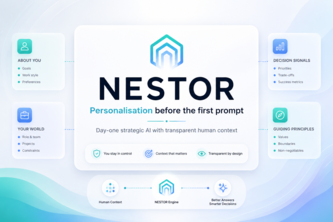
Self-reported purpose: A system that enables AI agents to provide personalized decision support by using a pre-defined Human Context Passport before the first prompt, without relying on behavioral inference or clinical diagnosis.
Change from prior state: The author describes an evolution from personal experimentation with a framework (Soft Screen X-RAY®) into a prototype product concept that separates identity from context for privacy-preserving AI interaction.
Single most important open question: Does the described approach to pre-prompt personalization offer a meaningful advantage over standard prompting techniques, and can it scale beyond synthetic demonstrations?
This is a self-reported, unverified account of a prototype submitted to an OpenAI hackathon. No evidence of revenue, customers, or traction exists in the description.
What The Product Actually Is
The description states that NESTOR is a system designed to provide personalized AI decision support by supplying structured human context before the first prompt. This context comes from a "Human Context Passport" which contains synthetic signals about user preferences and decision-making style.
- The system uses a JSON-based structure for the Human Context Passport.
- It separates authentication, identity mapping, and context authorization into distinct functions.
- It is built using Next.js, React, TypeScript, Node.js, and integrates with OpenAI's GPT-5.6 API.
- The prototype includes a browser interface where users can select which signals to enable for a given task.
- Responses are generated via two parallel OpenAI API calls: one baseline (no context) and one with enabled synthetic context.
Inference: The system appears to be a proof-of-concept demonstration rather than a production-ready product, as it relies on synthetic data and is described as part of an OpenAI Build Week prototype.
Positioning & Claim Evolution
The author positions NESTOR as an alternative to traditional AI personalization methods that rely on behavioral learning over time. The key claim is that NESTOR starts with objective human understanding before the first prompt, enabling immediate personalized decision support.
- The system claims not to use behavioral surveillance or clinical diagnosis.
- It emphasizes user control and transparency in how context is applied.
- It introduces a privacy-by-design architecture that separates identity from AI interaction.
- The author frames this as a way to improve relevance while maintaining privacy and autonomy.
Inference: The positioning reflects an attempt to differentiate from mainstream AI personalization models by focusing on pre-defined, user-controlled signals rather than model-based inference. However, the description does not demonstrate whether this approach actually improves outcomes or is more effective than standard prompting.
Target Customer & ICP
The description does not clearly define a specific customer segment or ideal customer profile (ICP). It suggests that NESTOR could be used by individuals who want to interact with AI agents in a more controlled and personalized way, particularly when making decisions involving risk or commitment.
- The system is presented as useful for people who value privacy and control over their data.
- It implies potential use cases around business decision-making, especially those requiring structured evaluation and risk management.
- No explicit mention of enterprise users, developers, or specific industries.
Inference: While the product targets individuals seeking personalized AI assistance, there is no clear indication of a defined target persona or market segment beyond general users interested in privacy-preserving tools.
Business Model & Pricing Evidence
There is no evidence provided regarding pricing, monetization strategy, or business model. The project is described as a prototype submitted to a hackathon, with no mention of any commercial activity, sales channels, or revenue streams.
Not evidenced: No information on how NESTOR would generate value for users or the company.
Technical & Delivery Signals
The system is built using modern web technologies including:
- Frontend: React, Next.js, Tailwind CSS
- Backend: Node.js, Vercel
- Language Model: GPT-5.6 (via OpenAI API)
- Data Handling: Zod schemas for validation, JSON fixtures, structured outputs
Key technical features include:
- Server-side validation of user-selected signals
- Parallel processing of baseline and NESTOR responses
- Deterministic logic for generating explanation panels (Context Used, Personalisation Delta, Evaluation)
- Strict error handling and safe diagnostics to prevent logging sensitive data
- Use of Codex during development for scaffolding and automation
Inference: The architecture shows a focus on reliability, security, and transparency. However, the prototype is limited by its use of synthetic data and does not yet demonstrate scalability or integration into real-world workflows.
Traction & Maturity Signals
The description indicates that this is a prototype submitted to an OpenAI Build Week hackathon. It includes:
- A live demonstration comparing baseline vs NESTOR responses
- Five consecutive successful live comparisons in controlled testing
- Use of automated tests (Vitest), schema validation (Zod), and structured outputs
However, there is no evidence of:
- Real-world usage or adoption
- Revenue or customer base
- Product-market fit or user feedback
- Production deployment beyond the demo environment
Inference: The project shows early-stage development maturity with a functional prototype but lacks any indication of traction or commercial viability.
Competitive Context
The description does not provide information about competitors or similar products in the market. It focuses on NESTOR’s unique positioning around pre-prompt personalization and privacy-by-design principles, but does not reference existing tools or platforms that address similar needs.
Not evidenced: No competitive landscape analysis or comparison with other AI personalization systems.
Open Questions & Risks
- Lack of real-world validation: The system is based entirely on synthetic data and has not been tested in actual use cases.
- Unclear scalability: The prototype uses a small team (one member) and limited infrastructure; no indication of how it would scale.
- Privacy claims without implementation details: While the architecture separates identity from AI interaction, there are no concrete mechanisms described for production-level privacy enforcement.
- No commercialization path: No evidence of monetization strategy or business model beyond the prototype.
- Dependency on external APIs: Reliance on OpenAI’s GPT-5.6 API limits control and introduces dependency risks.
Questions the description leaves open
- What specific improvements in decision quality or relevance have you observed in the synthetic tests compared to baseline prompts?
- How do you plan to transition from synthetic data to real human context without compromising privacy or accuracy?
- What are your plans for integrating Soft Screen X-RAY® into the system, and how will it be validated?
- Have you considered how users might perceive and trust the pre-defined signals in the Human Context Passport?
- How do you intend to measure success beyond the current demonstration?
- What is the roadmap for moving from prototype to production-ready product?
Overall Assessment
Confidence Level: Low
Assessment: This is a self-reported prototype submitted as part of an OpenAI hackathon. It presents an interesting idea around privacy-preserving AI personalization but lacks evidence of traction, revenue, or real-world adoption.
The concept may have potential for further development, particularly if the author can demonstrate measurable benefits over standard prompting techniques and establish a clear path to production deployment. However, at this stage, it is not ready for investment or partnership consideration without additional validation and evidence of progress beyond the prototype phase.
Note: This analysis is based solely on the self-reported project description provided by the caller. No external verification or historical data was used.
User Stories BotA demo video on every pull request
Get a demo video on every new feature
GitHub App that watches your pull requests and records a narrated, captioned demo.
Save time on demo prep and make informed decisions faster with a video walkthrough of every new feature.
Source
Submitted to the OpenAI 2026 hackathon on Devpost. Project home on Devpost. Back to the full gallery on Devpost.
This competitive analysis was produced by top-founders.com (opens in a new tab)
Generated by a language model from this project's public Devpost page — its tagline, the author's own write-up and any built-with tags listed there — as captured in August 2026. Short quotations are the author's words. It is an opinion on the idea as a business, not on the people behind it, and it reflects the description as published then. If the project has moved on, request a correction below. The analysis is not independent research and contains no verified traction, revenue or customer data.
An independent guide by KFG International LLC — not affiliated with, endorsed by, or connected to Devpost or OpenAI.