

Archive position — measured, not model output
0 likes on Devpost
2,263 of the 7,850 archived projects have more likes, and 5,587 share exactly 0 — so this project's #5,513 place in the like-ranked listing is a tie-break inside that group, not a ranking.
Projects (log scale)
Likes on Devpost. ▲ marks this project's group.
Show the figures
| Likes | Projects | Share of archive |
|---|---|---|
| 0 | 5,587 | 71.2% |
| 1 | 1,758 | 22.4% |
| 2 | 284 | 3.6% |
| 3–4 | 132 | 1.7% |
| 5–9 | 75 | 1.0% |
| 10+ | 14 | 0.2% |
 User Stories BotA demo video on every pull request
Get a demo video on every new feature
GitHub App that watches your pull requests and records a narrated, captioned demo.
Save time on demo prep and make informed decisions faster with a video walkthrough of every new feature.
Executive Summary
What the company appears to be: Netbrowse Voice is an AI-powered VoIP communication platform built around Asterisk, intended for small businesses and organisations needing affordable yet powerful telephony systems. The author states it aims to simplify PBX administration through a web-based interface and integrate AI receptionists into call routing.
What changed: This project began as a hackathon submission exploring the use of large language models (LLMs) in Asterisk-based PBX systems, with an emphasis on creating an AI receptionist without relying on third-party services like Elevelabs. It is described as a modular system built for deployment on Ubuntu, with plans to support FreePBX integration and mobile dialers.
Single most important open question: Is there any evidence of actual product-market fit or early traction from users beyond the author’s own development efforts?
Note: All claims are self-reported by the author. No independent verification exists. There is no evidence of revenue, customers, funding, or adoption beyond what is described in this submission.
What The Product Actually Is
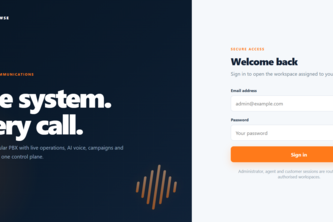
The description states that Netbrowse Voice is a modern, AI-powered VoIP and business communication platform built around Asterisk. It includes:
- A web-based control panel for managing extensions, users, call routes, ring groups, queues, recordings, billing, and live activity.
- AI receptionists that answer calls, speak naturally, collect information, and transfer to humans when needed.
- Support for:
- AI-generated voice prompts
- Call recordings and downloadable history
- Live call monitoring
- Automated outbound dialling
- Email notifications after calls
- Exporting data to spreadsheets or Google Sheets
- Modular addon system
- Integration with external PBX systems such as FreePBX
It is built using technologies including Asterisk, Node.js, TypeScript, HTML5/CSS3, JavaScript, Bash, Linux (Ubuntu), SIP, REST APIs, and AI tools like LLMs.
Inference: The platform appears to be a hybrid system combining traditional telephony infrastructure with modern web UI and AI capabilities. It is not a standalone product but rather an extension or alternative to existing PBX systems.
Positioning & Claim Evolution
The author positions Netbrowse Voice as:
- A simplified, user-friendly replacement for legacy PBX systems like FreePBX and FusionPBX.
- An AI-first approach to telephony that integrates artificial intelligence directly into the phone system rather than adding it later.
- A tool designed for non-technical users who want an affordable yet powerful communication solution.
Key claims include:
- The ability to create AI receptionists without using third-party platforms (e.g., Elevelabs).
- Leveraging ChatGPT 5.6 for voice agent functionality.
- Building a modular system that allows future feature additions without rebuilding the whole application.
- Supporting both full PBX use cases and partial integrations with existing systems.
Inference: The positioning reflects a shift from traditional, complex PBX setups toward a more accessible, AI-enhanced platform. However, there is no evidence of market validation or customer feedback to support these claims.
Target Customer & ICP
The author states that Netbrowse Voice is intended for:
- Small businesses
- Call centres
- Support teams
- Schools
- Healthcare facilities
- Organisations needing an affordable but powerful communication system
It targets users who may lack technical expertise in Linux or Asterisk configuration and want a clean, web-based interface to manage their telephony needs.
Inference: The ICP seems to be non-technical business owners or IT administrators looking for low-friction PBX solutions. However, no evidence exists of actual customer segments or personas defined by the author.
Business Model & Pricing Evidence
There is no mention of pricing models, monetisation strategies, or revenue streams in the description.
The author mentions:
- A reseller portal and standard customer panel.
- Plans to develop a DID marketplace.
- AI usage billing options (credits, allowances, flat monthly add-ons, per-minute pricing).
- Commercial modules with an app store for developers.
Inference: The business model appears to be evolving from a developer-centric tool into one that could include subscription-based services, marketplace fees, and module sales. However, no concrete details are provided about how this will be monetised.
Technical & Delivery Signals
The platform is built using:
- Asterisk as the core telephony engine
- Ubuntu as the OS environment
- Node.js, TypeScript, JavaScript, HTML5/CSS3 for frontend/backend
- Bash scripting and systemd for deployment automation
- AI tools like LLMs, speech-to-text, text-to-speech
Key technical features include:
- Modular architecture with separate components for web interface, API, telephony services, and module development tools.
- Automated installer script to prepare servers and configure applications.
- Integration between Asterisk and AI agents via SIP protocols.
- Support for Raspberry Pi and VPS deployments.
Inference: The technical approach shows a clear understanding of VoIP systems and modular software design. However, the lack of production data or performance metrics limits confidence in scalability or reliability.
Traction & Maturity Signals
There is no evidence of traction, customers, or adoption beyond the author’s own development work.
The project was submitted to the OpenAI 2026 hackathon and described as a "just started" exploration. The author notes:
- It began with experiments using ChatGPT 5.6.
- The AI receptionist functionality is still under development.
- Planned features include mobile dialers, FreePBX connector, DID marketplace, and outbound campaigns.
Inference: This is an early-stage prototype or proof-of-concept. No evidence of real-world usage or user feedback exists.
Competitive Context
The author references:
- Legacy PBX systems like FreePBX and FusionPBX.
- Third-party AI services such as Elevelabs.
- Other VoIP platforms that may offer similar features (e.g., Asterisk-based solutions).
No direct competitors are named, nor is there any indication of competitive positioning or differentiation in the market.
Inference: The competitive landscape likely includes established PBX vendors and open-source alternatives. However, no evidence exists to assess how Netbrowse Voice would compete or differentiate itself.
Open Questions & Risks
Several risks and open questions are evident from the description:
- Unproven commercial viability: No revenue, customers, or traction data.
- Technical complexity: Integrating Asterisk with AI agents presents significant engineering challenges, especially around latency and call quality.
- Security concerns: Deployment issues related to permissions and service access were noted during development.
- Lack of independent validation: All claims are self-reported; no third-party verification exists.
- Unclear monetisation path: While plans exist for billing and marketplace features, no clear roadmap or business model is presented.
Inference: The project lacks commercial maturity and market validation. It remains largely experimental and untested in real-world conditions.
Questions the description leaves open
- What specific problems are you solving that existing PBX systems don’t address?
- How do you plan to validate demand for this product before launching?
- Have you tested the AI receptionist with actual users or simulated conversations?
- What is your timeline and strategy for monetising the platform?
- Are there any partnerships or integrations already in place with DID providers or telecom carriers?
- Can you demonstrate a working prototype or alpha version of the platform?
- How do you plan to handle compliance, especially around data privacy and telecommunications regulations?
Overall Assessment
Not evidenced
There is insufficient evidence to assess whether Netbrowse Voice has investment potential or strategic value for partnership. The project is described as a hackathon submission with no demonstrated traction, revenue, or customer base.
Confidence Level: Very low — based entirely on self-reported claims and unverified assertions. No data supports commercial viability or scalability.
User Stories BotA demo video on every pull request
Get a demo video on every new feature
GitHub App that watches your pull requests and records a narrated, captioned demo.
Save time on demo prep and make informed decisions faster with a video walkthrough of every new feature.
Source
Submitted to the OpenAI 2026 hackathon on Devpost. Project home on Devpost. Back to the full gallery on Devpost.
This competitive analysis was produced by top-founders.com (opens in a new tab)
Generated by a language model from this project's public Devpost page — its tagline, the author's own write-up and any built-with tags listed there — as captured in August 2026. Short quotations are the author's words. It is an opinion on the idea as a business, not on the people behind it, and it reflects the description as published then. If the project has moved on, request a correction below. The analysis is not independent research and contains no verified traction, revenue or customer data.
An independent guide by KFG International LLC — not affiliated with, endorsed by, or connected to Devpost or OpenAI.