

Archive position — measured, not model output
1 like on Devpost
505 of the 7,850 archived projects have more likes, and 1,758 share exactly 1 — so this project's #1,589 place in the like-ranked listing is a tie-break inside that group, not a ranking.
Projects (log scale)
Likes on Devpost. ▲ marks this project's group.
Show the figures
| Likes | Projects | Share of archive |
|---|---|---|
| 0 | 5,587 | 71.2% |
| 1 | 1,758 | 22.4% |
| 2 | 284 | 3.6% |
| 3–4 | 132 | 1.7% |
| 5–9 | 75 | 1.0% |
| 10+ | 14 | 0.2% |
 User Stories BotA demo video on every pull request
Get a demo video on every new feature
GitHub App that watches your pull requests and records a narrated, captioned demo.
Save time on demo prep and make informed decisions faster with a video walkthrough of every new feature.
Executive Summary
What the company appears to be
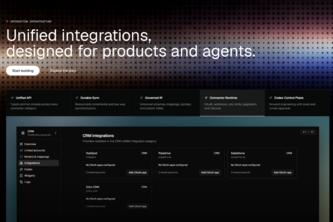
OpenMerge is described as a Unified Integration iPaaS (integration platform as a service) designed for products and agents. The author claims it includes a 2-way type-safe Sync Engine, built-in de-duplication, APIs, SDKs, and hosted widgets. It is positioned as a multi-tenant application enabling users to connect to multiple platforms (CRM, accounting, ATS, HRIS, etc.) with managed infrastructure and AI-assisted forward engineering.
What changed
The project was self-built over 4 days using AI tools like GPT-5.6 Sol High and Codex, with minimal human-coded lines of code. The author states this was an experiment in AI-driven development, resulting in a large-scale application that they claim could have taken months to build manually.
Single most important open question
Is there any evidence of real-world usage or product-market fit beyond the author’s own testing and internal use?
What The Product Actually Is
The description states that OpenMerge is:
- A Unified Integrations Backend iPaaS
- Designed for products and agents
- Includes a 2-way type-safe Sync Engine
- Has built-in de-duplication, APIs, SDKs, and hosted widgets
- Operates as a multi-tenant application
- Allows users to connect to platforms like CRM, accounting, ATS, HRIS, Ticketing/Knowledge Base
- Provides fully managed infrastructure for sync operations
- Uses AI to modify IRs, mappings, data types, evals, and automate forward engineering via a live agent harness
The author also says the system was built using AI tools (GPT-5.6 Sol High, Codex) with minimal human coding, and that it includes SDKs hosted on npm.
Inference This appears to be an integration backend platform aimed at developers or product teams who need to manage complex integrations across multiple systems, possibly with a focus on AI-assisted configuration and maintenance.
Positioning & Claim Evolution
The author positions OpenMerge as:
- A Unified Integration iPaaS
- Possibly the most radical idea since OpenClaw
- An application where AI modifies code/runtime via agent harness
- A tool for tailoring apps, updates & forward engineering for everyone
It is described as a symbiotic app that uses AI to automate time-consuming tasks like schema mapping and data type handling.
Inference The positioning evolves from a simple integration platform into something more ambitious — an AI-powered system that modifies runtime behavior and automates complex engineering tasks. However, this is presented as a vision or concept rather than a realized product with traction.
Target Customer & ICP
The description states:
- OpenMerge is designed for products and agents
- It allows users to connect to platforms like CRM, accounting, ATS, HRIS, Ticketing/Knowledge Base
Inference The primary target customer seems to be software developers or product teams building integrations, especially those managing multiple third-party services. The ICP likely includes SaaS companies with integration-heavy products or internal engineering teams needing robust sync capabilities.
Business Model & Pricing Evidence
There is no evidence of pricing, monetization strategy, or business model in the description.
Not evidenced
Technical & Delivery Signals
The author states:
- Built using GPT-5.6 Sol High and Codex
- Used AI agents for scaffolding, testing, validation
- Developed without writing more than 70 lines of actual code
- Application includes SDKs hosted on npm
- Uses a range of technologies including: clickhouse, codex, elasticsearch, fastapi, golang, mongodb, mq, nextjs, postgresql, python, redis, socket.io, tailwind, typescript
Inference The technical stack suggests a full-stack SaaS product with backend services, data storage, and frontend components. The use of AI in development indicates a novel approach to engineering but does not confirm product maturity or scalability.
Traction & Maturity Signals
The author states:
- Built while working a full-time job
- Has a "decent user base" for a related GTM Data SaaS (not named)
- The OpenMerge project itself is described as a proof-of-concept
- It was built in 4 days using AI tools
- Not yet tested in production with real users
Not evidenced
Competitive Context
The description does not mention any competitors or direct market comparisons.
Not evidenced
Open Questions & Risks
- The entire product was built by one person (Nishant Nath) using AI tools — no team, no external validation
- No evidence of revenue, customers, or real-world usage beyond the author’s own testing
- The project is described as a hackathon submission, not a commercial product
- The author claims to have used AI extensively but does not provide any details on how this affects reliability or maintainability
- There is no mention of security, scalability, or performance testing in production
Inference This is a highly experimental project with limited evidence of real-world application. It lacks the validation and infrastructure needed for commercial viability.
Questions the description leaves open
- What is the actual user base of the GTM Data SaaS mentioned? Is it generating revenue?
- Has OpenMerge been tested in production with real users or integrations?
- How does the AI-assisted development process ensure code quality and maintainability?
- Are there any plans to monetize OpenMerge, and if so, what is the business model?
- What are the technical limitations of relying on AI for such a complex system?
- Is there any documentation or support available for developers using OpenMerge?
Overall Assessment
The description presents OpenMerge as an experimental, AI-driven integration platform, built in 4 days by one individual using advanced AI tools. There is no evidence of revenue, customers, traction, or commercial viability beyond the author’s own use and testing.
Confidence: Low
This is a conceptual prototype, not a product with demonstrated market demand or scalability. While the technical approach is intriguing, there are no signs of real-world adoption or proven business model. Any investment or partnership would be highly speculative at this stage.
User Stories BotA demo video on every pull request
Get a demo video on every new feature
GitHub App that watches your pull requests and records a narrated, captioned demo.
Save time on demo prep and make informed decisions faster with a video walkthrough of every new feature.
Source
Submitted to the OpenAI 2026 hackathon on Devpost. Project home on Devpost. Back to the full gallery on Devpost.
This competitive analysis was produced by top-founders.com (opens in a new tab)
Generated by a language model from this project's public Devpost page — its tagline, the author's own write-up and any built-with tags listed there — as captured in August 2026. Short quotations are the author's words. It is an opinion on the idea as a business, not on the people behind it, and it reflects the description as published then. If the project has moved on, request a correction below. The analysis is not independent research and contains no verified traction, revenue or customer data.
An independent guide by KFG International LLC — not affiliated with, endorsed by, or connected to Devpost or OpenAI.