

Archive position — measured, not model output
0 likes on Devpost
2,263 of the 7,850 archived projects have more likes, and 5,587 share exactly 0 — so this project's #5,476 place in the like-ranked listing is a tie-break inside that group, not a ranking.
Projects (log scale)
Likes on Devpost. ▲ marks this project's group.
Show the figures
| Likes | Projects | Share of archive |
|---|---|---|
| 0 | 5,587 | 71.2% |
| 1 | 1,758 | 22.4% |
| 2 | 284 | 3.6% |
| 3–4 | 132 | 1.7% |
| 5–9 | 75 | 1.0% |
| 10+ | 14 | 0.2% |
 User Stories BotA demo video on every pull request
Get a demo video on every new feature
GitHub App that watches your pull requests and records a narrated, captioned demo.
Save time on demo prep and make informed decisions faster with a video walkthrough of every new feature.
Executive Summary
What the company appears to be
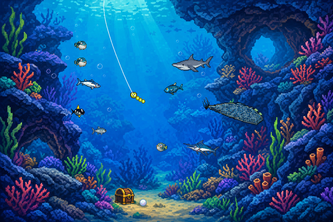
Nate the Bait is a self-reported native iOS arcade game built as a hackathon project. The description states it is a portrait-first game in which players control a character named Nate, navigating an ocean environment, catching creatures, collecting items, and making tactical decisions about how far to dive. It includes features like 96 species with distinct behaviors, offline persistence, Game Center integration, and accessibility support.
What changed
The project was submitted as part of the OpenAI 2026 hackathon. No evidence indicates prior existence or development history beyond this submission.
Single most important open question
Is there any evidence of commercial traction, monetization strategy, or user engagement beyond the internal TestFlight build and developer claims?
What The Product Actually Is
The description states that Nate the Bait is a portrait-first native iOS arcade game. It involves:
- Steering a character named Nate through a "continuously streamed pixel ocean"
- Catching fish, collecting pearls and treasure
- Making tactical choices about diving deeper or securing rewards
- Using abilities like Sonar Pop, Bubble Shield, and Pearl Rush
The game includes:
- An Ocean Dex with 96 species
- Cave-crawling crabs, hidden chests, and pearls
- Daily Expeditions, leaderboards, achievements, and customization options
- Offline functionality for progress and rewards
- Integration with GameKit for leaderboards and achievements
It is built using Swift 6, SwiftUI, SpriteKit, and other tools including Codex and GPT-5.6.
Not evidenced No information on revenue model, pricing, customer base, or monetization strategy.
Positioning & Claim Evolution
The description states the team wanted to create a game they would have loved as kids — one that feels playful immediately but reveals complexity over time. The core idea is rooted in the reversal of a fishing scenario: Nate is bait, but the player gives him a chance to explore instead.
Key positioning claims:
- A "tiny living ocean"
- A "native iOS arcade adventure"
- A game with "endless reefs" and "96 species"
- Designed for playfulness, exploration, and tactical depth
The project is positioned as a self-contained, offline-first experience, without ads or in-app purchases.
Inference This suggests an emphasis on immersive gameplay, replayability, and player agency, rather than monetization through microtransactions or advertising.
Target Customer & ICP
The description does not clearly define a target customer or ideal customer profile (ICP). It implies the game is for players who enjoy:
- Arcade-style games
- Exploration and discovery
- Tactical decision-making
It also mentions accessibility features, suggesting an audience that values inclusive design.
Not evidenced No demographic data, user personas, or market segmentation.
Business Model & Pricing Evidence
The description states the game is offline-first, with no ads or in-app purchases. It includes:
- Daily Expeditions
- Customization options
- Leaderboards and achievements
There is no mention of a pricing model, monetization strategy, or revenue streams.
Not evidenced No evidence of sales figures, pricing tiers, or commercial viability.
Technical & Delivery Signals
The game is built using:
- Swift 6
- SwiftUI (for UI navigation, HUD, Ocean Dex, rewards, shop, results)
- SpriteKit (for ocean simulation, terrain streaming, fish, cave collision, tether, currents, effects)
- GameKit (for leaderboards and achievements)
- Codex + GPT-5.6 for feedback loops, code generation, testing, and verification
Key technical features:
- Deterministic world by seed
- Streamed terrain with stable identities
- Texture atlases and alpha masks
- Fixed actor/node pools for performance
- 1,040 core, unit, integration tests + 40 UI tests in Build 29
Inference The team prioritized performance, reproducibility, and quality control, especially around gameplay mechanics and visual fidelity.
Traction & Maturity Signals
The project is described as a hackathon submission. It includes:
- A build delivered to TestFlight Internal QA (Build 29)
- 1,040+ tests across 87 suites
- 40 UI tests
- External TestFlight pass planned
There is no evidence of:
- User adoption or retention metrics
- Public release or distribution
- Customer feedback or reviews
- Revenue or monetization
Not evidenced No data on user engagement, downloads, or commercial traction.
Competitive Context
The description does not provide any information about competitors or market positioning. It is unclear whether the game competes with other iOS arcade games, mobile exploratory titles, or niche indie experiences.
Not evidenced No competitive analysis, market size, or differentiation from existing products.
Open Questions & Risks
- Unverified claims: All information is self-reported and unverified.
- No commercial traction: No evidence of users, sales, or monetization.
- Limited scope: Built as a hackathon project; no indication of long-term development plans.
- Unclear path to market: No mention of distribution strategy or marketing plan.
- AI dependency: Heavy reliance on AI tools (Codex + GPT-5.6) raises questions about scalability and team autonomy.
Inference This is a conceptual prototype, not a product in the market, with no evidence of commercial viability or user engagement.
Questions the description leaves open
- What is the current status of the game beyond TestFlight QA?
- Are there any plans for public release or distribution?
- How does the team intend to monetize the game if at all?
- Has the team validated gameplay with real users outside of internal testing?
- What are the long-term development goals and roadmap?
- Is there a plan for ongoing support, updates, or community engagement?
Overall Assessment
Not evidenced No data on financials, traction, or commercial potential.
Confidence level Very low — this is a self-reported hackathon project, with no evidence of revenue, customers, or market validation. The description indicates a strong technical foundation and attention to detail, but lacks any indication of commercial readiness or scalability.
Conclusion
This appears to be an early-stage prototype with no demonstrated traction or monetization strategy. It is not ready for investment or partnership consideration without further evidence of product-market fit, user engagement, or business model development.
User Stories BotA demo video on every pull request
Get a demo video on every new feature
GitHub App that watches your pull requests and records a narrated, captioned demo.
Save time on demo prep and make informed decisions faster with a video walkthrough of every new feature.
Source
Submitted to the OpenAI 2026 hackathon on Devpost. Project home on Devpost. Back to the full gallery on Devpost.
This competitive analysis was produced by top-founders.com (opens in a new tab)
Generated by a language model from this project's public Devpost page — its tagline, the author's own write-up and any built-with tags listed there — as captured in August 2026. Short quotations are the author's words. It is an opinion on the idea as a business, not on the people behind it, and it reflects the description as published then. If the project has moved on, request a correction below. The analysis is not independent research and contains no verified traction, revenue or customer data.
An independent guide by KFG International LLC — not affiliated with, endorsed by, or connected to Devpost or OpenAI.