

Archive position — measured, not model output
0 likes on Devpost
2,263 of the 7,850 archived projects have more likes, and 5,587 share exactly 0 — so this project's #7,439 place in the like-ranked listing is a tie-break inside that group, not a ranking.
Projects (log scale)
Likes on Devpost. ▲ marks this project's group.
Show the figures
| Likes | Projects | Share of archive |
|---|---|---|
| 0 | 5,587 | 71.2% |
| 1 | 1,758 | 22.4% |
| 2 | 284 | 3.6% |
| 3–4 | 132 | 1.7% |
| 5–9 | 75 | 1.0% |
| 10+ | 14 | 0.2% |
 User Stories BotA demo video on every pull request
Get a demo video on every new feature
GitHub App that watches your pull requests and records a narrated, captioned demo.
Save time on demo prep and make informed decisions faster with a video walkthrough of every new feature.
Executive Summary
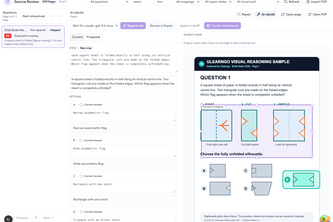
What the company appears to be: Ulearngo Verified Studio is a self-reported educational content creation tool that uses AI (specifically GPT-5.6) to reconstruct damaged exam PDFs into human-verified questions and visual lessons, with enforceable approval gates and deterministic rendering.
What changed: The project description indicates a shift from generic AI generation toward a structured workflow with two human approval steps: one for question reconstruction and another for lesson plan editing. It also introduces a focus on source provenance, immutable snapshots, and deterministic video output.
Single most important open question: Is there evidence of real-world adoption or traction beyond the hackathon demo? The description states no revenue, customers, or usage data exist beyond the author’s own account.
What The Product Actually Is
The description states that Ulearngo Verified Studio:
- Turns damaged exam PDFs into human-verified questions and source-grounded visual lessons.
- Uses GPT-5.6 for initial reconstruction of the question.
- Includes a two-step approval process:
- First, a human reviews and corrects the stem, options, answer, and visuals.
- Second, a human edits and approves the lesson plan.
- Compiles approved content into narrated MP4 videos with captions and a provenance manifest.
- Uses deterministic rendering via Chromium and FFmpeg to ensure reproducibility.
The system is built using TypeScript, React, Next.js, Playwright, Puppeteer, OpenAI APIs, and other technologies. It includes a monorepo structure and reusable video packages that validate evidence references and approval hashes before rendering.
Inference: The product appears to be a prototype or proof-of-concept for educational content generation with strong emphasis on human oversight and reproducibility.
Positioning & Claim Evolution
The description states:
- The project was built around the question: “What if AI generation had enforceable human approval and source provenance at every important step?”
- It positions itself as a tool that goes beyond speed to ensure trustworthiness in educational content.
- It emphasizes that human verification becomes valuable when it changes what the system is allowed to do — turning review into a compiler boundary.
Inference: The positioning evolved from a general-purpose AI tool to one focused on trust, reproducibility, and auditability in educational media creation. This reflects an intent to differentiate from unregulated generative tools by embedding human control and source tracking.
Target Customer & ICP
The description does not state who the target customer is or define an ideal customer profile (ICP).
Not evidenced: No mention of specific users, institutions, educators, or learners. The demo uses a geometry question but does not name any actual customers or use cases beyond the hackathon context.
Business Model & Pricing Evidence
The description does not provide evidence of a business model or pricing structure.
Not evidenced: There is no indication of how revenue would be generated, whether through subscriptions, per-use fees, licensing, or other mechanisms. No pricing information is included.
Technical & Delivery Signals
The description states:
- The system uses GPT-5.6 for content reconstruction.
- It leverages Playwright and Puppeteer for deterministic browser interaction.
- Video rendering is done with FFmpeg using Chromium captures.
- Content is validated through hashes and approval states before compilation.
- A real diagram renderer (
@ulearngo/diagrams) and interactive templates are used. - The system supports downloadable provenance manifests containing metadata, source hashes, and model routing.
Inference: The technical stack suggests a focus on reproducibility, validation, and deterministic outputs. The use of hashing and immutable snapshots indicates an intent to build trust in the generated content.
Traction & Maturity Signals
The description states:
- This is a hackathon submission (OpenAI 2026).
- It includes a public demo.
- Accomplishments include:
- A complete source-to-video workflow with two approval gates.
- Evidence anchors connecting every lesson scene to reviewed source material.
- A polished 48-second H.264/AAC lesson with captions and OpenAI narration.
- A downloadable provenance manifest.
- A deterministic Playwright judge journey.
Not evidenced: No evidence of revenue, customers, or adoption beyond the demo and hackathon submission. The project is described as a prototype, not a commercial product.
Competitive Context
The description does not provide any information about competitors or market positioning.
Not evidenced: No mention of existing tools in the educational content generation space, nor how Ulearngo Verified Studio compares to them.
Open Questions & Risks
- No traction evidence: The project is described as a hackathon submission with no real-world usage or revenue.
- Unverified claims: All descriptions are self-reported and unverified; there’s no third-party validation of the product’s functionality or impact.
- Limited scope: The demo uses only one example (a geometry question), suggesting limited application beyond that domain.
- Founder-only team: Only one member is listed, which may limit execution capacity for scaling or commercialization.
Questions the description leaves open
- What specific educational institutions or content creators are using this tool?
- How does the two-step approval process scale to larger volumes of content?
- Are there any plans to monetize or commercialize this beyond the hackathon?
- How do you plan to ensure consistent quality across different types of exam materials?
- What is your roadmap for expanding beyond the current deterministic video output?
Overall Assessment
The description states that Ulearngo Verified Studio is a self-reported prototype built for a hackathon. It shows technical sophistication in handling reproducibility, human review, and content validation but lacks evidence of traction, revenue, or customer adoption.
Assessment: Early-stage concept with strong technical execution and clear intent to address trust issues in AI-generated educational content. However, due to the lack of real-world data, commercial viability remains unproven. Not ready for investment or partnership without further evidence of product-market fit or traction.
User Stories BotA demo video on every pull request
Get a demo video on every new feature
GitHub App that watches your pull requests and records a narrated, captioned demo.
Save time on demo prep and make informed decisions faster with a video walkthrough of every new feature.
Source
Submitted to the OpenAI 2026 hackathon on Devpost. Project home on Devpost. Back to the full gallery on Devpost.
This competitive analysis was produced by top-founders.com (opens in a new tab)
Generated by a language model from this project's public Devpost page — its tagline, the author's own write-up and any built-with tags listed there — as captured in August 2026. Short quotations are the author's words. It is an opinion on the idea as a business, not on the people behind it, and it reflects the description as published then. If the project has moved on, request a correction below. The analysis is not independent research and contains no verified traction, revenue or customer data.
An independent guide by KFG International LLC — not affiliated with, endorsed by, or connected to Devpost or OpenAI.