

Archive position — measured, not model output
0 likes on Devpost
2,263 of the 7,850 archived projects have more likes, and 5,587 share exactly 0 — so this project's #5,386 place in the like-ranked listing is a tie-break inside that group, not a ranking.
Projects (log scale)
Likes on Devpost. ▲ marks this project's group.
Show the figures
| Likes | Projects | Share of archive |
|---|---|---|
| 0 | 5,587 | 71.2% |
| 1 | 1,758 | 22.4% |
| 2 | 284 | 3.6% |
| 3–4 | 132 | 1.7% |
| 5–9 | 75 | 1.0% |
| 10+ | 14 | 0.2% |
 User Stories BotA demo video on every pull request
Get a demo video on every new feature
GitHub App that watches your pull requests and records a narrated, captioned demo.
Save time on demo prep and make informed decisions faster with a video walkthrough of every new feature.
Executive Summary
Project: Moov
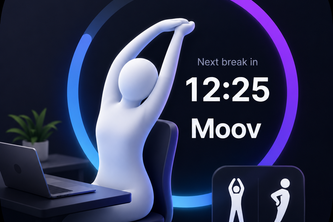
Author's self-description: A desktop application that helps people who sit all day protect their backs by enforcing short movement breaks every 30 minutes.
Key claim: Moov pauses the computer and ensures users complete a stretch before continuing work, using webcam-based movement detection via TensorFlow.js.
What changed: The project was submitted to the OpenAI 2026 hackathon as a personal solution to lower-back pain caused by long hours of sitting.
Single most important open question: Is there evidence that users actually adopt or engage with Moov’s break enforcement mechanism, or does it remain a prototype?
This is a self-reported, unverified account of a single-person project built for a hackathon. No revenue, customers, traction or commercial data are provided.
What The Product Actually Is
The description states that Moov is:
- A desktop application built with Tauri, Rust, JavaScript, HTML, CSS, and Vite.
- Designed to pause the computer screen every 30 minutes.
- Requires users to choose a stretch, step away from the screen, and hold the position for 10 seconds.
- Uses webcam input and TensorFlow.js to verify correct execution of the stretch.
- Includes a backup timed stretch if movement detection fails.
Inference: The app enforces a break via full-screen interruption and uses computer vision to validate user compliance. It is not a web or mobile product, but a desktop tool.
Positioning & Claim Evolution
The author states:
- Moov was inspired by personal experience with lower-back pain.
- It aims to prevent serious back problems by encouraging small daily movement breaks.
- The app seeks to replace dismissible notifications with enforced action.
- The goal is to help desk workers build a healthy habit before pain escalates.
Inference: Moov positions itself as a behavioral health tool, not a medical device or fitness tracker. It emphasizes enforcement over suggestion and targets sedentary professionals.
Target Customer & ICP
The description states:
- Moov is for people who sit all day.
- Specifically named groups: developers, remote workers, students, gamers.
- The app is intended for anyone who spends many hours in front of a screen.
Inference: The target customer profile is sedentary professionals, with an ICP that includes remote workers and developers. No evidence of segmentation beyond this.
Business Model & Pricing Evidence
The description states:
- Moov is a desktop application.
- It is built as a personal project for a hackathon.
- No pricing, monetization or business model details are provided.
Inference: There is no evidence of a commercial business model. The app appears to be a prototype with no stated revenue path.
Technical & Delivery Signals
The description states:
- Built using Tauri, Rust, JavaScript, HTML, CSS, Vite.
- Uses TensorFlow.js for webcam-based movement detection.
- Runs locally on the user’s device.
- Includes a backup timed stretch if camera access fails.
Inference: The app is technically self-contained and uses modern lightweight desktop development tools. It leverages AI for movement recognition, but no evidence of scalability or performance data.
Traction & Maturity Signals
The description states:
- Moov was built as a hackathon project.
- The team size is 1 person (Giress Kenn).
- No mention of user adoption, downloads, usage metrics, or feedback.
Inference: There is no evidence of traction or product-market fit. It remains a prototype with no commercial deployment or user base.
Competitive Context
The description states:
- Moov is a personal solution to a common problem.
- No direct competitors are named.
- The app aims to improve upon simple reminders, which are often ignored.
Inference: Moov likely competes with desktop-based break reminder tools or ergonomic habit trackers, but no evidence of existing market players or competitive positioning is provided.
Open Questions & Risks
The description states:
- The app uses webcam input, raising privacy concerns.
- Movement detection relies on TensorFlow.js, which may be inconsistent across devices.
- The user experience must balance helpfulness and annoyance.
- No fallback for camera access denial or model failure beyond a backup timer.
Inference: Key risks include:
- Privacy issues from webcam use.
- Technical fragility of movement detection.
- Low adoption if users find it too intrusive or unreliable.
- No commercial viability without a clear monetization path.
Questions the description leaves open
- Has the app been tested with real users, and what feedback did you receive?
- What is the expected user retention rate for the break enforcement feature?
- How does Moov handle edge cases like poor lighting or camera positioning?
- Are there plans to monetize the app, and if so, how?
- How do you plan to scale beyond a single-person hackathon project?
Overall Assessment
The description states:
- Moov is a personal hackathon project.
- No evidence of traction, revenue or commercial viability.
Inference: This is a pre-product-stage prototype, not a viable investment or partnership opportunity. It lacks any commercial signal, user data, or business model. The author’s own account does not suggest a path to product-market fit or scalability.
User Stories BotA demo video on every pull request
Get a demo video on every new feature
GitHub App that watches your pull requests and records a narrated, captioned demo.
Save time on demo prep and make informed decisions faster with a video walkthrough of every new feature.
Source
Submitted to the OpenAI 2026 hackathon on Devpost. Project home on Devpost. Back to the full gallery on Devpost.
This competitive analysis was produced by top-founders.com (opens in a new tab)
Generated by a language model from this project's public Devpost page — its tagline, the author's own write-up and any built-with tags listed there — as captured in August 2026. Short quotations are the author's words. It is an opinion on the idea as a business, not on the people behind it, and it reflects the description as published then. If the project has moved on, request a correction below. The analysis is not independent research and contains no verified traction, revenue or customer data.
An independent guide by KFG International LLC — not affiliated with, endorsed by, or connected to Devpost or OpenAI.