

Archive position — measured, not model output
0 likes on Devpost
2,263 of the 7,850 archived projects have more likes, and 5,587 share exactly 0 — so this project's #5,372 place in the like-ranked listing is a tie-break inside that group, not a ranking.
Projects (log scale)
Likes on Devpost. ▲ marks this project's group.
Show the figures
| Likes | Projects | Share of archive |
|---|---|---|
| 0 | 5,587 | 71.2% |
| 1 | 1,758 | 22.4% |
| 2 | 284 | 3.6% |
| 3–4 | 132 | 1.7% |
| 5–9 | 75 | 1.0% |
| 10+ | 14 | 0.2% |
 User Stories BotA demo video on every pull request
Get a demo video on every new feature
GitHub App that watches your pull requests and records a narrated, captioned demo.
Save time on demo prep and make informed decisions faster with a video walkthrough of every new feature.
Executive Summary
What the company appears to be
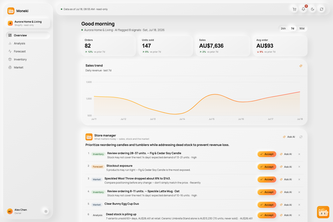
Moneki is a self-reported AI-powered operations copilot for retail and hospitality, built as a local demo application for an OpenAI hackathon. It includes functionality around sales forecasting, inventory planning, purchasing advice, and a dashboard. The product integrates with GPT-5.6 Sol for explanation of deterministic outputs.
What changed
The project description states that Moneki existed before Build Week (the hackathon), but the Scenario Planner — which uses GPT-5.6 Sol to explain calculations — was added during the competition period. This new component is described as a distinct feature built on top of an existing baseline.
The single most important open question
Is there any evidence that Moneki has moved beyond a hackathon demo, or whether it has traction, revenue, or customers in real-world use?
What The Product Actually Is
The description states that Moneki is a local retail operations workspace built around the fictional Aurora Home & Living store. It includes:
- A Scenario Planner to test demand changes, supplier lead times, and inventory budgets.
- Calculations performed deterministically before contacting an AI model.
- Integration with GPT-5.6 Sol for generating structured explanations of results.
- A dashboard built in React, served via FastAPI.
- Use of synthetic data for demonstration purposes.
The application is described as a local demo using Python 3.12, FastAPI, DuckDB, SQLite, and React. It does not appear to be a production-ready SaaS offering or connected to live commerce systems.
Evidence
- The product is built around a fictional store (Aurora Home & Living).
- It uses synthetic data for all operations.
- The Scenario Planner performs calculations first, then feeds results into GPT-5.6 Sol.
- No mention of real-world deployment or integration with live APIs beyond Shopify and Azure.
Inference The product is a prototype or demo, not a commercial offering.
Positioning & Claim Evolution
The author states that retail dashboards are good at showing what happened, but rarely help owners decide what to do next. Moneki aims to bridge this gap by providing daily insights, forecasts, and actionable advice.
It positions itself as an AI operations manager for retail and restaurant groups, offering:
- Sales forecasts
- Purchasing and restock advice
- Menu, cost, and pricing analysis
- Multi-store dashboard
The product is described as a local demo with no live commerce connectors or production integrations. The Scenario Planner was added during the hackathon.
Evidence
- Moneki is positioned as an AI operations manager for retail/hospitality.
- It includes features like forecasting, purchasing advice, and dashboards.
- The Scenario Planner is described as a new feature built during Build Week.
Inference The positioning is aspirational. No evidence of real-world adoption or commercial traction.
Target Customer & ICP
The description states that Moneki targets retail and restaurant groups, with a focus on independent retailers who may struggle with inventory decisions due to demand increases, supplier delays, or budget constraints.
It does not specify whether the target is small businesses, franchisees, or enterprise clients.
Evidence
- The product is aimed at retail and restaurant groups.
- It addresses challenges faced by independent retailers.
- No segmentation or customer personas are described.
Inference The ICP is likely small to mid-sized independent retailers or local chains. No evidence of a defined buyer persona or customer segment.
Business Model & Pricing Evidence
There is no evidence in the description of a business model, pricing structure, or monetization strategy.
Evidence
- No mention of subscriptions, per-user fees, or usage-based pricing.
- No indication of how Moneki would be sold or deployed to customers.
Inference The product is not yet commercialized. The business model remains undefined.
Technical & Delivery Signals
The application is built using:
- Backend: Python 3.12, FastAPI
- Frontend: React, compiled with esbuild
- Databases: DuckDB, SQLite
- AI Integration: GPT-5.6 Sol via OpenAI SDK
- Authentication: Google OAuth, Microsoft OAuth
- Other Tools: pandas, httpx, scrypt, shopify-api
The demo is self-contained and can be run locally using a moneki-demo command.
Evidence
- The application uses Python, FastAPI, React, DuckDB, SQLite.
- It integrates with GPT-5.6 Sol for explanations.
- No live commerce or production integrations are mentioned.
- The demo is designed to work without Node.js or external dependencies.
Inference The technical stack suggests a local prototype or internal tool, not a scalable SaaS platform.
Traction & Maturity Signals
There is no evidence of traction, revenue, customers, or adoption beyond the hackathon demo.
Evidence
- The product was built for a hackathon.
- It uses synthetic data and fictional stores.
- No real-world usage or customer feedback is reported.
- No mention of funding, headcount, or prior launches.
Inference The product is at an early stage — likely pre-product-market fit. No signs of commercial traction.
Competitive Context
The description does not provide information about competitors or the competitive landscape in retail operations or AI-powered planning tools.
Evidence
- No mention of existing solutions in the market.
- No comparison to other platforms or tools.
Inference No evidence of competitive positioning or awareness of existing players.
Open Questions & Risks
- Over-reliance on a single AI model: GPT-5.6 Sol is used for explanations, but fallbacks are described as deterministic.
- Limited scope and demo-only nature: The product is not commercialized and lacks real-world data or users.
- No monetization strategy: No indication of how the product would be sold or funded.
- Unverified claims: All descriptions are self-reported and unverified.
Evidence
- The product is a hackathon demo with no production use.
- No evidence of revenue, customers, or funding.
- AI integration is described as limited to explanation, not decision-making.
Inference The project lacks commercial viability or traction. It may be a proof-of-concept rather than a scalable business.
Questions the description leaves open
- What is the timeline for moving from this demo to a production-ready product?
- Are there any real-world users or pilot customers currently testing Moneki?
- How does the team plan to monetize the product, and what pricing model are you considering?
- What are the key assumptions in your forecasting and planning logic?
- Have you considered how to integrate with live commerce systems beyond Shopify?
- What is the long-term vision for AI integration — will it be used for decision-making or just explanation?
Overall Assessment
Not evidenced.
The project description provides no evidence of traction, revenue, customers, or commercial viability. It is a hackathon demo with no indication of real-world adoption or funding.
Confidence Low
Risk
High (demo-only, no monetization strategy)
Next Steps
If this is a pre-product-market-fit prototype, further diligence would require evidence of traction, customer feedback, or a clear path to commercialization.
User Stories BotA demo video on every pull request
Get a demo video on every new feature
GitHub App that watches your pull requests and records a narrated, captioned demo.
Save time on demo prep and make informed decisions faster with a video walkthrough of every new feature.
Source
Submitted to the OpenAI 2026 hackathon on Devpost. Project home on Devpost. Back to the full gallery on Devpost.
This competitive analysis was produced by top-founders.com (opens in a new tab)
Generated by a language model from this project's public Devpost page — its tagline, the author's own write-up and any built-with tags listed there — as captured in August 2026. Short quotations are the author's words. It is an opinion on the idea as a business, not on the people behind it, and it reflects the description as published then. If the project has moved on, request a correction below. The analysis is not independent research and contains no verified traction, revenue or customer data.
An independent guide by KFG International LLC — not affiliated with, endorsed by, or connected to Devpost or OpenAI.