

Archive position — measured, not model output
1 like on Devpost
505 of the 7,850 archived projects have more likes, and 1,758 share exactly 1 — so this project's #1,479 place in the like-ranked listing is a tie-break inside that group, not a ranking.
Projects (log scale)
Likes on Devpost. ▲ marks this project's group.
Show the figures
| Likes | Projects | Share of archive |
|---|---|---|
| 0 | 5,587 | 71.2% |
| 1 | 1,758 | 22.4% |
| 2 | 284 | 3.6% |
| 3–4 | 132 | 1.7% |
| 5–9 | 75 | 1.0% |
| 10+ | 14 | 0.2% |
 User Stories BotA demo video on every pull request
Get a demo video on every new feature
GitHub App that watches your pull requests and records a narrated, captioned demo.
Save time on demo prep and make informed decisions faster with a video walkthrough of every new feature.
Executive Summary
What the company appears to be
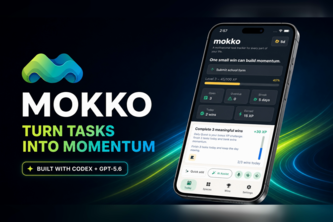
Mokko done is a motivational task manager for iOS and Android that uses AI to organize tasks into structured plans, break down goals, and gamify productivity. It is described as a personal productivity app built by a single founder (Ahmed Shafei), with an emphasis on reducing overwhelm through AI-assisted planning and gamification.
What changed
The project was originally built as a FlutterFlow app and redeveloped from scratch during the OpenAI 2026 hackathon, incorporating AI assistance via Codex and GPT-5.6. It is now in a review-ready state for Apple App Store submission (Android not yet published), with a focus on improving user experience, authentication flows, and AI reliability.
The single most important open question
Is there evidence of early traction or user feedback that would indicate demand for this type of AI-enhanced task management product? The description does not provide any data on users, adoption, revenue, or customer engagement beyond the author’s own claims.
What The Product Actually Is
The description states that mokko is a motivational task manager for iOS and Android (Android not yet published). It combines practical planning with positive reinforcement features such as:
- Organizing responsibilities into life Spaces (Home, Work, Kids, Personal, Errands).
- Capturing tasks using natural language or voice input.
- Using AI Assist to clean up notes, extract actionable tasks, suggest subtasks, and create daily plans.
- Breaking large goals into smaller actions.
- Tracking habits, recurring tasks, reminders, priorities, deadlines.
- Grouping related work into Missions with visible progress.
- Gamification elements like XP, streaks, badges, and celebration of completed work.
- Collaboration through secure invitation links.
- Weekly progress reviews without punishment for unfinished tasks.
It is built as a cross-platform Flutter application using an MVVM-inspired architecture. The AI layer uses structured prompts and expects machine-readable JSON output from models like Codex and GPT-5.6.
Positioning & Claim Evolution
The author positions mokko as a tool that helps people decide what to do next, follow through, and feel good about moving forward — especially when life feels chaotic or overwhelming.
It is described as being deliberately assistive rather than autonomous: AI proposes plans and structures while users retain control. The goal is not to replace decision-making but to reduce the effort required to reach a good one.
The product also emphasizes gamification, turning task completion into a rewarding experience, and aims to be a calm, encouraging layer between what someone needs to do and the next realistic step they can take.
This positioning reflects an evolution from generic task managers toward a more emotionally supportive and AI-integrated approach to productivity.
Target Customer & ICP
The description does not clearly define a specific target customer or ideal customer profile (ICP). However, it implies that mokko is aimed at individuals who struggle with:
- Overwhelm due to competing responsibilities.
- Difficulty turning vague intentions into actionable steps.
- Needing motivation and structure to stay productive.
It targets users who may be looking for something more than a basic task list — someone interested in motivational planning, habit tracking, and progress visualization. The inclusion of Spaces like Home, Work, Kids, and Personal suggests it's designed for people managing multiple life domains.
There is no evidence of segmentation by age group, profession, or other demographic characteristics.
Business Model & Pricing Evidence
The description does not provide any information about pricing models, monetization strategies, or business model details. It mentions support for subscriptions but does not elaborate on how these would function or whether they are currently active.
No revenue data, pricing tiers, or customer acquisition costs are provided.
Technical & Delivery Signals
- The app is built using Flutter, with an MVVM-inspired architecture.
- Backend services are powered by Firebase, including authentication, cloud persistence, storage, serverless functions, messaging, and secure collaboration workflows.
- AI integration uses Codex and GPT-5.6 via structured prompts and JSON outputs.
- The system includes strict timeouts, output validation, confidence handling, and deterministic fallbacks to ensure reliability even if the AI fails.
- It supports Google and Apple sign-in, local notifications, deep links, hosted invitation fallbacks, offline-friendly state handling.
- The app was rebuilt from scratch during a hackathon using Codex for architectural inspection, behavior tracing, and implementation acceleration.
These technical choices suggest a focus on robustness, scalability, and user experience consistency across platforms.
Traction & Maturity Signals
There is no evidence of traction or maturity indicators such as:
- Revenue
- Customer base
- User engagement metrics
- Active users
- Product usage data
- Market validation
The project is described as being in a review-ready state for Apple App Store submission, with Android not yet published. It was submitted to the OpenAI 2026 hackathon, indicating it’s still in early development or launch phase.
Competitive Context
The description does not mention competitors or provide any competitive analysis. However, based on its features — such as AI-powered task structuring, gamification, habit tracking, and multi-space organization — mokko appears to compete with:
- General-purpose productivity apps (e.g., Todoist, Notion, Microsoft To Do)
- Habit-tracking tools (e.g., Streaks, Loop Habit Builder)
- Motivational productivity platforms that incorporate gamification
No differentiation strategy or competitive advantage is explicitly stated.
Open Questions & Risks
- Lack of traction: No evidence of users, revenue, or adoption.
- Single-founder model: The entire product was built by one person (Ahmed Shafei), which raises questions about scalability and long-term maintenance.
- Unverified claims: All descriptions are self-reported; there is no independent verification of features, performance, or outcomes.
- AI dependency risk: While the system includes fallbacks, over-reliance on AI could lead to poor user experience if models fail or return inconsistent results.
- Limited platform support: Android version not yet published, limiting reach.
- Gamification concerns: If not carefully implemented, gamification can become superficial or even demotivating.
Questions the description leaves open
- What is the current status of the Android release? When will it be available?
- Are there any early users or beta testers providing feedback on the product?
- How does mokko plan to monetize its service, and what pricing strategy is being considered?
- Has the team explored partnerships or integrations with existing productivity tools?
- What are the key challenges in scaling beyond a single developer?
- How do you measure success for the AI features — e.g., accuracy of task extraction, user satisfaction scores?
- What is your long-term vision for collaboration and shared Spaces?
- How do you intend to handle data privacy and security concerns related to personal task management?
Overall Assessment
Not evidenced.
The project description provides no information about financials, traction, or market validation that would support an investment or partnership decision. While the idea shows promise in addressing user pain points around overwhelm and motivation, there is insufficient evidence of product-market fit, scalability, or commercial viability to assess whether this represents a viable opportunity for investment or strategic alignment.
The author’s own account describes a functional prototype with AI integration and gamification features, but without any data on adoption, revenue, or user engagement, it remains speculative. A deeper due-diligence effort would require access to actual usage metrics, customer interviews, or financial projections — none of which are present in the current description.
User Stories BotA demo video on every pull request
Get a demo video on every new feature
GitHub App that watches your pull requests and records a narrated, captioned demo.
Save time on demo prep and make informed decisions faster with a video walkthrough of every new feature.
Source
Submitted to the OpenAI 2026 hackathon on Devpost. Project home on Devpost. Back to the full gallery on Devpost.
This competitive analysis was produced by top-founders.com (opens in a new tab)
Generated by a language model from this project's public Devpost page — its tagline, the author's own write-up and any built-with tags listed there — as captured in August 2026. Short quotations are the author's words. It is an opinion on the idea as a business, not on the people behind it, and it reflects the description as published then. If the project has moved on, request a correction below. The analysis is not independent research and contains no verified traction, revenue or customer data.
An independent guide by KFG International LLC — not affiliated with, endorsed by, or connected to Devpost or OpenAI.