

Archive position — measured, not model output
1 like on Devpost
505 of the 7,850 archived projects have more likes, and 1,758 share exactly 1 — so this project's #1,480 place in the like-ranked listing is a tie-break inside that group, not a ranking.
Projects (log scale)
Likes on Devpost. ▲ marks this project's group.
Show the figures
| Likes | Projects | Share of archive |
|---|---|---|
| 0 | 5,587 | 71.2% |
| 1 | 1,758 | 22.4% |
| 2 | 284 | 3.6% |
| 3–4 | 132 | 1.7% |
| 5–9 | 75 | 1.0% |
| 10+ | 14 | 0.2% |
 User Stories BotA demo video on every pull request
Get a demo video on every new feature
GitHub App that watches your pull requests and records a narrated, captioned demo.
Save time on demo prep and make informed decisions faster with a video walkthrough of every new feature.
Executive Summary
What the company appears to be
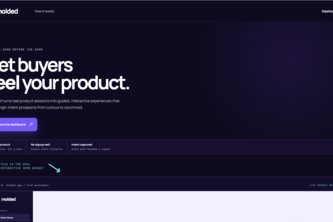
Molded is a self-reported platform that enables sales teams to record, edit, and deploy interactive product demos directly from their web applications. The author states it uses a Chrome extension to capture browser activity (via rrweb), allows editing in a visual Studio, and publishes interactive demos that can collect CRM leads.
What changed
The project was submitted as part of the OpenAI 2026 hackathon. It is described as a proof-of-concept built over a short timeframe with limited resources (e.g., one team member). The author describes an early-stage product with no verified traction or revenue.
Single most important open question
Is there evidence that Molded has moved beyond the prototype stage, and if so, how does it currently operate in terms of customer acquisition, usage, or monetization?
What The Product Actually Is
The description states that Molded is a platform for creating interactive product demos using:
- A Chrome extension (Manifest V3) that records browser activity using rrweb, capturing DOM snapshots, clicks, scrolls, and interaction events.
- A dashboard to display recorded sessions.
- A visual Studio where creators can place, resize, and lock spotlight targets over the recorded experience.
- An interactive demo player based on rrweb replay in interactive mode, allowing prospects to follow a guided path and interact with the product interface.
- A publish flow that embeds direction and includes a lead-capturing form.
- Optional OpenAI-powered tour suggestions, with a local fallback for core functionality.
The author claims Molded helps teams capture real browser sessions rather than rebuilding UI as mockups, and aims to make demos feel less like presentations and more like proof of product value.
Inference: The platform appears to be designed to bridge the gap between a polished marketing site and the actual product experience by enabling guided exploration instead of passive video or call-to-action flows.
Positioning & Claim Evolution
The author states that Molded is built to address two main issues:
- Timing of demos: Product demos are often too late in the funnel — by the time someone sees the product, they have already booked a call or dropped off.
- Gap between marketing and product: There's a disconnect between a polished marketing site and the real product; Molded aims to close this gap by capturing genuine browser sessions.
The core positioning is that “your product is often your best salesperson,” and Molded helps it do that job earlier in the buying journey.
Inference: The platform positions itself as an alternative to traditional demo tools, focusing on immediacy, interactivity, and lead generation through real product exploration rather than passive media or scheduling.
Target Customer & ICP
The description states that Molded is intended for sales teams at companies who want to record, build, and deploy interactive demos that turn passive viewers into qualified CRM leads.
It also implies a use case where the demo lives directly on a company’s website, suggesting B2B SaaS or enterprise software companies as likely customers.
Inference: The target customer is likely B2B SaaS firms with product-led growth strategies, sales teams looking to improve lead capture, and organizations that rely heavily on product demonstrations during early-stage engagement.
Business Model & Pricing Evidence
There is no evidence in the description of a business model or pricing structure. The author does not mention any revenue streams, monetization methods, or pricing tiers.
Not evidenced: No indication of whether Molded intends to charge customers, how it plans to make money, or what kind of pricing model it might adopt.
Technical & Delivery Signals
The project is built using:
- TanStack Start
- React
- Chrome extension (Manifest V3)
- rrweb for recording browser activity
- Supabase for optional cloud storage
- OpenAI API integration for tour suggestions (with fallback)
The author notes technical challenges such as:
- Chrome extension injection timing and tab restrictions.
- Handling navigation, delayed event batches, and unexpected recording ends.
- Making replay fit cleanly into UI components like cards and dashboards.
- Keeping spotlight targets fixed after locking.
They also mention learning how to turn raw sessions into persuasive experiences without making them feel like videos.
Inference: The platform is technically complex but built with modern web tooling. It shows early-stage engineering maturity, though it lacks production-grade reliability or scalability features noted in the "What’s next" section.
Traction & Maturity Signals
The project was submitted to a hackathon (OpenAI 2026), indicating an early-stage prototype.
There is no evidence of:
- Revenue
- Customers
- Usage metrics
- Product adoption
- Any form of traction beyond the author’s own description
Not evidenced: No data on user engagement, retention, or business impact.
Competitive Context
The description does not mention specific competitors. However, based on the stated functionality — capturing browser sessions and turning them into interactive demos — Molded likely competes with:
- Traditional demo platforms (e.g., Loom, Vimeo, Screencastify)
- Product-led growth tools (e.g., Productboard, Gainsight, Crisp, Intercom)
- Demo creation tools that allow guided walkthroughs or embedded experiences
It also overlaps with AI-powered demo tools or conversational interfaces, though no such tools are named.
Inference: Molded appears to be in a niche between generic screen recording and full-fledged product experience platforms. It may differentiate itself by combining real browser capture with interactive editing and lead generation.
Open Questions & Risks
- No verified traction or revenue: The project is described as a hackathon submission, with no evidence of market validation.
- Single founder team: Only one member listed (Dilmi Kottahachchi), which raises questions about execution capacity and scalability.
- Prototype nature: Built for a hackathon, not production-ready; lacks features like authentication, analytics dashboards, or durable cloud storage.
- Dependency on Chrome extension and rrweb: These technologies may not scale well or be reliable in enterprise environments.
- AI layer is described as future work: The OpenAI integration is currently optional and not core to the workflow.
Inference: The risk of failure is high due to lack of product-market fit, limited team size, and unproven commercial viability.
Questions the description leaves open
- Has Molded moved beyond the hackathon prototype stage? If so, what changes have been made?
- Are there any early adopters or pilot customers currently using the platform?
- What is the current technical architecture and how does it handle reliability issues like unexpected recording ends or tab navigation?
- How do you plan to monetize this product — is there a pricing model in mind?
- What are the key assumptions about user behavior that drive your design decisions?
- How do you intend to scale beyond a single developer’s effort?
Overall Assessment
The description indicates that Molded is an early-stage hackathon project with no verified traction, revenue, or customer base.
It has potential in the product demo space but lacks evidence of commercial viability or market readiness.
Assessment: Not ready for investment or partnership at this time. The idea shows promise, but there is insufficient evidence to assess whether it can become a viable business.
User Stories BotA demo video on every pull request
Get a demo video on every new feature
GitHub App that watches your pull requests and records a narrated, captioned demo.
Save time on demo prep and make informed decisions faster with a video walkthrough of every new feature.
Source
Submitted to the OpenAI 2026 hackathon on Devpost. Project home on Devpost. Back to the full gallery on Devpost.
This competitive analysis was produced by top-founders.com (opens in a new tab)
Generated by a language model from this project's public Devpost page — its tagline, the author's own write-up and any built-with tags listed there — as captured in August 2026. Short quotations are the author's words. It is an opinion on the idea as a business, not on the people behind it, and it reflects the description as published then. If the project has moved on, request a correction below. The analysis is not independent research and contains no verified traction, revenue or customer data.
An independent guide by KFG International LLC — not affiliated with, endorsed by, or connected to Devpost or OpenAI.