

Archive position — measured, not model output
0 likes on Devpost
2,263 of the 7,850 archived projects have more likes, and 5,587 share exactly 0 — so this project's #5,333 place in the like-ranked listing is a tie-break inside that group, not a ranking.
Projects (log scale)
Likes on Devpost. ▲ marks this project's group.
Show the figures
| Likes | Projects | Share of archive |
|---|---|---|
| 0 | 5,587 | 71.2% |
| 1 | 1,758 | 22.4% |
| 2 | 284 | 3.6% |
| 3–4 | 132 | 1.7% |
| 5–9 | 75 | 1.0% |
| 10+ | 14 | 0.2% |
 User Stories BotA demo video on every pull request
Get a demo video on every new feature
GitHub App that watches your pull requests and records a narrated, captioned demo.
Save time on demo prep and make informed decisions faster with a video walkthrough of every new feature.
Executive Summary
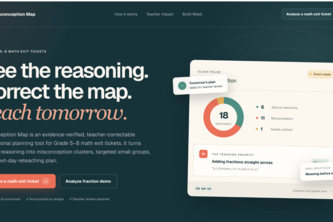
The company appears to be a two-person team building an AI-powered instructional planning tool for Grade 5–8 math teachers. The product, Misconception Map, claims to analyze anonymous student responses and cluster them into evidence-based misconception patterns, then generate teacher-correctable small groups and reteaching plans.
What changed
The project is a hackathon submission, not yet a commercial product. It was built in a short timeframe using AI tools like GPT-5.6 and Codex, with no evidence of revenue, customers or adoption.
The single most important open question
Is there sufficient evidence that teachers actually want or will use this tool, and whether the described functionality can be reliably delivered at scale?
This analysis is based entirely on the self-reported project description provided by the authors. It contains no verified financials, customer data, traction metrics or independent validation.
What The Product Actually Is
The description states that Misconception Map is an evidence-based instructional planning tool for Grade 5–8 mathematics teachers. Teachers input:
- A learning objective
- A question and rubric
- Anonymous student responses
The application then:
- Identifies recurring misconception patterns
- Groups students by reasoning strategy rather than correctness alone
- Shows evidence from student work supporting each pattern
- Generates teacher-friendly instructional recommendations
- Creates targeted small groups
- Suggests a mini lesson and practice questions
- Produces an exit ticket for the following lesson
- Exports reports for planning and documentation
It is described as a full-stack web application built with Next.js, React, TypeScript, Tailwind CSS, OpenAI GPT-5.6, Codex, Zod, and others.
The system is said to use GPT-5.6 in the instructional reasoning layer to analyze anonymous student responses and identify misconception patterns.
It also includes a demo mode for judges that does not require API credentials, and supports both live GPT-5.6 analysis and deterministic demo functionality.
Not evidenced: whether this is a working prototype or a production-ready product; how it integrates with existing LMS platforms; or if it has been tested in real classrooms.
Positioning & Claim Evolution
The authors state that Misconception Map aims to shift the focus from grading to understanding student thinking. It positions itself as an AI system that supports teacher decision-making rather than replacing teacher judgment.
It is described as not just another AI grader, but a tool focused on student reasoning instead of grades, translating AI analysis into concrete instructional actions, and keeping teachers in control of instructional decisions.
The project's positioning emphasizes:
- Evidence-based misconception clustering
- Teacher-correctable small groups
- Actionable reteaching plans
- Transparency over black-box outputs
- Trust-building through verifiable evidence
Inferred: The tool is positioned as a supportive AI companion for educators, not a replacement. However, the claim of being “not just another AI grader” lacks verification or comparison data.
Target Customer & ICP
The target customer is Grade 5–8 mathematics teachers, according to the tagline and project description.
The authors describe their ideal user as someone who:
- Grades exit tickets or short assessments
- Needs to understand why students answered incorrectly
- Wants to group students by reasoning strategy rather than correctness alone
- Seeks actionable teaching plans based on student thinking
Not evidenced: Whether this is a defined ICP beyond the stated grade level and subject. No segmentation, persona details, or user research data are provided.
Business Model & Pricing Evidence
The description does not contain any information about:
- Revenue model (e.g., SaaS subscription, freemium, one-time purchase)
- Pricing structure
- Monetization strategy
- Customer acquisition plans
- Go-to-market approach
Not evidenced: No indication of how the product would be sold or who would pay for it.
Technical & Delivery Signals
The application is built as a modern full-stack web app using:
- Next.js
- React
- TypeScript
- Tailwind CSS
- OpenAI GPT-5.6
- Codex
- Zod
- Markdown & CSV export utilities
It uses GPT-5.6 for instructional reasoning and Codex to accelerate development across multiple stages including architecture, UI components, server-side integration, schema design, export functionality, automated tests, and documentation.
The system includes:
- A structured analysis pipeline with schema validation
- A clearly labeled demo mode for judges
- Support for both live GPT-5.6 analysis and deterministic demo mode
Inferred: The use of AI tools like Codex suggests a rapid development process, but no evidence is given about scalability or reliability in production environments.
Traction & Maturity Signals
The project is described as a hackathon submission to the OpenAI 2026 hackathon on Devpost. It was built by two team members (Hanxia Li and June Y).
No evidence of:
- Revenue
- Customers
- User adoption
- Product-market fit
- Iteration history or feedback loops
- Market validation
Not evidenced: No traction data, usage metrics, or product maturity indicators beyond the initial prototype.
Competitive Context
The description does not mention any direct competitors. It does state that one of the key challenges was avoiding the trap of building "just another AI grader", implying that such tools exist in the market.
Inferred: The tool competes with traditional grading systems and possibly other AI-powered educational platforms, but no competitive landscape is described or analyzed.
Open Questions & Risks
- Unproven market demand: No evidence of teacher interest, usage, or feedback.
- Limited team size: Only two developers; raises questions about scalability and execution capability.
- No revenue or monetization strategy: The product has no clear path to commercial viability.
- Dependence on AI tools: Heavy reliance on GPT-5.6 and Codex may not be sustainable or scalable without further development.
- Lack of real-world testing: The tool is described as a hackathon prototype, with no evidence of classroom deployment or effectiveness.
- Unverified claims: All benefits are self-reported; there is no independent validation of AI accuracy or pedagogical value.
Questions the description leaves open
- What specific feedback have you received from teachers who tried the tool?
- How do you plan to validate that your misconception clustering is accurate and useful in practice?
- Have you tested this with actual classrooms, or is it purely theoretical?
- What is your go-to-market strategy for reaching Grade 5–8 math teachers?
- How will you monetize this product? Is there a pricing model or revenue plan?
- What are the technical limitations of relying on GPT-5.6 for real-time analysis in educational settings?
- Can you describe how the demo mode differs from live functionality, and what that means for usability?
- Are there any privacy or compliance concerns related to handling student data?
Overall Assessment
Not evidenced: There is no evidence of a viable business model, customer traction, or commercial readiness.
The project is described as a hackathon submission, built by two people, and lacks any indication of product-market fit, revenue, or scalability. It presents a compelling idea but offers no proof that it will succeed in the market.
Confidence level: Low
This is an early-stage concept with potential, but without verified traction, revenue, or customer validation, it cannot be evaluated as a serious investment or partnership opportunity at this time.
User Stories BotA demo video on every pull request
Get a demo video on every new feature
GitHub App that watches your pull requests and records a narrated, captioned demo.
Save time on demo prep and make informed decisions faster with a video walkthrough of every new feature.
Source
Submitted to the OpenAI 2026 hackathon on Devpost. Project home on Devpost. Back to the full gallery on Devpost.
This competitive analysis was produced by top-founders.com (opens in a new tab)
Generated by a language model from this project's public Devpost page — its tagline, the author's own write-up and any built-with tags listed there — as captured in August 2026. Short quotations are the author's words. It is an opinion on the idea as a business, not on the people behind it, and it reflects the description as published then. If the project has moved on, request a correction below. The analysis is not independent research and contains no verified traction, revenue or customer data.
An independent guide by KFG International LLC — not affiliated with, endorsed by, or connected to Devpost or OpenAI.