

Archive position — measured, not model output
0 likes on Devpost
2,263 of the 7,850 archived projects have more likes, and 5,587 share exactly 0 — so this project's #5,335 place in the like-ranked listing is a tie-break inside that group, not a ranking.
Projects (log scale)
Likes on Devpost. ▲ marks this project's group.
Show the figures
| Likes | Projects | Share of archive |
|---|---|---|
| 0 | 5,587 | 71.2% |
| 1 | 1,758 | 22.4% |
| 2 | 284 | 3.6% |
| 3–4 | 132 | 1.7% |
| 5–9 | 75 | 1.0% |
| 10+ | 14 | 0.2% |
 User Stories BotA demo video on every pull request
Get a demo video on every new feature
GitHub App that watches your pull requests and records a narrated, captioned demo.
Save time on demo prep and make informed decisions faster with a video walkthrough of every new feature.
Executive Summary
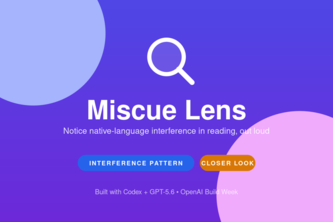
The company appears to be a single-person project (Maier Yan) developing an AI-powered tool called "Miscue Lens" for English language learners in classrooms. The tool listens to students read aloud, transcribes the reading, aligns it with the original text, and classifies misread words as either explainable interference patterns or inconsistent patterns requiring teacher attention. It is described as a descriptive observation tool, not diagnostic.
What changed
The project pivoted from a fixed two-language model (English/Chinese) to a generalizable framework using AI tools like Codex and GPT-5.6 for classification and explanation logic.
The single most important open question
Is there any evidence of real-world usage or feedback from teachers or students? The description states no revenue, customers, or traction data are available beyond the authors' own account.
What The Product Actually Is
The description states that Miscue Lens:
- Listens to a student read aloud
- Transcribes the reading
- Aligns the transcript against the original passage word-by-word
- Classifies each misread word as either an "interference_pattern" or "inconsistent_pattern"
- Generates a plain-language, teacher-facing summary and concrete practice tip
- Translates into the student's native language when relevant
- Is described as a "descriptive observation tool", not diagnostic
The system uses:
- Node/Express + TypeScript backend
- Single-file vanilla HTML/CSS/JS frontend
- OpenAI SDK for transcription (gpt-4o-transcribe)
- GPT-5.6 for classification and explanation via Structured Outputs
- A Levenshtein-style word diff algorithm for alignment
Inference The tool is described as a classroom support mechanism, not an assessment or intervention system.
Positioning & Claim Evolution
The description states that:
- Teachers working with English language learners must make informal judgments about misread words
- There is no tool support for this process
- This is not a Duolingo problem — it's about teacher interpretation of student reading, not pronunciation practice or proficiency testing
Inference The positioning evolved from a fixed-language model to a generalizable framework, driven by the use of Codex to refactor core logic.
Target Customer & ICP
The description states:
- Teachers working with English language learners
- Specifically those who must judge whether a misread word is due to language transfer or worth closer attention
- The tool is intended for classroom use, not standardized testing or general practice apps
Inference The target customer is a teacher in an ESL/EFL context, likely in K–12 or adult education settings.
Business Model & Pricing Evidence
Not evidenced. The description does not state any pricing model, monetization strategy, or business model details.
Technical & Delivery Signals
The description states:
- Built with Node/Express + TypeScript backend and vanilla HTML/CSS/JS frontend
- Uses OpenAI SDK for transcription (gpt-4o-transcribe)
- Uses GPT-5.6 for classification and explanation via Structured Outputs
- Implements a Levenshtein-style word diff algorithm for alignment
- The initial build was done in a Claude-assisted session
- Codex was used to refactor the core logic from a fixed two-language model to a generalizable one
Inference The tool is built with modern web and AI stack, but no evidence of production deployment or scalability.
Traction & Maturity Signals
Not evidenced. The description states:
- It's a single-person project (Maier Yan)
- No revenue, customers, or traction data are available
- The tool is described as a working end-to-end pipeline, but not yet deployed in real classrooms
- No mention of user testing, feedback loops, or adoption metrics
Competitive Context
Not evidenced. The description does not reference any existing tools or competitors in the ESL/reading support space.
Open Questions & Risks
- Single-person project: The entire development effort is attributed to one person (Maier Yan), which raises questions about scalability and long-term maintenance.
- No real-world usage: There is no evidence of actual classroom deployment or user feedback.
- AI dependency without verification: Reliance on GPT-5.6 and Codex for classification and explanation, but no validation of accuracy or consistency in real-world use.
- Limited language support: Currently only supports English and Chinese; expansion to other languages is stated as a future goal, not an implemented feature.
- Descriptive-only tool: The tool is explicitly described as non-diagnostic, which may limit its utility for teachers seeking deeper insights.
Questions the description leaves open
- What specific feedback have you received from teachers or students using this tool?
- How do you plan to validate the accuracy of GPT-5.6's classification and explanations in real-world settings?
- Are there any plans for user testing or pilot programs with actual classrooms?
- What is your roadmap for expanding language support beyond English and Chinese?
- How do you intend to scale this tool beyond a single developer?
Overall Assessment
Not evidenced. The description does not provide any information about funding, valuation, or partnership interest.
User Stories BotA demo video on every pull request
Get a demo video on every new feature
GitHub App that watches your pull requests and records a narrated, captioned demo.
Save time on demo prep and make informed decisions faster with a video walkthrough of every new feature.
Source
Submitted to the OpenAI 2026 hackathon on Devpost. Project home on Devpost. Back to the full gallery on Devpost.
This competitive analysis was produced by top-founders.com (opens in a new tab)
Generated by a language model from this project's public Devpost page — its tagline, the author's own write-up and any built-with tags listed there — as captured in August 2026. Short quotations are the author's words. It is an opinion on the idea as a business, not on the people behind it, and it reflects the description as published then. If the project has moved on, request a correction below. The analysis is not independent research and contains no verified traction, revenue or customer data.
An independent guide by KFG International LLC — not affiliated with, endorsed by, or connected to Devpost or OpenAI.