

Archive position — measured, not model output
0 likes on Devpost
2,263 of the 7,850 archived projects have more likes, and 5,587 share exactly 0 — so this project's #5,337 place in the like-ranked listing is a tie-break inside that group, not a ranking.
Projects (log scale)
Likes on Devpost. ▲ marks this project's group.
Show the figures
| Likes | Projects | Share of archive |
|---|---|---|
| 0 | 5,587 | 71.2% |
| 1 | 1,758 | 22.4% |
| 2 | 284 | 3.6% |
| 3–4 | 132 | 1.7% |
| 5–9 | 75 | 1.0% |
| 10+ | 14 | 0.2% |
 User Stories BotA demo video on every pull request
Get a demo video on every new feature
GitHub App that watches your pull requests and records a narrated, captioned demo.
Save time on demo prep and make informed decisions faster with a video walkthrough of every new feature.
Executive Summary
What the company appears to be
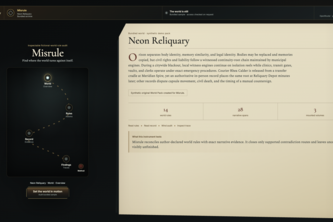
Misrule is a self-reported tool for writers, lore editors, campaign creators, and narrative-system designers that audits fictional-world rules against cited narrative evidence using AI-assisted reasoning. It operates on structured JSON World Packs containing explicit rules, constraints, conditions, temporal facts, and exact narrative evidence spans.
What changed
The author describes building an inspectable continuity auditor that separates contradiction from ambiguity through two-stage reasoning and application-owned validation of results. The system was refined from a one-pass inference model to candidate generation followed by focused adjudication after early failures in semantic accuracy.
Single most important open question
Does Misrule actually work as described, or is this a demonstration project with limited real-world applicability?
What The Product Actually Is
The description states that Misrule is an "inspectable continuity auditor for writers, lore editors, campaign creators, and narrative-system designers." It operates on structured World Packs containing:
- world and source-volume metadata;
- explicit rules, constraints, conditions, and temporal facts;
- exact narrative evidence spans.
World Packs are portable JSON documents that can be opened, created, imported, edited, exported, saved, and deleted locally in the browser. The system performs two reasoning stages: a broad search for possible conflicts followed by adjudication of each candidate.
The description states that "the model does not control the final public result" and that Misrule "converts the response into an application-owned contract and validates its structure, cited rule and span identities, reasoning relationships, and semantic consistency before displaying anything."
It also states that "a user can inspect the rule, narrative evidence, inference route, and—when the answer remains unresolved—the narrow missing fact and two evidence-supported readings."
The system is built with Next.js, React, TypeScript, Zod, Vitest, and an OpenAI-compatible inference client. The public hosted audit currently uses OpenRouter with Gemini 2.5 Flash and JSON-object transport.
Positioning & Claim Evolution
The author states that the inspiration came from a problem in fictional-world continuity: "A fictional world can contradict itself long after a rule is established." This led to an idea of testing whether an AI system could reason across explicit fictional-world rules and exact narrative evidence while remaining inspectable enough for writers to verify every conclusion.
The description states that most continuity tools are designed around search, notes, or general chat, and that Misrule was built as a narrower approach focused on reasoning across structured data rather than broad searching.
The author claims the system distinguishes between contradiction and ambiguity by identifying one narrow missing fact and preserving two readings supported by evidence. The system also requires exact citation validation and rejects malformed or unsupported results instead of quietly repairing them.
The positioning evolved from an initial concept to a more refined architecture involving two-stage reasoning, application-owned result semantics, and deterministic evaluation after early failures in semantic accuracy.
Target Customer & ICP
The description states that Misrule is intended for "writers, lore editors, campaign creators, and narrative-system designers."
It also mentions that the system was built with the goal of helping creators work with structured World Packs containing explicit rules, constraints, conditions, temporal facts, and exact narrative evidence spans.
The author notes that the tool is designed to be inspectable enough that a writer could verify every conclusion, suggesting an audience that values transparency and control over automated outputs.
Business Model & Pricing Evidence
Not evidenced. The description does not contain any information about pricing, monetization, or business model.
Technical & Delivery Signals
The system uses GPT-5.6 and Codex for development and reasoning, but the deployed runtime uses OpenRouter with Gemini 2.5 Flash and JSON-object transport. The author states that "AI-assisted development did not remove the need for product judgment" and that they made decisions about what problem to solve, what evidence counts, where automation stops, and when a convincing result is not trustworthy enough.
The system is built with Next.js, React, TypeScript, Zod, Vitest, and an OpenAI-compatible inference client. It uses local storage for browser-created World Packs, which are stored locally in the browser.
The author describes making model output inspectable by rejecting malformed, uncited, or semantically unsupported results instead of quietly repairing them into something that merely looks convincing.
Traction & Maturity Signals
Not evidenced. The description does not contain any information about revenue, customers, adoption, or traction beyond what the author states.
Competitive Context
The description states that "most continuity tools are designed around search, notes, or general chat" and that Misrule was built as a narrower approach focused on reasoning across structured data rather than broad searching.
It also mentions that the system does not yet parse complete manuscripts, PDFs, EPUB files, or Scrivener projects, and does not use RAG or embeddings.
The author notes that the tool currently audits structured World Pack JSON and does not provide accounts, cloud persistence, collaborative editing, or manuscript-scale ingestion. Browser-created World Packs are stored locally.
Open Questions & Risks
- The system is described as a hackathon submission with no evidence of real-world use or traction.
- The author states that the current live audit quality depends on the configured inference provider and model, indicating potential inconsistency in results.
- The tool does not yet parse complete manuscripts, PDFs, EPUB files, or Scrivener projects, limiting its utility for real-world applications.
- The system currently only supports local storage of World Packs, which limits scalability and collaboration.
- The author notes that the system was initially built with GPT-5.6 but uses a different model for deployment, suggesting potential inconsistency in reasoning quality.
- The tool does not yet support collaborative editing or cloud persistence, which are common features in similar tools.
Questions the description leaves open
- What specific real-world use cases have been tested beyond the hackathon environment?
- How is the system validated for accuracy and consistency across different types of fictional worlds?
- What are the plans for expanding beyond local storage to support cloud persistence and collaboration?
- How does the system handle edge cases or ambiguous scenarios that were not covered in the initial testing?
- What is the roadmap for supporting manuscript-scale ingestion and parsing of various file formats?
- How does the system ensure consistency when different inference providers are used?
- What metrics or KPIs are being tracked to measure success beyond the hackathon submission?
Overall Assessment
Not evidenced. The description does not contain any information about funding, valuation, or investment status.
The author states that this was submitted to the OpenAI 2026 hackathon on Devpost and that everything above is the authors' own account. It is not independently verified, and no revenue, customer or traction data is available beyond what they state.
The system appears to be a proof-of-concept built during a hackathon with limited real-world application. The author notes several current limitations including lack of manuscript-scale ingestion, cloud persistence, collaborative editing, and RAG capabilities. There is no evidence of commercial traction or adoption beyond the self-reported description.
User Stories BotA demo video on every pull request
Get a demo video on every new feature
GitHub App that watches your pull requests and records a narrated, captioned demo.
Save time on demo prep and make informed decisions faster with a video walkthrough of every new feature.
Source
Submitted to the OpenAI 2026 hackathon on Devpost. Project home on Devpost. Back to the full gallery on Devpost.
This competitive analysis was produced by top-founders.com (opens in a new tab)
Generated by a language model from this project's public Devpost page — its tagline, the author's own write-up and any built-with tags listed there — as captured in August 2026. Short quotations are the author's words. It is an opinion on the idea as a business, not on the people behind it, and it reflects the description as published then. If the project has moved on, request a correction below. The analysis is not independent research and contains no verified traction, revenue or customer data.
An independent guide by KFG International LLC — not affiliated with, endorsed by, or connected to Devpost or OpenAI.