

Archive position — measured, not model output
0 likes on Devpost
2,263 of the 7,850 archived projects have more likes, and 5,587 share exactly 0 — so this project's #5,324 place in the like-ranked listing is a tie-break inside that group, not a ranking.
Projects (log scale)
Likes on Devpost. ▲ marks this project's group.
Show the figures
| Likes | Projects | Share of archive |
|---|---|---|
| 0 | 5,587 | 71.2% |
| 1 | 1,758 | 22.4% |
| 2 | 284 | 3.6% |
| 3–4 | 132 | 1.7% |
| 5–9 | 75 | 1.0% |
| 10+ | 14 | 0.2% |
 User Stories BotA demo video on every pull request
Get a demo video on every new feature
GitHub App that watches your pull requests and records a narrated, captioned demo.
Save time on demo prep and make informed decisions faster with a video walkthrough of every new feature.
Executive Summary
What the company appears to be
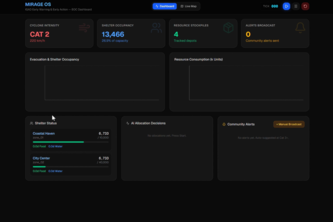
MIRAGE is a self-reported multi-agent system designed to support disaster response by automating resource allocation decisions through Digital Twins and AI agents, while maintaining human oversight via governance workflows. It was developed as a research project and later adapted for a hackathon submission.
What changed
The author states that the system evolved from a research question into something buildable for real-world operations teams, with an emphasis on making the early-warning-to-action pipeline visible and legible to stakeholders — particularly by adding community alerting and visualization layers.
Single most important open question
Is there evidence of any traction, revenue, or operational use beyond the hackathon context? The description does not indicate whether MIRAGE has moved past prototype or demonstration stage, nor whether it is being used in actual disaster response scenarios.
What The Product Actually Is
The description states that MIRAGE:
- Simulates a disaster using five coordinated Digital Twins: Cyclone, Population, Shelter, Resource, and Infrastructure.
- Uses four specialized agents (Risk, Shelter, Logistics, Resource) to propose allocations based on shared state.
- Applies a deterministic conflict resolver with one of four strategies — WEIGHTED, FCFS, EQUAL, or PRO_RATA — to resolve agent disagreements.
- Incorporates a governance workflow requiring human approval through an L1/L2/L3 state machine.
- Includes a community alerting mechanism so decisions reach affected populations.
Inferred: The system is built around a blackboard architecture where agents reason over shared data and conflict resolution ensures reproducibility. It also includes a frontend dashboard visualizing the simulation live, with GIS layers and alert panels added for the hackathon.
Positioning & Claim Evolution
The author claims MIRAGE addresses a gap in disaster response: “not because the warning never arrives, but because nobody can turn the warning into a decision fast enough.” This positions it as solving coordination inefficiencies in early action workflows.
It evolved from a research project focused on proving fairness and reproducibility of allocation decisions to a tool aimed at enabling real-world operational use. The shift was driven by aligning its architecture with needs identified by agencies like IGAD in East Africa.
Inferred: The positioning emphasizes automation of complex logistics under pressure, while preserving human judgment and transparency.
Target Customer & ICP
The description states that MIRAGE maps onto the “early warning → early action” gap that agencies like IGAD are trying to close in East Africa. It also mentions that the system was designed for real operations teams who could stand behind it.
Inferred: The primary target customer appears to be disaster response organizations or government agencies operating in regions prone to cyclones and other natural disasters, particularly those seeking scalable, explainable decision-making tools.
Not evidenced: No specific names of customers, partnerships, or use cases beyond the hackathon are provided.
Business Model & Pricing Evidence
The description does not contain any information about pricing, monetization, or business model. It focuses entirely on the technical and conceptual aspects of the system.
Not evidenced: No evidence of revenue streams, customer acquisition plans, or commercial viability beyond a hackathon submission.
Technical & Delivery Signals
The backend is built with Python/FastAPI using a blackboard architecture:
- Digital Twins write state.
- Agents read and reason over it.
- Conflict resolver and governance engine are separate modules for independent testing.
Frontend uses Next.js and visualizes the simulation live, including:
- GIS layer showing shelters, resources, hazard zones.
- Community alert panel integrated into the existing state model.
Inferred: The system was designed with modularity and testability in mind, allowing validation of core logic before UI/UX additions. The architecture supports deterministic behavior for reproducibility.
Not evidenced: No evidence regarding scalability, deployment infrastructure, or integration capabilities beyond the hackathon demo.
Traction & Maturity Signals
The description indicates that:
- The system was developed over months as a research project.
- Evaluation engine, governance state machine, and Digital Twins were validated before the hackathon.
- The hackathon window was limited (days), so only additive features were added.
Inferred: There is some maturity in core logic, but no evidence of production use or adoption beyond the hackathon.
Not evidenced: No data on usage, performance metrics, customer feedback, or post-hackathon development trajectory.
Competitive Context
The description does not mention specific competitors or direct market comparisons. However, it references agencies like IGAD (Intergovernmental Authority on Development), which operate in East Africa and may be involved in disaster response coordination.
Inferred: MIRAGE likely competes with or complements existing emergency management systems or early warning platforms used in humanitarian contexts, though no explicit competitor names are given.
Not evidenced: No competitive landscape analysis, pricing comparisons, or market positioning relative to other tools.
Open Questions & Risks
- Lack of traction: The system exists only as a hackathon submission and research prototype; there is no evidence of real-world deployment or adoption.
- Unproven commercial viability: No revenue model, customers, or monetization strategy are described.
- Limited scope: The system simulates cyclone landfall and does not appear to support other types of disasters or broader operational domains.
- Determinism vs. adaptability: While deterministic behavior is valuable for reproducibility, it may limit flexibility in dynamic environments.
- Single-founder team: The project is attributed to one individual (Joshua A), raising questions about scalability and resource availability.
Questions the description leaves open
- Has MIRAGE been tested or piloted with any real-world disaster response teams?
- What are the key assumptions underlying the allocation strategies (WEIGHTED, FCFS, etc.)? Are they validated empirically?
- How does the system handle uncertainty in input data or changing conditions during a real event?
- Is there any plan to expand beyond cyclone simulations or East Africa?
- What is the roadmap for moving from prototype to production-ready system?
- How are human approvals integrated into decision-making workflows in practice?
- Are there any partnerships with humanitarian organizations or government agencies already in place?
Overall Assessment
The description presents MIRAGE as a conceptually sound, technically well-structured research-to-hackathon prototype addressing a meaningful problem in disaster response. However, the lack of evidence for traction, revenue, or operational use beyond the hackathon limits its commercial readiness.
Confidence level Low — based on self-reported evidence only, with no external validation or data points on adoption, performance, or market fit.
Assessment Not ready for investment or partnership at this stage. The system shows promise in theory and early design, but lacks demonstrated value creation or scalability. Further diligence would require proof of concept testing, stakeholder engagement, and a clear path to monetization or operational deployment.
User Stories BotA demo video on every pull request
Get a demo video on every new feature
GitHub App that watches your pull requests and records a narrated, captioned demo.
Save time on demo prep and make informed decisions faster with a video walkthrough of every new feature.
Source
Submitted to the OpenAI 2026 hackathon on Devpost. Project home on Devpost. Back to the full gallery on Devpost.
This competitive analysis was produced by top-founders.com (opens in a new tab)
Generated by a language model from this project's public Devpost page — its tagline, the author's own write-up and any built-with tags listed there — as captured in August 2026. Short quotations are the author's words. It is an opinion on the idea as a business, not on the people behind it, and it reflects the description as published then. If the project has moved on, request a correction below. The analysis is not independent research and contains no verified traction, revenue or customer data.
An independent guide by KFG International LLC — not affiliated with, endorsed by, or connected to Devpost or OpenAI.