

Archive position — measured, not model output
0 likes on Devpost
2,263 of the 7,850 archived projects have more likes, and 5,587 share exactly 0 — so this project's #5,295 place in the like-ranked listing is a tie-break inside that group, not a ranking.
Projects (log scale)
Likes on Devpost. ▲ marks this project's group.
Show the figures
| Likes | Projects | Share of archive |
|---|---|---|
| 0 | 5,587 | 71.2% |
| 1 | 1,758 | 22.4% |
| 2 | 284 | 3.6% |
| 3–4 | 132 | 1.7% |
| 5–9 | 75 | 1.0% |
| 10+ | 14 | 0.2% |
 User Stories BotA demo video on every pull request
Get a demo video on every new feature
GitHub App that watches your pull requests and records a narrated, captioned demo.
Save time on demo prep and make informed decisions faster with a video walkthrough of every new feature.
Executive Summary
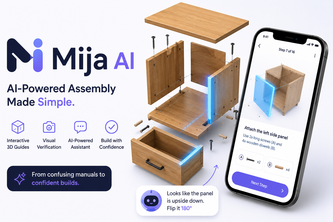
The company appears to be a two-person team building a mobile-first assembly companion powered by AI, using GPT-5.6 for step-aware guidance and visual verification. The product is described as a lightweight PWA deployed on Vercel, with a demo mode and live AI mode. It targets users assembling flat-pack furniture, aiming to reduce confusion in manuals through structured steps and visual checks.
What changed
The project was submitted to the OpenAI 2026 hackathon, indicating an early-stage prototype or proof-of-concept.
The single most important open question
Is there any evidence of user adoption, revenue, or traction beyond the hackathon demo?
What The Product Actually Is
- The description states that Mija AI is a mobile assembly companion.
- It guides users through 12 focused steps for assembling a Nordic bedside cabinet.
- Each step includes:
- Parts to use
- Timing
- Tools required
- Exploded visual
- Contextual help
- Visual confidence check
- The experience is delivered via a lightweight mobile web app built with JavaScript, HTML, and CSS.
- It uses Vercel Functions for AI endpoints.
- In Live AI mode, it uses the OpenAI Responses API with GPT-5.6.
- A Demo Mode allows judges to test the full experience without an account or API key.
Note
The product is described as a prototype, not a commercial offering. No evidence of actual users, customers, or revenue is provided.
Positioning & Claim Evolution
- The description states that Mija AI was inspired by turning confusing manuals into calm, checkable steps.
- It aims to reduce stress during assembly by:
- Making the next action visible
- Providing confidence checks
- Keeping the builder's judgment intact
- The product is positioned as a mobile-first companion, not a replacement for human decision-making.
Inference The positioning implies a focus on usability and clarity in complex tasks, but no evidence of market validation or user feedback beyond the hackathon context.
Target Customer & ICP
- The description states that Mija AI is intended for users who build flat-pack furniture.
- It targets people who experience confusion with manuals, particularly around:
- Dense diagrams
- Unfamiliar hardware
- Vague instructions
Note
No evidence of a defined customer persona or segment beyond the general use case of furniture assembly.
Business Model & Pricing Evidence
- The description does not state any pricing model or business model.
- It mentions two modes:
- Demo Mode: No account or API key required.
- Live AI Mode: Requires an OpenAI API key.
- There is no mention of monetization, subscriptions, or paid features.
Inference The product appears to be a prototype with no commercial model evident. The presence of two modes suggests potential for future monetization but no evidence of it.
Technical & Delivery Signals
- Built as a progressive web app (PWA) using:
- JavaScript
- HTML5
- CSS3
- Deployed on Vercel
- Uses OpenAI API (specifically GPT-5.6) for AI reasoning and visual verification.
- Backend uses Vercel Functions and Supabase PostgreSQL.
- The team used Codex to accelerate development.
- No evidence of production infrastructure, scalability, or security practices beyond the demo.
Inference The tech stack suggests a lightweight prototype. No evidence of enterprise-grade delivery or long-term technical strategy.
Traction & Maturity Signals
- The project was submitted to the OpenAI 2026 hackathon.
- It includes a public repository with local setup instructions and sample data.
- Demo Mode is available for judges without account creation.
- No evidence of:
- Customers
- Revenue
- User engagement metrics
- Product usage data
Inference The project is at an early stage, likely a prototype or proof-of-concept. No signs of traction or product-market fit.
Competitive Context
- The description does not mention any competitors.
- It implies that current solutions for flat-pack furniture assembly are confusing or lack clarity.
- No evidence of existing products in this space or competitive differentiation.
Inference There is no competitive analysis or positioning against other tools. The market context is not described.
Open Questions & Risks
- The product is a hackathon submission, not a commercial offering.
- No evidence of:
- Revenue
- Customers
- Product-market fit
- Scalable infrastructure
- Reliance on GPT-5.6 and external APIs may create dependency risks.
- The team size is 2, which may limit execution capacity.
- Demo Mode is a workaround for API key limitations, suggesting a prototype-level experience.
Inference The project lacks commercial viability or traction indicators. It is not evident that it has moved beyond the idea stage.
Questions the description leaves open
- What is the intended path from this hackathon prototype to a product with users?
- Are there any plans for monetization or pricing models?
- How do you plan to scale beyond the current demo and API-based approach?
- Have you tested the product with real users outside of the hackathon?
- What are the long-term technical dependencies, and how will they be managed?
Overall Assessment
- The project is a hackathon prototype, not a commercial product.
- No evidence of revenue, customers, or traction.
- The team is small (2 members), and the tech stack suggests a lightweight prototype.
- There is no indication of a viable business model or product-market fit.
Assessment Not ready for investment or partnership. This is an early-stage idea with no demonstrated commercial potential.
User Stories BotA demo video on every pull request
Get a demo video on every new feature
GitHub App that watches your pull requests and records a narrated, captioned demo.
Save time on demo prep and make informed decisions faster with a video walkthrough of every new feature.
Source
Submitted to the OpenAI 2026 hackathon on Devpost. Project home on Devpost. Back to the full gallery on Devpost.
This competitive analysis was produced by top-founders.com (opens in a new tab)
Generated by a language model from this project's public Devpost page — its tagline, the author's own write-up and any built-with tags listed there — as captured in August 2026. Short quotations are the author's words. It is an opinion on the idea as a business, not on the people behind it, and it reflects the description as published then. If the project has moved on, request a correction below. The analysis is not independent research and contains no verified traction, revenue or customer data.
An independent guide by KFG International LLC — not affiliated with, endorsed by, or connected to Devpost or OpenAI.