

Archive position — measured, not model output
1 like on Devpost
505 of the 7,850 archived projects have more likes, and 1,758 share exactly 1 — so this project's #1,453 place in the like-ranked listing is a tie-break inside that group, not a ranking.
Projects (log scale)
Likes on Devpost. ▲ marks this project's group.
Show the figures
| Likes | Projects | Share of archive |
|---|---|---|
| 0 | 5,587 | 71.2% |
| 1 | 1,758 | 22.4% |
| 2 | 284 | 3.6% |
| 3–4 | 132 | 1.7% |
| 5–9 | 75 | 1.0% |
| 10+ | 14 | 0.2% |
 User Stories BotA demo video on every pull request
Get a demo video on every new feature
GitHub App that watches your pull requests and records a narrated, captioned demo.
Save time on demo prep and make informed decisions faster with a video walkthrough of every new feature.
Executive Summary
What the company appears to be
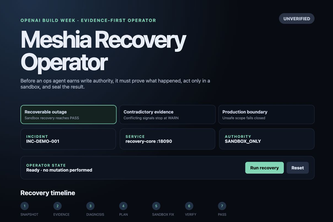
Meshia Recovery Operator is a self-reported local-first recovery test bench designed for safe agentic operations. It implements an evidence-first workflow that separates facts from inference, enforces authority boundaries, and verifies actions in a sandbox before granting write permission. The project is built as a standalone tool during the OpenAI Build Week hackathon.
What changed
The author states this is a new standalone project created for the OpenAI 2026 hackathon. It was inspired by a broader "Meshia recovery architecture" but uses a separate repository, synthetic incidents, and no access to real systems or production environments.
Single most important open question — the commercial due-diligence read
Is there any evidence of traction, revenue, customer adoption, or product-market fit beyond the author’s own description? The project is described as a proof-of-concept with no verified business metrics, users, or market validation.
What The Product Actually Is
The description states that Meshia Recovery Operator is:
- A local-first recovery test bench for safe agentic operations.
- It loads synthetic incidents and captures initial state.
- It records observable evidence, separates facts from inference, and produces a structured diagnosis.
- It evaluates authority, selects allowlisted actions, applies them only in an in-memory sandbox, and independently verifies results.
- It generates a tamper-evident report with SHA-256 sealing.
It includes three validated scenarios:
- Recoverable outage
- Contradictory evidence
- Production boundary (fails closed)
The system is built using React, TypeScript, Vite, Node.js, and optionally integrates OpenAI APIs via an adapter.
Inference: The product appears to be a framework or tool for validating agent actions in controlled environments before allowing real-world changes.
Positioning & Claim Evolution
The author positions the project as:
- An evidence-first recovery operator, emphasizing that capability does not equal authority.
- A system that proves incidents, tests fixes in sandbox, and verifies results before granting write authority.
- Not just an agent that can act, but one that demonstrates when it has earned the right to act.
It is described as a new standalone project created during the OpenAI Build Week submission period. It was inspired by a broader "Meshia recovery architecture" but operates independently and without access to real production systems or credentials.
Inference: The positioning reflects a strong emphasis on operational safety, transparency, and trust through verification — not just automation.
Target Customer & ICP
The description does not name specific customers or target industries. However, it implies:
- Teams working with agentic operations, particularly those seeking to avoid uncontrolled access to production systems.
- Organizations looking for pre-production safety gates in their deployment workflows.
- Developers or engineers who want to ensure that AI agents are validated before they can mutate real environments.
Inference: The ICP likely includes software engineering teams, DevOps practitioners, and AI/ML platform developers focused on secure automation.
Business Model & Pricing Evidence
There is no evidence of a business model or pricing structure in the description. The project is described as a hackathon submission with no mention of monetization, licensing, or commercial use cases.
Inference: No commercial viability or revenue model has been demonstrated beyond the author’s own development effort.
Technical & Delivery Signals
The system is built using:
- React, TypeScript, Vite, Node.js
- Optional integration with OpenAI APIs via an adapter
- Uses Codex and GPT-5.6 for planning, implementation, review, testing, correction, verification, and submission preparation
Key technical features include:
- Separation of concerns between facts, inference, authority, action, and verification.
- In-memory sandbox execution.
- SHA-256 sealing for tamper-evident reporting.
- Deterministic local fallback when live API access is unavailable.
- Allowlisted synthetic tools.
- Structured output with schema validation.
Inference: The architecture shows deliberate design around safety, reproducibility, and control over agent behavior — not just functionality.
Traction & Maturity Signals
There is no evidence of traction, revenue, or customer adoption. The project is described as a new standalone project created during the OpenAI Build Week hackathon. It includes:
- Three validated scenarios
- A demonstration that runs locally without API keys
- Use of Codex and GPT-5.6 in development
It does not reference any existing users, partners, or product usage beyond its own authorship.
Inference: This is a prototype or proof-of-concept with no demonstrated market traction or maturity.
Competitive Context
The description does not mention competitors or direct substitutes. However, the focus on safe agentic operations, sandboxed testing, and evidence-based decision-making aligns with trends in:
- AI safety
- DevOps automation
- Secure deployment pipelines
- Operational risk management tools
It is positioned as a pre-production safety gate for teams using agentic systems.
Inference: The space may include tools focused on secure CI/CD, sandboxed execution environments, or AI governance platforms — though no specific competitors are named.
Open Questions & Risks
- No verified traction or revenue: The project is described as a hackathon submission with no evidence of real-world adoption.
- Self-reported only: All claims are unverified and based solely on the author’s own account.
- Limited scope: It operates in a synthetic environment and does not yet connect to real systems or production data.
- No commercialization path: No indication of how this would transition from prototype to product or service.
- Dependency on author’s expertise: The project is built by one person (Antonio Lisi), which raises questions about scalability and team capacity.
Inference: Without external validation, the risk of overstatement in claims or lack of real-world applicability remains high.
Questions the description leaves open
- What are the actual use cases you've identified for this tool beyond the hackathon?
- How would you scale this from a single developer to a team or enterprise?
- Are there any plans to integrate with existing DevOps or CI/CD platforms?
- What is your roadmap for moving from synthetic to real-world environments?
- Have you considered how this might be used in production workflows, and what barriers exist?
- How do you plan to validate that the sandbox truly isolates actions?
- What are the limitations of the current architecture that would prevent broader adoption?
Overall Assessment
Not evidenced: There is no evidence of revenue, customers, or traction beyond the author’s own description. The project is described as a hackathon submission with no commercialization strategy or market validation.
Confidence level: Low — this is a self-reported prototype with no third-party verification, no business model, and no demonstrated product-market fit.
Assessment: At this stage, Meshia Recovery Operator appears to be an experimental tool with strong technical design but no clear path to commercial viability or partnership opportunity. It may have potential as a future product if further developed with real-world use cases, but currently lacks the evidence needed for investment or strategic interest.
User Stories BotA demo video on every pull request
Get a demo video on every new feature
GitHub App that watches your pull requests and records a narrated, captioned demo.
Save time on demo prep and make informed decisions faster with a video walkthrough of every new feature.
Source
Submitted to the OpenAI 2026 hackathon on Devpost. Project home on Devpost. Back to the full gallery on Devpost.
This competitive analysis was produced by top-founders.com (opens in a new tab)
Generated by a language model from this project's public Devpost page — its tagline, the author's own write-up and any built-with tags listed there — as captured in August 2026. Short quotations are the author's words. It is an opinion on the idea as a business, not on the people behind it, and it reflects the description as published then. If the project has moved on, request a correction below. The analysis is not independent research and contains no verified traction, revenue or customer data.
An independent guide by KFG International LLC — not affiliated with, endorsed by, or connected to Devpost or OpenAI.