

Archive position — measured, not model output
0 likes on Devpost
2,263 of the 7,850 archived projects have more likes, and 5,587 share exactly 0 — so this project's #5,379 place in the like-ranked listing is a tie-break inside that group, not a ranking.
Projects (log scale)
Likes on Devpost. ▲ marks this project's group.
Show the figures
| Likes | Projects | Share of archive |
|---|---|---|
| 0 | 5,587 | 71.2% |
| 1 | 1,758 | 22.4% |
| 2 | 284 | 3.6% |
| 3–4 | 132 | 1.7% |
| 5–9 | 75 | 1.0% |
| 10+ | 14 | 0.2% |
 User Stories BotA demo video on every pull request
Get a demo video on every new feature
GitHub App that watches your pull requests and records a narrated, captioned demo.
Save time on demo prep and make informed decisions faster with a video walkthrough of every new feature.
Executive Summary
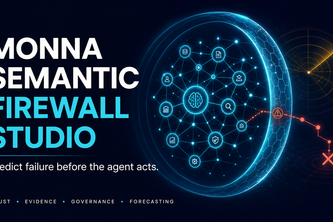
Project: MONNA Semantic Firewall Studio
Author's Claim: A developer tool for controlling semantic boundaries of ontology-grounded AI agents, using a deterministic semantic firewall to enforce policy-based access control over knowledge graphs.
What Changed: The project is described as a hackathon submission that builds on the idea of separating language understanding from security authority in AI agent systems. It introduces a framework for validating natural-language questions against structured ontologies.
Single Most Important Open Question: Does the author’s self-reported architecture and approach to validation have sufficient grounding to be viable beyond a proof-of-concept, or does it rely on untested assumptions about model behavior and graph alignment?
What The Product Actually Is
The description states that MONNA Semantic Firewall Studio is a developer tool designed for controlling the semantic boundaries of ontology-grounded AI agents. It aims to enforce policy-based access control over knowledge graphs.
It consists of three components:
- Capability Prober: Discovers supported question and reasoning paths from an ontology.
- Taxonomy Compiler: Validates question patterns, rejecting those requiring missing or ambiguous relationships.
- Semantic Firewall: Evaluates incoming questions and returns structured ADMIT or REFUSE decisions with reasons, classified paths, matched archetypes, and auditability.
The system uses:
- GPT-5.6 and Codex for interpreting natural-language questions into candidate graph paths.
- A deterministic validation engine to check these against the actual ontology and compiled taxonomy.
- Versioned JSON artifacts for ontologies, taxonomies, and firewall decisions.
- A closed-fail mechanism when model output is invalid or ambiguous.
Inference: The product appears to be a conceptual framework, not yet a deployed tool. It is described as being built during a hackathon with early-stage implementation using GPT-5.6 and Codex.
Positioning & Claim Evolution
The author positions MONNA Semantic Firewall Studio as:
- A developer tool for AI agents that operate on structured knowledge.
- A solution to the problem of AI agents producing convincing but unauthorized answers.
- A system that enforces policy-based access control, not just keyword filtering.
Key claims:
- The system is built around the principle: “The floor is policy. The ceiling is the graph.”
- It separates language understanding from security authority.
- It uses LLMs to interpret questions, but graph validation makes final decisions.
- It supports auditability and version control.
Inference: This is a conceptual positioning of a tool that could be part of a broader category of AI governance or agent control systems. The author does not claim it is in production, nor does the description suggest any prior development beyond a hackathon prototype.
Target Customer & ICP
The description states:
- MONNA Semantic Firewall Studio is designed for developers working with ontology-grounded AI agents.
- It targets users who need to control semantic boundaries and ensure that agent responses are grounded in authorized knowledge sources.
Inference: The target customer appears to be technical developers or AI engineers, likely within organizations using or building AI agents with structured knowledge bases (e.g., RAG systems, knowledge graphs). However, no specific customer segments or personas are named.
Business Model & Pricing Evidence
The description does not contain any information about:
- Pricing
- Revenue model
- Monetization strategy
- Customer acquisition plans
Not evidenced
Technical & Delivery Signals
The system is described as being built with:
- GPT-5.6
- OpenAI Codex
- React and TypeScript
- JSON-based artifacts for ontologies, taxonomies, and firewall decisions
It includes:
- A deterministic validation engine
- Versioned artifacts
- Fail-closed behavior in ambiguous or invalid cases
- Audit logs and reason codes
- A visual interface for understanding why a question was admitted or refused
Inference: The technical approach is described as hybrid, combining LLM interpretation with deterministic graph validation. It suggests an architecture that prioritizes inspectability, auditability, and safety over automation.
Traction & Maturity Signals
The description states:
- This is a hackathon submission.
- The system is currently in early conceptual exploration.
- It includes a runnable Build Week implementation, but no production deployment or customer feedback is mentioned.
Not evidenced
Competitive Context
The description does not mention:
- Competitors
- Market positioning relative to other AI governance tools
- Existing solutions in the space of agent control, knowledge graph validation, or semantic firewalls
Not evidenced
Open Questions & Risks
- Unproven assumptions: The system relies on GPT-5.6 to interpret questions and propose candidate paths, but it is unclear how well this model will generalize across different ontologies or handle adversarial inputs.
- Limited validation scope: The project is described as a hackathon prototype with no mention of testing against real-world data or edge cases.
- No evidence of scalability or integration: There is no indication that the system can be integrated into existing AI agent workflows or scaled for enterprise use.
- Single-person team: The team size is listed as one, which may limit development velocity and depth.
Questions the description leaves open
- What specific types of ontologies or knowledge graphs does this tool support?
- How does the system handle cases where the model’s interpretation is ambiguous but the graph allows a path?
- Has the validation engine been tested against adversarial inputs or edge cases?
- What are the limitations of the current JSON-based artifact format in terms of interoperability with other tools (e.g., RDF, OWL)?
- How does the system handle version mismatches between ontologies and taxonomies?
- Are there any plans for integrating with CI/CD pipelines or existing agent frameworks?
Overall Assessment
Not evidenced
The description is self-reported, unverified, and lacks any evidence of traction, revenue, customers, or market validation. It describes a conceptual tool in early development stage, not a product ready for investment or partnership.
This is a pre-product idea with strong conceptual framing but no demonstrated commercial viability or technical maturity. The author’s claims are ambitious, but the evidence provided does not support them beyond the scope of a hackathon prototype.
User Stories BotA demo video on every pull request
Get a demo video on every new feature
GitHub App that watches your pull requests and records a narrated, captioned demo.
Save time on demo prep and make informed decisions faster with a video walkthrough of every new feature.
Source
Submitted to the OpenAI 2026 hackathon on Devpost. Project home on Devpost. Back to the full gallery on Devpost.
This competitive analysis was produced by top-founders.com (opens in a new tab)
Generated by a language model from this project's public Devpost page — its tagline, the author's own write-up and any built-with tags listed there — as captured in August 2026. Short quotations are the author's words. It is an opinion on the idea as a business, not on the people behind it, and it reflects the description as published then. If the project has moved on, request a correction below. The analysis is not independent research and contains no verified traction, revenue or customer data.
An independent guide by KFG International LLC — not affiliated with, endorsed by, or connected to Devpost or OpenAI.