

Archive position — measured, not model output
0 likes on Devpost
2,263 of the 7,850 archived projects have more likes, and 5,587 share exactly 0 — so this project's #5,381 place in the like-ranked listing is a tie-break inside that group, not a ranking.
Projects (log scale)
Likes on Devpost. ▲ marks this project's group.
Show the figures
| Likes | Projects | Share of archive |
|---|---|---|
| 0 | 5,587 | 71.2% |
| 1 | 1,758 | 22.4% |
| 2 | 284 | 3.6% |
| 3–4 | 132 | 1.7% |
| 5–9 | 75 | 1.0% |
| 10+ | 14 | 0.2% |
 User Stories BotA demo video on every pull request
Get a demo video on every new feature
GitHub App that watches your pull requests and records a narrated, captioned demo.
Save time on demo prep and make informed decisions faster with a video walkthrough of every new feature.
Executive Summary
What the company appears to be
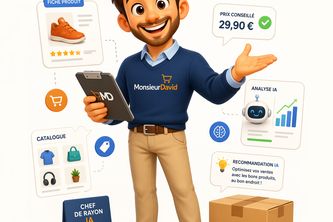
MonsieurDavid - Product Opportunity Studio is a self-reported AI-powered tool for e-commerce merchandisers that automates product assortment decisions by interpreting supplier catalogues and applying commercial rules, while maintaining human oversight and explainability.
What changed
The project description indicates this is an entry into the OpenAI 2026 hackathon. It describes a demo version built as a Python/JavaScript application with GPT-5.6 integration, designed to guide merchandisers through Create, Update, Review or Block decisions for product references.
Single most important open question
Is there evidence of commercial traction, revenue or adoption beyond the author’s own submission? The description is entirely self-reported and unverified; no third-party data, customers or financials are provided.
What The Product Actually Is
The description states that MonsieurDavid is a governed assortment copilot. It starts with existing products in a store and reads supplier catalogues to produce clear commercial assessments for each candidate reference:
- Create a relevant new product.
- Update an existing product with stronger data.
- Review a plausible but uncertain match.
- Block a product that fails identity, margin, category or required-data safeguards.
It uses GPT-5.6 for interpreting ambiguous variants and document structures, while hard rules govern identity, economics and safeguards. The system is designed to be human-first, visual, and explainable, with a focus on reversible scenarios, editable work queues, and human approval before storefront outcomes.
The tool also supports bounded public evidence, showing similarity, uncertainty, and price references only when comparable listings meet thresholds — without claiming sales volume or silently changing prices.
It is built as an independent Python/JavaScript application that reads various formats (CSV, TSV, Excel, JSON, PDFs, Word tables) and integrates with GPT-5.6 via the OpenAI API.
Inference The tool appears to be a decision-support system for e-commerce merchandising workflows, not a general-purpose AI agent or content generator.
Positioning & Claim Evolution
The author states that MonsieurDavid is designed to answer one commercial question:
“What deserves a place in my store, at a viable price, and why?”
This positions the tool as an assortment intelligence copilot, focused on governed decision-making rather than generic AI automation.
It explicitly contrasts itself with a generic AI agent, which it says can only create plausible copy. MonsieurDavid is said to govern the entire commercial decision process from source to storefront outcome, including:
- Transparent field mapping
- Identity checks and semantic reconciliation
- Margin, VAT, policy and required-data safeguards
- Contextual GPT-5.6 judgement where facts are ambiguous
- Bounded public evidence with visible provenance and uncertainty
- Reversible scenarios, editable work queue, human approval
- Concrete storefront outcome (not an invisible draft)
Claim
The tool is not just AI-generated content but a reviewable recommendation system that allows merchants to challenge, improve and safely approve decisions.
Target Customer & ICP
The description states that the tool is designed for small e-commerce teams, enabling them to move from raw data to an approved storefront outcome without losing control.
It also mentions that the normal product is built primarily for CognitiShop, a semantic CMS, and supports integrations with WooCommerce, PrestaShop, and Magento.
The author notes that the contest edition is self-contained, with no external integrations active — meaning this demo version does not yet connect to real systems or data sources.
Inference The target customer appears to be e-commerce merchandisers or product managers working in small-to-medium-sized businesses using platforms like WooCommerce, PrestaShop, Magento or CognitiShop. However, no actual customers or use cases are evidenced beyond the author’s own claims.
Business Model & Pricing Evidence
The description does not provide any information about pricing, business model, monetization strategy, or revenue streams.
It mentions that the normal product is designed for CognitiShop, and that integrations with other platforms exist, but no details are given on how these would be monetized.
Not evidenced.
Technical & Delivery Signals
The author states that the contest edition was built as an independent Python 3.12 and vanilla JavaScript application using fictional fixtures.
It supports reading multiple data formats:
- CSV, TSV, text tables
- Excel, JSON, Word tables, PDFs, scans
GPT-5.6 is called through the OpenAI Responses API, used for:
- Bounded document recovery after consent
- Semantic reconciliation
- Optional mapping and policy assistance
- Market research
- Structured product-card drafting
The author also mentions that Codex was used to accelerate implementation, automate tests, interaction design, UX guidance, and documentation.
Inference The technical stack is lightweight and modular, built for demonstration purposes. No production-grade infrastructure or scalability details are provided.
Traction & Maturity Signals
There is no evidence of traction, revenue, customers, or adoption beyond the author’s own submission.
The project is described as a contest entry, and the demo version is explicitly stated to be:
- Safe
- Free
- Self-contained
- Without real supplier feeds, CMS writes, emails, or payment integrations
No data on usage, performance metrics, or user feedback is provided.
Not evidenced.
Competitive Context
The author does not name competitors or provide a competitive landscape analysis.
However, the tool positions itself as distinct from generic AI agents, which it says can only generate copy, while MonsieurDavid governs decisions end-to-end with safeguards and explainability.
It is implied to compete in the space of AI-powered e-commerce merchandising tools or product data management systems, but no specific competitors are named.
Inference The tool likely competes with AI-assisted product cataloguing, supplier data integration, or assortment planning tools — though no direct comparison or competitive positioning is made.
Open Questions & Risks
- No commercial traction or revenue evidence: The project is a contest entry and lacks any indication of real-world adoption.
- Unverified claims: All descriptions are self-reported and unverified; no third-party validation or data exists.
- Demo-only architecture: The contest edition is isolated, with no external integrations or live data flows.
- No pricing or monetization model: No indication of how the tool would be sold or priced in a commercial context.
- Founder-only team: Only one person (Max Reman) is listed as part of the team — raising questions about execution capacity and scalability.
Questions the description leaves open
- What evidence supports the claim that GPT-5.6 provides meaningful business judgment in this domain?
- How does the tool handle edge cases or ambiguous product data beyond what was demonstrated?
- Are there any real-world tests or early adopters of the non-demo version?
- What is the roadmap for integrating with actual e-commerce platforms like WooCommerce, PrestaShop, and Magento?
- How will the tool be monetized, and what pricing model is envisioned?
- What are the key assumptions about user behavior in the merchandising workflow that underpin this solution?
Overall Assessment
The project description is entirely self-reported and unverified. It presents a conceptual framework for an AI-assisted e-commerce merchandising tool, but provides no evidence of traction, revenue, customers or commercial viability.
It is described as a contest entry, built in isolation without external integrations or live data flows.
Confidence level: Low
This is not a commercial due-diligence read based on verified facts. It is an analysis of a self-reported concept with no supporting evidence of product-market fit, customer demand, or business execution capability.
Not evidenced.
User Stories BotA demo video on every pull request
Get a demo video on every new feature
GitHub App that watches your pull requests and records a narrated, captioned demo.
Save time on demo prep and make informed decisions faster with a video walkthrough of every new feature.
Source
Submitted to the OpenAI 2026 hackathon on Devpost. Project home on Devpost. Back to the full gallery on Devpost.
This competitive analysis was produced by top-founders.com (opens in a new tab)
Generated by a language model from this project's public Devpost page — its tagline, the author's own write-up and any built-with tags listed there — as captured in August 2026. Short quotations are the author's words. It is an opinion on the idea as a business, not on the people behind it, and it reflects the description as published then. If the project has moved on, request a correction below. The analysis is not independent research and contains no verified traction, revenue or customer data.
An independent guide by KFG International LLC — not affiliated with, endorsed by, or connected to Devpost or OpenAI.