

Archive position — measured, not model output
0 likes on Devpost
2,263 of the 7,850 archived projects have more likes, and 5,587 share exactly 0 — so this project's #5,270 place in the like-ranked listing is a tie-break inside that group, not a ranking.
Projects (log scale)
Likes on Devpost. ▲ marks this project's group.
Show the figures
| Likes | Projects | Share of archive |
|---|---|---|
| 0 | 5,587 | 71.2% |
| 1 | 1,758 | 22.4% |
| 2 | 284 | 3.6% |
| 3–4 | 132 | 1.7% |
| 5–9 | 75 | 1.0% |
| 10+ | 14 | 0.2% |
 User Stories BotA demo video on every pull request
Get a demo video on every new feature
GitHub App that watches your pull requests and records a narrated, captioned demo.
Save time on demo prep and make informed decisions faster with a video walkthrough of every new feature.
Executive Summary
What the company appears to be
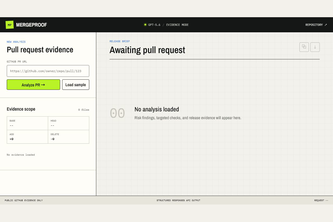
MergeProof is a self-reported tool that processes public GitHub pull requests using GPT-5.6 to generate structured release decisions, test plans, and rollback checklists. It claims to turn unstructured code review into evidence-cited outputs with strict formatting.
What changed
The project was submitted as part of the OpenAI 2026 hackathon. No prior version or history is evidenced; this is a single-authored, self-contained prototype built in a hackathon context.
Single most important open question
Is there any evidence that the tool has been used beyond its own development and demonstration? The description states no revenue, customers, or traction data are available.
What The Product Actually Is
The description states that MergeProof accepts a public GitHub pull-request URL and collects metadata and changed-file patches. It then uses GPT-5.6 to convert this into a structured release brief including:
- An assessment and risk score
- Affected surfaces
- Cited findings
- A prioritized test plan
- Release and rollback steps
- Explicit unknowns
Every finding must cite one or more supplied file paths. The output is exported as JSON.
Inference The tool appears to be a proof-of-concept prototype built for a hackathon, not a production-ready SaaS offering.
Positioning & Claim Evolution
The author states that the product was inspired by the distinction between code review and release approval. It aims to make the boundary visible between these two roles — i.e., that a review may say code is reasonable but a release decision requires evidence-based clarity.
Claim
MergeProof was built to make that boundary visible, ensuring release owners know what changed, which tests matter, what evidence is missing, and how to roll back.
Inference This positioning suggests an intent to address a gap in current AI-assisted code review tools — specifically, the lack of grounded, evidence-backed decision-making.
Target Customer & ICP
The description does not identify specific customer segments or personas. It only mentions that the tool works with public GitHub pull requests and is intended for release owners who need structured decision-making.
Inference It may target software teams using GitHub, particularly those managing release decisions in a CI/CD context, but no explicit ICP is stated.
Business Model & Pricing Evidence
No business model or pricing information is provided. The description does not mention monetization, subscriptions, or any commercial offering beyond the prototype.
Not evidenced
Technical & Delivery Signals
The product is built as a single Cloudflare Worker with static assets. It:
- Validates canonical GitHub PR URLs
- Reads metadata and up to 40 changed-file patches
- Enforces evidence budgets (per-file and total)
- Sends bounded payloads to the OpenAI Responses API
- Uses GPT-5.6 with medium reasoning and strict JSON Schema output
- Renders structured responses in the browser without executing repository content
Inference The architecture is minimal, serverless, and designed for a specific use case (public PRs). It’s not described as scalable or integrated into existing workflows.
Traction & Maturity Signals
There is no evidence of traction, revenue, customers, or adoption. The project was submitted to a hackathon and has no archived history or usage data beyond its own development.
Not evidenced
Competitive Context
The description does not mention competitors or the broader marketplace. It only states that existing AI review tools often produce confident prose without showing which evidence supports each claim.
Inference It positions itself as a response to a perceived gap in current AI-assisted code review tools, but no competitive analysis is provided.
Open Questions & Risks
- Prototype-only: The tool was built for a hackathon and has no evidence of production use or scalability.
- Limited scope: It only works with public GitHub PRs; private repositories are not supported in the current version.
- No commercial traction: No revenue, customers, or adoption data is available.
- Self-reported claims: All descriptions are unverified self-reports without external corroboration.
Questions the description leaves open
- What was the actual use case that drove this project? Was it a real problem faced by teams?
- Has the tool been tested or used in any real-world environment beyond the hackathon?
- How does it handle edge cases, such as large PRs or PRs with many changed files?
- Are there plans to support private repositories or CI integrations?
- What is the intended path from prototype to product?
Overall Assessment
Not evidenced
The project is a self-reported hackathon submission with no evidence of commercial traction, revenue, or customer adoption. It is described as a minimal prototype built for a single use case (public GitHub PRs) and does not show signs of a scalable business model or product-market fit.
The description states that the tool was built in a hackathon context and has no archived history or independent verification. It is not clear whether this represents a viable commercial opportunity or just an experimental idea.
User Stories BotA demo video on every pull request
Get a demo video on every new feature
GitHub App that watches your pull requests and records a narrated, captioned demo.
Save time on demo prep and make informed decisions faster with a video walkthrough of every new feature.
Source
Submitted to the OpenAI 2026 hackathon on Devpost. Project home on Devpost. Back to the full gallery on Devpost.
This competitive analysis was produced by top-founders.com (opens in a new tab)
Generated by a language model from this project's public Devpost page — its tagline, the author's own write-up and any built-with tags listed there — as captured in August 2026. Short quotations are the author's words. It is an opinion on the idea as a business, not on the people behind it, and it reflects the description as published then. If the project has moved on, request a correction below. The analysis is not independent research and contains no verified traction, revenue or customer data.
An independent guide by KFG International LLC — not affiliated with, endorsed by, or connected to Devpost or OpenAI.