

Archive position — measured, not model output
0 likes on Devpost
2,263 of the 7,850 archived projects have more likes, and 5,587 share exactly 0 — so this project's #5,593 place in the like-ranked listing is a tie-break inside that group, not a ranking.
Projects (log scale)
Likes on Devpost. ▲ marks this project's group.
Show the figures
| Likes | Projects | Share of archive |
|---|---|---|
| 0 | 5,587 | 71.2% |
| 1 | 1,758 | 22.4% |
| 2 | 284 | 3.6% |
| 3–4 | 132 | 1.7% |
| 5–9 | 75 | 1.0% |
| 10+ | 14 | 0.2% |
 User Stories BotA demo video on every pull request
Get a demo video on every new feature
GitHub App that watches your pull requests and records a narrated, captioned demo.
Save time on demo prep and make informed decisions faster with a video walkthrough of every new feature.
Executive Summary
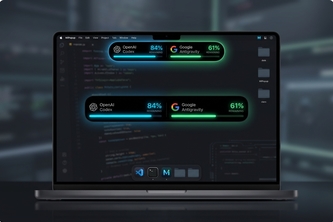
What the company appears to be: Notchvisor is a macOS utility built as a hackathon project that integrates with local AI model quotas (OpenAI Codex and Google Antigravity) and recommends cost-efficient models using a local-first approach. It presents this information in a Dynamic Island-style UI on the MacBook notch.
What changed: The author describes building a tool to solve three pain points for AI developers: quota blindness, subscription fragmentation, and inefficient model usage. This is presented as an application that runs locally and avoids cloud transmission of API keys or tokens.
Single most important open question: Is there any evidence of product-market fit, user adoption, or commercial traction beyond the hackathon submission? The description states no revenue, customers, or usage data exist beyond the project itself.
Note: This analysis is based entirely on self-reported information from the author. No external verification or historical data is available. All claims are stated by the author and not independently confirmed.
What The Product Actually Is
The description states that Notchvisor is a local-first macOS utility designed to monitor AI subscription quotas (Codex & Antigravity) and recommend optimal models based on cost-efficiency. It uses:
- A Dynamic Island-style UI, pinned to the MacBook notch or floating on non-notch screens.
- Local data retrieval via JSON-RPC streams from local endpoints (e.g., codex app-server).
- Zero-credential security: No OAuth tokens or API keys are transmitted to cloud servers.
- An optimization algorithm that balances model IQ score and cost, selecting the cheapest model within 90% of maximum intelligence.
Inference: The product is a developer tool built for macOS using Swift and SwiftUI. It is not a SaaS offering but a desktop application with local processing capabilities.
Positioning & Claim Evolution
The author positions Notchvisor as a utility that solves three key problems:
- Quota Blindness – Users are unaware when they’ve hit usage limits.
- Subscription Fragmentation – Managing multiple dashboards or CLI tools is cumbersome.
- Efficiency Dilemma – Developers default to expensive models unnecessarily.
The product claims to offer a sleek, unobtrusive UI, local-first processing, and privacy-focused design (no cloud transmission of credentials).
Claim vs Fact: These are self-stated intentions and use cases. No evidence is provided that users actually experience these issues or adopt the tool.
Target Customer & ICP
The description states that Notchvisor targets AI developers who subscribe to premium model suites like OpenAI Codex and Google Antigravity.
Inference: The intended customer segment is likely technical professionals working in AI development environments, particularly those using macOS and managing multiple subscriptions.
Business Model & Pricing Evidence
The description does not provide any information about pricing or business model. It only describes the tool as a local utility with no cloud components.
Not evidenced: No mention of monetization strategy, pricing tiers, or commercial plans.
Technical & Delivery Signals
The project was built using:
- Swift 6 & SwiftUI
- AppKit for custom window controls
- CADisplayLink for animation
- PTY (openpty) and IPC for terminal interaction
- JSON-RPC for Codex quota retrieval
- Local daemon interaction for Antigravity
Inference: The tool is a native macOS application with strong integration into system-level components. It avoids cloud-based APIs, which may indicate a privacy-first approach.
Traction & Maturity Signals
The project was submitted to the OpenAI 2026 hackathon on Devpost. No evidence of revenue, users, or adoption beyond this submission is provided.
Not evidenced: No data on usage, retention, or product-market fit exists in the description.
Competitive Context
The author does not name competitors or describe the competitive landscape. The tool appears to address a niche within AI developer workflows.
Not evidenced: No mention of existing tools solving similar problems or market positioning relative to them.
Open Questions & Risks
- No commercial traction beyond a hackathon submission.
- Single founder team (Steve Yang) — raises questions about scalability and execution capacity.
- Limited scope: Only supports macOS, and only works with Codex and Antigravity.
- Unproven market demand: No evidence of user feedback or real-world usage.
Inference: The tool is experimental and untested in production environments. It lacks commercial viability indicators.
Questions the description leaves open
- What specific AI development workflows does Notchvisor aim to improve, and how do you know?
- Have you tested the tool with real users or teams beyond yourself?
- How do you plan to monetize this tool if it remains a local utility?
- Are there plans to expand support beyond macOS or to other AI platforms?
- What is your long-term vision for the product, and how does it differ from existing tools?
Overall Assessment
Not evidenced: No data on revenue, customer base, traction, or scalability exists in the description.
Confidence Level: Low — this is a self-reported hackathon project with no evidence of commercial viability or market adoption.
Assessment: Notchvisor appears to be an experimental tool built by one developer for a specific niche. It lacks any demonstrated product-market fit, revenue, or traction. It may be a proof-of-concept or early-stage idea, but there is no indication it has progressed beyond the prototype stage or attracted users.
User Stories BotA demo video on every pull request
Get a demo video on every new feature
GitHub App that watches your pull requests and records a narrated, captioned demo.
Save time on demo prep and make informed decisions faster with a video walkthrough of every new feature.
Source
Submitted to the OpenAI 2026 hackathon on Devpost. Project home on Devpost. Back to the full gallery on Devpost.
This competitive analysis was produced by top-founders.com (opens in a new tab)
Generated by a language model from this project's public Devpost page — its tagline, the author's own write-up and any built-with tags listed there — as captured in August 2026. Short quotations are the author's words. It is an opinion on the idea as a business, not on the people behind it, and it reflects the description as published then. If the project has moved on, request a correction below. The analysis is not independent research and contains no verified traction, revenue or customer data.
An independent guide by KFG International LLC — not affiliated with, endorsed by, or connected to Devpost or OpenAI.