

Archive position — measured, not model output
0 likes on Devpost
2,263 of the 7,850 archived projects have more likes, and 5,587 share exactly 0 — so this project's #5,595 place in the like-ranked listing is a tie-break inside that group, not a ranking.
Projects (log scale)
Likes on Devpost. ▲ marks this project's group.
Show the figures
| Likes | Projects | Share of archive |
|---|---|---|
| 0 | 5,587 | 71.2% |
| 1 | 1,758 | 22.4% |
| 2 | 284 | 3.6% |
| 3–4 | 132 | 1.7% |
| 5–9 | 75 | 1.0% |
| 10+ | 14 | 0.2% |
 User Stories BotA demo video on every pull request
Get a demo video on every new feature
GitHub App that watches your pull requests and records a narrated, captioned demo.
Save time on demo prep and make informed decisions faster with a video walkthrough of every new feature.
Executive Summary
What the company appears to be
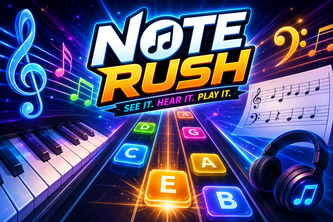
Note Rush — See It. Hear It. Play It. is a self-reported cross-platform music-learning game built using Flutter and PHP, with agentic development involving Codex and GPT-5.6. The product claims to integrate notation reading, rhythm, ear training, and instrument practice into six arcade-style games. It is described as playable in a browser without an account, with optional accounts for progress tracking and rankings.
What changed
The project description indicates a shift from traditional music education methods (separate exercises) to an integrated experience where learners connect symbols, sounds, and actions through gameplay. The use of agentic development tools like Codex and GPT-5.6 is highlighted as a key innovation in its creation.
Single most important open question
Is there evidence that Note Rush has achieved meaningful traction or adoption beyond the hackathon context? The description does not include any data on users, revenue, or customer engagement — all claims are self-reported.
What The Product Actually Is
The description states that Note Rush is a cross-platform music-learning game built with Flutter and PHP. It includes six arcade-style games designed to teach musical skills:
- Note Rush (read notes)
- Rhythm Rush (identify rhythms)
- Hearing Rush (recognize pitches)
- Playing Rush (play notes on instrument/voice)
- Echo Rush (repeat melodies)
- 10min Rush (five skill sections with scoring)
It supports treble clef, bass clef, or Grand Staff, and allows players to select tempo and difficulty levels. The game uses real-time pitch detection via microphone, which is processed on-device without uploading audio.
The product is described as playable in a browser without an account, with optional accounts for progress tracking, streaks, rankings, and leaderboards.
Claim
Note Rush is a complete, playable learning product.
- Evidence: The description states it includes six connected games covering visual, aural, rhythmic, physical, and memory-based musicianship.
- Inference: It supports one clear learning journey: recognizing symbols → connecting to sound → turning into action.
Positioning & Claim Evolution
The project positions itself as a music-learning tool that connects notation, rhythm, ear training, and instrument practice through game mechanics inspired by rhythm games. The tagline — “See it. Hear it. Play it.” — reflects this integration.
It claims to address the fragmentation of traditional music education by creating an immersive loop where learners experience all aspects simultaneously.
Claim
Learning music is often divided into separate exercises; Note Rush connects them from the beginning.
- Evidence: The description says: “Learning music is often divided into separate exercises... We wanted to make that connection happen from the beginning.”
Claim
It uses agentic development (Codex + GPT-5.6) to build the product.
- Evidence: The write-up states: “Note Rush was built in close collaboration with Codex and GPT-5.6... not by adding a decorative chatbot to a finished product, but by using agentic development throughout the real build.”
Target Customer & ICP
The description does not explicitly define a target customer or ideal customer profile (ICP). However, it implies that the product is aimed at music learners, particularly those who may benefit from gamified instruction.
It mentions support for different clefs and instruments, suggesting an audience that includes both beginners and intermediate learners. The optional Sound Check feature suggests attention to accessibility and calibration for various playing conditions.
Claim
Note Rush targets music learners seeking integrated practice.
- Evidence: The write-up says: “We wanted to make that connection happen from the beginning” — implying a learner-focused approach.
- Inference: It likely appeals to students, hobbyists, or educators looking for interactive tools.
Business Model & Pricing Evidence
There is no evidence of pricing information or business model in the description. The product can be played free in a browser without an account, and optional accounts are described as adding features like streaks, score history, rankings, and leaderboards.
Claim
Optional accounts add value beyond basic play.
- Evidence: “Optional accounts add practice streaks, score history, difficulty-specific progress graphs, personal rankings, and an opt-in public leaderboard.”
- Inference: This suggests a freemium model with monetization potential through premium features or subscriptions.
Technical & Delivery Signals
The project is built using Flutter (cross-platform), PHP, and integrates audio signal processing, pitch detection, and real-time microphone input. It uses Codex and GPT-5.6 for agentic development.
Key technical elements include:
- On-device pitch detection
- Cross-platform audio handling
- Responsive layouts for web, iOS, and Android
- Shared codebase across platforms
- Real-time feedback mechanisms
Claim
The product is built with agentic tools (Codex + GPT-5.6).
- Evidence: “Note Rush was built in close collaboration with Codex and GPT-5.6...”
- Inference: This indicates a modern, AI-assisted development approach.
Claim
Pitch detection works on-device.
- Evidence: “Microphone-enabled games use real-time, on-device pitch detection, and microphone audio is never uploaded.”
- Inference: Privacy-preserving design is emphasized.
Traction & Maturity Signals
There is no evidence of traction or maturity beyond the hackathon submission. The description makes no mention of:
- Users
- Revenue
- Customers
- Adoption metrics
- Product usage data
The only signal of progress is that it was submitted to a major hackathon (OpenAI 2026), and that it includes a playable browser version.
Claim
Note Rush is a complete, playable learning product.
- Evidence: The write-up lists accomplishments such as six games, cross-platform support, real-time pitch detection, and test suites.
- Inference: This suggests a mature prototype or MVP, but not yet proven market traction.
Competitive Context
The description does not reference competitors or the broader marketplace. It focuses on its own unique positioning — integrating notation, rhythm, ear training, and practice into one experience using gamification and AI.
Claim
Note Rush is positioned as a novel approach to music education.
- Evidence: “Inspired by the immediacy of rhythm games...” and “We wanted to make that connection happen from the beginning.”
- Inference: It aims to differentiate from traditional apps or tools that separate musical skills.
Open Questions & Risks
- No traction data: The product is described as a hackathon submission with no evidence of real-world adoption.
- Unverified claims: All statements are self-reported and unverified; there’s no third-party validation.
- Unclear monetization path: While optional accounts exist, there’s no indication of how they will be monetized.
- AI dependency risk: Heavy reliance on Codex and GPT-5.6 may not scale or be replicable outside the current development team.
- Technical complexity: Real-time pitch detection across platforms is challenging; lack of performance data raises concerns.
Open Question
No evidence of user engagement, retention, or revenue.
- Evidence: Not stated anywhere in the description.
- Inference: This could indicate a prototype or early-stage product lacking commercial viability.
Questions the description leaves open
- What is the expected user base for Note Rush beyond the hackathon?
- How does the team plan to monetize optional accounts and premium features?
- Has the pitch detection system been tested with real instruments in diverse environments?
- Are there plans to expand beyond the current six games or support more advanced notation?
- What is the long-term roadmap for platform expansion (e.g., desktop apps, webinars)?
- How does the team intend to validate educational effectiveness (e.g., learning outcomes)?
- Is there any internal testing or feedback from teachers or learners?
Overall Assessment
Not evidenced.
The description provides no information about:
- Revenue
- Customers
- Traction
- Market size
- Financials
- Team experience beyond the single founder (Benoit Valin)
This is a self-reported, unverified product description, likely representing an early-stage prototype or hackathon entry.
Assessment The project shows promise in concept and execution but lacks commercial due-diligence evidence. It cannot be evaluated for investment or partnership potential without further data on users, adoption, or financials.
User Stories BotA demo video on every pull request
Get a demo video on every new feature
GitHub App that watches your pull requests and records a narrated, captioned demo.
Save time on demo prep and make informed decisions faster with a video walkthrough of every new feature.
Source
Submitted to the OpenAI 2026 hackathon on Devpost. Project home on Devpost. Back to the full gallery on Devpost.
This competitive analysis was produced by top-founders.com (opens in a new tab)
Generated by a language model from this project's public Devpost page — its tagline, the author's own write-up and any built-with tags listed there — as captured in August 2026. Short quotations are the author's words. It is an opinion on the idea as a business, not on the people behind it, and it reflects the description as published then. If the project has moved on, request a correction below. The analysis is not independent research and contains no verified traction, revenue or customer data.
An independent guide by KFG International LLC — not affiliated with, endorsed by, or connected to Devpost or OpenAI.