

Archive position — measured, not model output
1 like on Devpost
505 of the 7,850 archived projects have more likes, and 1,758 share exactly 1 — so this project's #1,434 place in the like-ranked listing is a tie-break inside that group, not a ranking.
Projects (log scale)
Likes on Devpost. ▲ marks this project's group.
Show the figures
| Likes | Projects | Share of archive |
|---|---|---|
| 0 | 5,587 | 71.2% |
| 1 | 1,758 | 22.4% |
| 2 | 284 | 3.6% |
| 3–4 | 132 | 1.7% |
| 5–9 | 75 | 1.0% |
| 10+ | 14 | 0.2% |
 User Stories BotA demo video on every pull request
Get a demo video on every new feature
GitHub App that watches your pull requests and records a narrated, captioned demo.
Save time on demo prep and make informed decisions faster with a video walkthrough of every new feature.
Executive Summary
Company: Meeting Debt Collector
Self-reported purpose: A full-stack productivity app that turns meeting talk into accountability by extracting commitments, tracking deadlines, and automating follow-ups.
Key commercial signals: The description states the product is a full-stack app with backend and frontend components, supports integrations (Slack, Resend), and includes offline demo mode. It uses LLMs for extraction but allows deterministic fallbacks. No revenue, customers or traction data are provided.
Most important open question: Is there a real market need for this type of commitment-tracking tool, or is it a hackathon prototype with limited commercial viability?
What The Product Actually Is
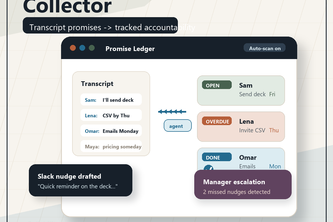
The description states that Meeting Debt Collector is a full-stack productivity app designed to extract commitments from meeting transcripts and track them through various lifecycle stages (open, due soon, overdue, escalated, done, dismissed). It supports manual correction, deadline scanning, escalation of repeated misses, and detection of completion evidence in follow-up transcripts.
It includes features such as:
- Commitment extraction with owners, deadlines, confidence levels, and reasoning
- Board view for visual tracking
- Nudging and escalation logic
- Calendar feeds, owner portals, analytics, and export capabilities
The app is built using Next.js, React, FastAPI, Python, and integrates with tools like OpenAI, Supabase, Slack, and Resend. It supports both offline demo mode and optional live integrations.
Inference: The tool appears to be a commitment-tracking assistant for teams, built as a prototype or MVP, likely targeting remote or distributed work environments where accountability is difficult to maintain.
Positioning & Claim Evolution
The description states that the app addresses a common problem: meeting commitments disappearing into chat scrollback and memory. It positions itself as a tool to turn spoken or written commitments into visible, actionable items with owners, deadlines, and follow-through tracking.
It claims to:
- Extract commitments from transcripts using LLMs
- Provide visibility into commitment status
- Automate nudges and escalations
- Support manual correction and review
Inference: The positioning is that of a productivity assistant for accountability, targeting teams or individuals who struggle with follow-through on meeting outcomes. It does not claim to be a replacement for existing project management tools, but rather a complementary layer focused on commitment tracking.
Target Customer & ICP
The description does not explicitly state the target customer or ideal customer profile (ICP). However, it implies that the tool is aimed at:
- Teams or individuals who attend meetings regularly
- Users who struggle with meeting follow-through
- Remote or distributed teams where commitments can easily get lost
Inference: The ICP likely includes productivity-focused professionals, project managers, and remote team leads. However, no evidence of customer personas, usage data, or market segmentation is provided.
Business Model & Pricing Evidence
The description does not provide any information on pricing, monetization strategy, or business model. It only states that the app supports integrations with services like Slack and Resend, and can run offline in demo mode.
Inference: There is no evidence of a paid version or commercial offering. The tool appears to be a prototype or hackathon submission, not a commercial product with a defined pricing structure.
Technical & Delivery Signals
The app is built using:
- Frontend: Next.js 16, React 19, TypeScript, Tailwind CSS
- Backend: FastAPI, Python, PostgreSQL (with Supabase fallback)
- LLMs: GPT-5.6 via Codex
- Integrations: Slack, Resend, calendar feeds
- Testing: 202 passing backend tests covering agent behavior, security, scheduler, and end-to-end flows
It supports:
- Deterministic fallbacks for integrations
- Offline demo mode
- One-command local setup (Windows/macOS/Linux)
- In-memory repository as default storage
Inference: The technical stack suggests a modular, scalable prototype, with a focus on reliability and ease of local deployment. It is designed to be extensible but currently lacks commercial-grade infrastructure or monetization features.
Traction & Maturity Signals
The description does not provide any evidence of traction, revenue, customer adoption, or usage metrics. It only describes the tool as a hackathon submission with:
- A demo flow
- Sample data included
- Local setup instructions
- Test coverage
Inference: There is no evidence of product-market fit, user engagement, or commercial viability beyond the prototype stage.
Competitive Context
The description does not mention any competitors. However, based on its functionality (commitment tracking, follow-up automation), it may overlap with:
- Project management tools like Asana, Notion, Monday.com
- Meeting productivity tools that extract action items
- AI-powered task tracking assistants
No evidence of competitive analysis or differentiation is provided.
Open Questions & Risks
- Prototype-only: The app is described as a hackathon submission with no commercial traction.
- No revenue or customer data: No evidence of monetization, users, or adoption.
- Unproven market need: The description does not validate demand for this specific tool.
- Overreliance on LLMs: While it supports deterministic fallbacks, the core functionality depends on AI extraction, which may be unreliable in real-world use.
- Limited integrations: Only a few optional integrations are mentioned; no evidence of a broader ecosystem.
Questions the description leaves open
- What is the actual problem you're solving, and how do you know it's significant?
- Have you tested this tool with real users or teams?
- How do you plan to monetize this product if you intend to commercialize it?
- What are your assumptions about user behavior and adoption?
- How does this differ from existing tools like Notion, Asana, or Slack?
- Are there any legal or privacy concerns with processing meeting transcripts?
Overall Assessment
Self-reported: Meeting Debt Collector is a hackathon prototype built to address the problem of lost commitments in meetings. It includes a full-stack demo with LLM-powered extraction and optional integrations, but no evidence of traction, revenue, or commercial viability.
Confidence level: Low — the description is self-reported and unverified, and lacks any data on users, customers, or market demand.
Assessment: Not ready for investment or partnership. The tool shows potential as a prototype, but there is no evidence of product-market fit, commercial traction, or scalability beyond a hackathon demo.
User Stories BotA demo video on every pull request
Get a demo video on every new feature
GitHub App that watches your pull requests and records a narrated, captioned demo.
Save time on demo prep and make informed decisions faster with a video walkthrough of every new feature.
Source
Submitted to the OpenAI 2026 hackathon on Devpost. Project home on Devpost. Back to the full gallery on Devpost.
This competitive analysis was produced by top-founders.com (opens in a new tab)
Generated by a language model from this project's public Devpost page — its tagline, the author's own write-up and any built-with tags listed there — as captured in August 2026. Short quotations are the author's words. It is an opinion on the idea as a business, not on the people behind it, and it reflects the description as published then. If the project has moved on, request a correction below. The analysis is not independent research and contains no verified traction, revenue or customer data.
An independent guide by KFG International LLC — not affiliated with, endorsed by, or connected to Devpost or OpenAI.