

Archive position — measured, not model output
1 like on Devpost
505 of the 7,850 archived projects have more likes, and 1,758 share exactly 1 — so this project's #1,435 place in the like-ranked listing is a tie-break inside that group, not a ranking.
Projects (log scale)
Likes on Devpost. ▲ marks this project's group.
Show the figures
| Likes | Projects | Share of archive |
|---|---|---|
| 0 | 5,587 | 71.2% |
| 1 | 1,758 | 22.4% |
| 2 | 284 | 3.6% |
| 3–4 | 132 | 1.7% |
| 5–9 | 75 | 1.0% |
| 10+ | 14 | 0.2% |
 User Stories BotA demo video on every pull request
Get a demo video on every new feature
GitHub App that watches your pull requests and records a narrated, captioned demo.
Save time on demo prep and make informed decisions faster with a video walkthrough of every new feature.
Executive Summary
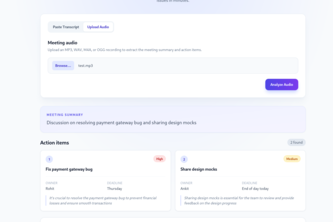
The description states that Meeting-to-Action Agent is a tool designed to convert meeting transcripts or audio recordings into structured action items, which are then automatically created as GitHub issues. The author reports building an end-to-end workflow using React, Node.js, Groq API, and GitHub REST API. It is presented as a hackathon project with no evidence of revenue, customers, or traction.
The single most important open question is: What is the actual commercial viability of this tool in real-world team environments, given that it requires manual input (e.g., personal access token) and appears to be built for demonstration rather than production use?
This analysis is based entirely on self-reported information from the project description. No independent verification or historical data are available.
What The Product Actually Is
The description states that Meeting-to-Action Agent:
- Takes meeting text transcripts or audio recordings as input
- Transcribes audio using Whisper
- Analyzes the content via AI (llama-3.3-70b-versatile accessed via Groq API) to extract structured action items including task, owner, deadline, priority, and rationale
- Displays results in a human-readable format for review
- Allows users to create GitHub issues from these action items by entering a GitHub owner, repository, and personal access token
It is described as an end-to-end tool that creates actual GitHub issues, not just mockups or dashboards.
Inference: The product appears to be a proof-of-concept workflow for converting meeting output into actionable work items in GitHub. It uses AI to extract structured data from unstructured inputs and integrates with GitHub for execution.
Positioning & Claim Evolution
The description states that the tool was inspired by teams spending time in meetings but lacking follow-through due to:
- Action items getting buried in transcripts
- Lack of clear ownership or deadlines
- Manual effort required to copy items into project trackers
It claims to close this gap by finding genuine commitments and sending them directly to GitHub.
The author also mentions that they're proud of:
- A real end-to-end workflow (GitHub issues created, not just mockups)
- Clean, human-readable AI output fully reviewable before creation
- Fast demo flow suitable for live presentation
Inference: The positioning is that of a productivity tool aimed at improving meeting-to-action conversion, particularly for teams already using GitHub. It positions itself as a solution to inefficiencies in current workflows.
Target Customer & ICP
The description does not explicitly name target customers or define an ideal customer profile (ICP). However, it implies:
- Teams that use GitHub for project management
- Users who attend meetings and want structured follow-up
- Developers or technical teams likely to benefit from automation of issue creation
Inference: The ICP likely includes small to mid-sized technical teams using GitHub, possibly in agile development environments where structured action items are critical.
Business Model & Pricing Evidence
There is no evidence provided about pricing, monetization strategy, or business model. The description only mentions that the tool creates actual GitHub issues and integrates with GitHub’s API.
Inference: No commercial model is evident from the self-reported description. It appears to be a prototype or hackathon project without any indication of how it would generate revenue.
Technical & Delivery Signals
The description states:
- Built with React + Tailwind CSS for frontend
- Node.js + Express for backend
- AI components: Groq API (Whisper for transcription, llama-3.3-70b-versatile for analysis)
- GitHub REST API for issue creation
- Developer AI used during development via Codex
Challenges mentioned include:
- Getting structured JSON output from LLMs
- Prompt engineering to extract only real commitments
- Secure handling of user-supplied tokens
- UI design for trustworthiness and error handling
Accomplishments noted:
- End-to-end workflow with actual GitHub issue creation
- Fast demo flow using sample data
- Human-readable AI results
Inference: The tool is technically feasible but built as a prototype. It shows some integration capability with GitHub and LLMs, though it lacks production-grade security or scalability features.
Traction & Maturity Signals
There is no evidence of traction, revenue, customers, or adoption beyond the author’s own account. The project was submitted to a hackathon and described as a proof-of-concept.
Inference: No signs of product-market fit or real-world usage are evident. It remains at the prototype stage.
Competitive Context
The description does not mention competitors or similar tools. However, based on the stated functionality, potential areas of overlap might include:
- Meeting summarization tools (e.g., Otter.ai, Notion AI)
- GitHub issue automation tools
- Task management integrations with meeting platforms
Inference: The competitive landscape is unclear due to lack of evidence. The tool seems niche and focused on a specific use case within the GitHub ecosystem.
Open Questions & Risks
Key risks and open questions based on the description:
- Security risk: Requires users to input personal access tokens directly into the UI, which could expose sensitive credentials.
- Limited scalability: Built for demonstration purposes; no evidence of handling large-scale or enterprise use cases.
- Dependency on AI accuracy: Relies heavily on LLMs to extract structured data from unstructured inputs — this is a known challenge in NLP.
- No production-ready features: Missing authentication, secure token handling, and support for multiple platforms or integrations beyond GitHub.
- Unproven commercial viability: No evidence of market demand or monetization strategy.
Inference: The tool is not ready for enterprise deployment and lacks key features needed for real-world adoption.
Questions the description leaves open
- What specific user pain points does this solve, and how do you know?
- How would you handle token security in a production environment?
- Are there any plans to support other platforms beyond GitHub (e.g., Jira, Asana)?
- Has the tool been tested with real users or teams?
- What are your thoughts on the accuracy of AI-generated action items? Have you seen false positives or missed commitments?
- How do you plan to monetize this product if it becomes viable?
Overall Assessment
The description states that Meeting-to-Action Agent is a hackathon project with no evidence of traction, revenue, or customer adoption.
Inference: At this stage, the tool is not ready for investment or partnership consideration. It lacks commercial viability, scalability, and production-readiness. It may be a promising idea but currently exists only as a proof-of-concept.
User Stories BotA demo video on every pull request
Get a demo video on every new feature
GitHub App that watches your pull requests and records a narrated, captioned demo.
Save time on demo prep and make informed decisions faster with a video walkthrough of every new feature.
Source
Submitted to the OpenAI 2026 hackathon on Devpost. Project home on Devpost. Back to the full gallery on Devpost.
This competitive analysis was produced by top-founders.com (opens in a new tab)
Generated by a language model from this project's public Devpost page — its tagline, the author's own write-up and any built-with tags listed there — as captured in August 2026. Short quotations are the author's words. It is an opinion on the idea as a business, not on the people behind it, and it reflects the description as published then. If the project has moved on, request a correction below. The analysis is not independent research and contains no verified traction, revenue or customer data.
An independent guide by KFG International LLC — not affiliated with, endorsed by, or connected to Devpost or OpenAI.