

Archive position — measured, not model output
0 likes on Devpost
2,263 of the 7,850 archived projects have more likes, and 5,587 share exactly 0 — so this project's #5,361 place in the like-ranked listing is a tie-break inside that group, not a ranking.
Projects (log scale)
Likes on Devpost. ▲ marks this project's group.
Show the figures
| Likes | Projects | Share of archive |
|---|---|---|
| 0 | 5,587 | 71.2% |
| 1 | 1,758 | 22.4% |
| 2 | 284 | 3.6% |
| 3–4 | 132 | 1.7% |
| 5–9 | 75 | 1.0% |
| 10+ | 14 | 0.2% |
 User Stories BotA demo video on every pull request
Get a demo video on every new feature
GitHub App that watches your pull requests and records a narrated, captioned demo.
Save time on demo prep and make informed decisions faster with a video walkthrough of every new feature.
Executive Summary
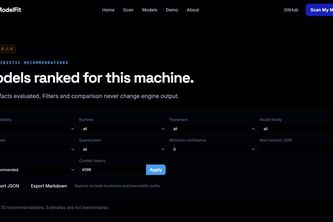
What the company appears to be: ModelFit is a self-reported developer tool that scans local hardware and recommends compatible local LLMs with configuration guidance. The author states it was built for the OpenAI 2026 hackathon, and no revenue, customers or traction data are available.
What changed: The project description shows an author-built tool focused on solving a specific problem — how to choose and configure local LLMs based on hardware capabilities. It is not described as having evolved from another product or business model.
Single most important open question: Is there any evidence of real-world usage, adoption, or traction beyond the author's own development work?
What The Product Actually Is
The description states that ModelFit:
- Scans or accepts a computer’s hardware profile including OS, CPU, GPU, memory, disk space, and installed runtimes.
- Evaluates a curated catalog of local LLM artifacts and produces artifact-level recommendations containing compatibility classification, quantization, execution strategy, runtime guidance, estimated memory allocation, practical context window, confidence score, reason codes, assumptions, unknown evidence, alternative artifacts, and safe launch-command templates.
- Supports six compatibility states: Excellent, Good, Usable, Slow, Unsupported, Indeterminate.
- Provides automatic local hardware scanning, manual entry, sample profiles, searchable model catalog, ranked results, deterministic explanations, optional GPT-5.6 explanations, runtime configuration guidance, comparison of up to three configurations, JSON/Markdown exports, and optional benchmark preflight and execution.
- Is built as a React + FastAPI monorepo using technologies like Docker, llama.cpp, Ollama, Pydantic, TanStack Query, Vitest, and more.
Inference: The tool appears to be a developer-facing utility for local LLM deployment and configuration, not a commercial product or service yet.
Positioning & Claim Evolution
The author states:
- ModelFit was inspired by the difficulty developers face in choosing local LLMs due to lack of hardware-awareness beyond basic metrics like parameter count or download size.
- It aims to replace guesswork with a transparent, hardware-aware system that explains not only whether a model can run but also tradeoffs involved.
- It serves as a future hardware-intelligence layer for QuantEngine, a separate project focused on compressing and optimizing models.
Inference: The positioning is that of a utility tool for developers working with local LLMs. It positions itself as more accurate and informative than existing tools or approaches, but no claims about market dominance, competitive differentiation, or adoption are made.
Target Customer & ICP
The description states:
- ModelFit targets developers who want to run large language models locally.
- It supports macOS, Linux, and Windows platforms.
- It is designed for users who need hardware-aware recommendations and runtime guidance.
Inference: The primary customer segment appears to be software engineers or technical users working with local AI models. No further segmentation or persona details are provided.
Business Model & Pricing Evidence
The description does not state:
- Whether ModelFit has a commercial business model.
- If it charges for access, features, or usage.
- Any pricing information or monetization strategy.
Not evidenced: No evidence of any business model or pricing structure is present in the self-reported description.
Technical & Delivery Signals
The description states:
- Built as a React + FastAPI monorepo using TypeScript, Tailwind CSS, TanStack Query, Vitest, Pydantic, JSON Schema, Docker, Ollama, llama.cpp, and others.
- Implements platform-specific scanners for macOS, Linux, and Windows with read-only, least-privileged access.
- Uses allowlisted process execution, strict timeouts, output limits, sanitized logging, and shell=False to ensure security.
- Includes a versioned, source-attributed catalog of 15 curated model variants and 30 GGUF artifacts.
- Implements deterministic compatibility engine using memory analysis formulas and handles missing metadata gracefully by lowering confidence rather than estimating.
- GPT-5.6 is used only for optional explanation and cannot override deterministic results.
Inference: The technical implementation shows a strong focus on correctness, security, and transparency. It avoids AI hallucinations by separating deterministic logic from optional NLP explanations.
Traction & Maturity Signals
The description states:
- ModelFit was submitted to the OpenAI 2026 hackathon.
- Includes over 100 backend tests and more than 30 frontend tests.
- Has a hosted-demo and local full-feature deployment modes.
- Never fabricates benchmark results, hardware support, missing model metadata, or local runtime availability.
Not evidenced: No evidence of revenue, customers, user base, or adoption beyond the author’s own development work. No data on usage frequency, retention, or engagement is provided.
Competitive Context
The description does not mention:
- Direct competitors in the local LLM compatibility space.
- How ModelFit compares to existing tools or platforms for local AI deployment.
Not evidenced: No competitive analysis or positioning relative to other tools is included.
Open Questions & Risks
The description states:
- Cross-platform hardware detection is complex and requires platform-specific adapters.
- Apple unified memory handling avoids double-counting but introduces complexity.
- Missing model metadata leads to lower confidence, not estimation.
- Runtime support versus theoretical support requires explicit evidence.
- AI-generated technical errors are mitigated by separating deterministic logic from optional explanations.
Inference: Risks include:
- Complexity of cross-platform compatibility.
- Dependency on accurate hardware and model metadata.
- Potential for misalignment between deterministic engine and optional GPT layer if not carefully controlled.
- Lack of real-world usage or feedback to validate assumptions.
Questions the description leaves open
- What is the actual utility or demand for this tool among developers?
- Are there any early adopters or users beyond the author’s own development?
- Has the tool been tested on a wide range of hardware configurations?
- How does ModelFit plan to scale its model catalog and support new runtimes?
- Is there any intention to commercialize the tool, and if so, how?
- What are the plans for integrating with QuantEngine, and what is the timeline for that?
- How do you intend to measure success or impact beyond internal testing?
Overall Assessment
The description states:
- ModelFit was built as a hackathon submission.
- It includes no revenue, customer, or traction data.
- The tool is described as functional and secure but not yet commercialized.
Inference: There is no evidence of a viable business model or market traction. The project appears to be an author-built prototype with strong technical execution, but no indication of commercial viability or scalability at this stage. It may have potential for future development or integration into larger ecosystems like QuantEngine, but currently lacks any demonstrated path to monetization or adoption.
Confidence Level: Low — based entirely on self-reported information without external validation or evidence of traction.
User Stories BotA demo video on every pull request
Get a demo video on every new feature
GitHub App that watches your pull requests and records a narrated, captioned demo.
Save time on demo prep and make informed decisions faster with a video walkthrough of every new feature.
Source
Submitted to the OpenAI 2026 hackathon on Devpost. Project home on Devpost. Back to the full gallery on Devpost.
This competitive analysis was produced by top-founders.com (opens in a new tab)
Generated by a language model from this project's public Devpost page — its tagline, the author's own write-up and any built-with tags listed there — as captured in August 2026. Short quotations are the author's words. It is an opinion on the idea as a business, not on the people behind it, and it reflects the description as published then. If the project has moved on, request a correction below. The analysis is not independent research and contains no verified traction, revenue or customer data.
An independent guide by KFG International LLC — not affiliated with, endorsed by, or connected to Devpost or OpenAI.