

Archive position — measured, not model output
0 likes on Devpost
2,263 of the 7,850 archived projects have more likes, and 5,587 share exactly 0 — so this project's #7,324 place in the like-ranked listing is a tie-break inside that group, not a ranking.
Projects (log scale)
Likes on Devpost. ▲ marks this project's group.
Show the figures
| Likes | Projects | Share of archive |
|---|---|---|
| 0 | 5,587 | 71.2% |
| 1 | 1,758 | 22.4% |
| 2 | 284 | 3.6% |
| 3–4 | 132 | 1.7% |
| 5–9 | 75 | 1.0% |
| 10+ | 14 | 0.2% |
 User Stories BotA demo video on every pull request
Get a demo video on every new feature
GitHub App that watches your pull requests and records a narrated, captioned demo.
Save time on demo prep and make informed decisions faster with a video walkthrough of every new feature.
Executive Summary
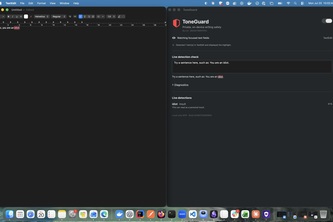
ToneGuard is a self-reported macOS application that claims to run an on-device AI model for real-time detection of toxic or off-tone language in text. The author states it was built as part of a hackathon and does not collect or send user data to the internet. It is described as a privacy-first tool, designed to help users communicate thoughtfully by flagging potentially negative language before messages are sent.
The project’s positioning centers on privacy and real-time feedback in communication. The author claims it uses Swift and macOS native development with an integrated ML model, though no technical details or performance metrics are provided.
Key open question: Is there evidence that this product has any traction, revenue, or adoption beyond the single developer's prototype?
The description is entirely self-reported and unverified — no third-party validation, no customer data, no financials, no product usage. The author states a vision but not a realized business model or market presence.
What The Product Actually Is
- The description states that ToneGuard is a native macOS app.
- It uses Swift and integrates an on-device ML model.
- It is designed to detect toxic, negative, or off-tone language in real time, highlighting it before the user sends a message.
- It does not use the internet or cloud processing, according to the author.
Inference: The product appears to be a proof-of-concept or prototype built for a hackathon. No evidence of commercial deployment or scalability beyond macOS is provided.
Positioning & Claim Evolution
- The author positions ToneGuard as a privacy-first communication tool.
- It is described as helping people communicate thoughtfully without sending text to the internet.
- The app is framed as a real-time feedback mechanism, intended to help users avoid unintended negative interpretations of their messages.
Inference: The positioning reflects a strong emphasis on privacy and user intent, but no evidence suggests this has evolved from an idea into a product with market traction or customer feedback loops.
Target Customer & ICP
- The description states that ToneGuard is built for people who want to communicate thoughtfully.
- It targets users of macOS, as it is a native macOS app.
- No specific personas, use cases, or behavioral segments are detailed.
Inference: The target customer is not clearly defined beyond "users of macOS" and those concerned with communication tone. No evidence of market research or user segmentation exists.
Business Model & Pricing Evidence
- The description does not state a business model.
- There is no mention of pricing, monetization, or revenue streams.
- The app is described as a prototype, built for a hackathon.
Inference: No evidence of any commercial model, pricing strategy, or monetization plan exists. The project appears to be non-commercial in nature.
Technical & Delivery Signals
- The app is built using Swift and runs on macOS.
- It uses an on-device ML model, with no internet access or cloud processing.
- The author mentions that Codex helped with implementation details, suggesting use of AI-assisted development tools.
- The app provides real-time feedback.
Inference: Technical delivery is limited to a prototype, and no evidence of scalability, performance data, or production-grade infrastructure is provided. The use of Codex suggests a rapid prototyping approach.
Traction & Maturity Signals
- The project was submitted to the OpenAI 2026 hackathon.
- It is described as a working prototype, not a commercial product.
- No evidence of customer adoption, usage metrics, or product maturity beyond the initial build is provided.
Inference: There is no evidence of traction, user engagement, or product development beyond the initial hackathon submission. The project appears to be in an early stage of development.
Competitive Context
- The description does not mention competitors.
- No evidence of existing tools or platforms addressing similar privacy-first communication feedback is provided.
- The app’s positioning as a privacy-focused, on-device AI tool may align with emerging trends in data privacy and AI ethics.
Inference: No competitive analysis is evident. The project does not appear to be part of an existing market or ecosystem.
Open Questions & Risks
- The project is described as a single-developer hackathon submission, with no team, funding, or commercial traction.
- It is unclear whether the app has been tested in real-world conditions or validated with users.
- No evidence of product-market fit, scalability, or long-term viability exists.
- The author’s claim that it "does not rely on the internet" may be a marketing feature, but no technical validation or performance data is provided.
Inference: The lack of any commercial or user-facing evidence raises significant concerns about whether this is a viable product or just an idea.
Questions the description leaves open
- What is the specific use case you are targeting, and how did you identify it?
- How does your on-device ML model perform in real-world scenarios?
- Have you conducted any user testing or feedback sessions?
- What are the technical limitations of running this on macOS only?
- Is there a roadmap for expansion beyond English or macOS?
- What is your plan for monetization, if any?
Overall Assessment
- The project is described as a single-developer hackathon submission, with no evidence of traction, revenue, or commercial viability.
- It is not evident that the product has moved beyond a prototype stage.
- There is no indication of a scalable business model, customer base, or competitive positioning.
Inference: Based on the self-reported description alone, there is no evidence to support an investment or partnership opportunity. The project appears to be an early-stage idea with no demonstrated commercial potential.
User Stories BotA demo video on every pull request
Get a demo video on every new feature
GitHub App that watches your pull requests and records a narrated, captioned demo.
Save time on demo prep and make informed decisions faster with a video walkthrough of every new feature.
Source
Submitted to the OpenAI 2026 hackathon on Devpost. Project home on Devpost. Back to the full gallery on Devpost.
This competitive analysis was produced by top-founders.com (opens in a new tab)
Generated by a language model from this project's public Devpost page — its tagline, the author's own write-up and any built-with tags listed there — as captured in August 2026. Short quotations are the author's words. It is an opinion on the idea as a business, not on the people behind it, and it reflects the description as published then. If the project has moved on, request a correction below. The analysis is not independent research and contains no verified traction, revenue or customer data.
An independent guide by KFG International LLC — not affiliated with, endorsed by, or connected to Devpost or OpenAI.