

Archive position — measured, not model output
0 likes on Devpost
2,263 of the 7,850 archived projects have more likes, and 5,587 share exactly 0 — so this project's #5,360 place in the like-ranked listing is a tie-break inside that group, not a ranking.
Projects (log scale)
Likes on Devpost. ▲ marks this project's group.
Show the figures
| Likes | Projects | Share of archive |
|---|---|---|
| 0 | 5,587 | 71.2% |
| 1 | 1,758 | 22.4% |
| 2 | 284 | 3.6% |
| 3–4 | 132 | 1.7% |
| 5–9 | 75 | 1.0% |
| 10+ | 14 | 0.2% |
 User Stories BotA demo video on every pull request
Get a demo video on every new feature
GitHub App that watches your pull requests and records a narrated, captioned demo.
Save time on demo prep and make informed decisions faster with a video walkthrough of every new feature.
Executive Summary
What the company appears to be
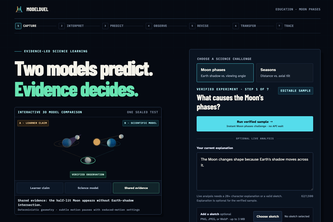
ModelDuel is a browser-based educational tool designed to help learners confront and revise misconceptions in science (specifically astronomy) through an interactive sequence: capture → interpret → predict → observe → revise → transfer → trace. It uses AI models to extract learner mental models and provide feedback, while deterministic code governs simulation, evidence revelation, and grading.
What changed
The project was submitted as part of the OpenAI 2026 hackathon. The description indicates it is a prototype built in a short timeframe, with no revenue or customer data available. It includes both live and verified (authored) paths for interaction, with clear separation between AI-assisted interpretation and deterministic application logic.
Single most important open question
Is there evidence that the tool’s pedagogical design—particularly its use of prediction-before-evidence and conceptual revision—is effective in changing learner understanding? The description states no learning outcome data or validation beyond pilot feasibility signals.
What The Product Actually Is
The description states that ModelDuel is a browser-based educational experience for learners to explore scientific misconceptions. It guides users through a structured sequence involving:
- Capture: Learner explains an idea (text or sketch).
- Interpret: AI extracts the learner’s mental model.
- Predict: Learner makes a prediction before seeing evidence.
- Observe: Evidence is revealed in a deterministic simulation.
- Revise: Learner revises their explanation with feedback from AI.
- Transfer: Learner answers a new question to test understanding.
- Trace: A compact summary of the revision process is preserved for review.
The tool uses GPT-5.6 Terra and Luna for model interpretation and feedback, but all simulations, evidence, and grading are handled by deterministic code (e.g., Three.js, Cloudflare Workers). The system distinguishes between live and verified paths, with the latter not requiring API keys or paid model calls.
Inference The product is a prototype educational tool built for a hackathon. It is not described as a commercial SaaS offering, nor does it include any mention of pricing, subscriptions, or monetization.
Positioning & Claim Evolution
The description states that ModelDuel was inspired by the idea that correct answers don’t necessarily reflect conceptual change in learners. It aims to make misconceptions “runnable predictions” that must face evidence.
Claims made
- The tool helps learners revise mental models through a structured pedagogical loop.
- It distinguishes between AI-assisted interpretation and deterministic truth in science.
- It avoids handing grading authority or scientific truth to the model.
- It supports both live and verified (authored) paths, clearly labeled.
Inference The positioning is educational and focused on conceptual learning design. The tool does not claim to be a general-purpose AI tutor or platform but rather a specific pedagogical framework for addressing misconceptions in science.
Target Customer & ICP
The description states that the first pilot is one middle-school astronomy lesson, targeting learners who are working through misconceptions like Earth’s shadow causing moon phases or distance causing seasons.
Claims made
- The tool targets students in middle school.
- It focuses on specific scientific misconceptions.
- It is designed for use in a classroom setting with teacher review of learner traces.
Inference The ICP appears to be educators and learners in K–12 science education, particularly those working with conceptual change. No evidence suggests it targets enterprise or higher education users.
Business Model & Pricing Evidence
Not evidenced.
Absence of evidence
There is no mention of pricing, subscriptions, monetization, or business model in the description.
Technical & Delivery Signals
The tool is built using:
- Frontend: Next.js, React, TypeScript, Three.js
- Backend: Cloudflare Workers, OpenAI API (GPT-5.6 Terra and Luna), Playwright, Zod schemas
- AI integration: Programmatic Tool Calling, structured outputs, validated GPT responses
- Security & privacy: Store: false for live data; server-side evaluation tokens; fail-closed design
Claims made
- The system separates AI interpretation from deterministic truth.
- Live paths are schema-constrained and cost-bounded.
- Verified samples do not require API keys or paid model calls.
- The tool supports WebGL fallbacks and responsive layouts.
Inference The architecture is designed with a strong emphasis on security, control, and reproducibility. It uses a hybrid approach where AI is used for interpretation and feedback, while deterministic code handles truth and grading.
Traction & Maturity Signals
Not evidenced.
Absence of evidence
There is no mention of users, customers, revenue, or adoption metrics. The project is described as a hackathon submission with no indication of production use or growth.
Competitive Context
Not evidenced.
Absence of evidence
The description does not name competitors or describe the broader market landscape for AI-powered conceptual learning tools.
Open Questions & Risks
- No learning outcome data: The tool is described as a pilot with feasibility signals, but no evidence of causal learning gain.
- Unproven pedagogical design: While it uses a structured loop, there is no validation that this approach works in practice.
- Limited scope: Only two astronomy misconceptions are implemented; no indication of scalability or broader content support.
- No commercialization path: The tool is described as a prototype with no mention of monetization or product-market fit.
- Dependency on AI models: While the system uses AI for interpretation, it does not describe how model performance or accuracy will be validated or improved.
Questions the description leaves open
- What specific learning outcomes are you trying to measure in your pilot?
- How do you plan to validate that learners actually revise their misconceptions through this process?
- Are there any plans to expand beyond the two astronomy scenarios?
- What is the long-term vision for monetization or scaling the tool?
- How do you ensure consistency and accuracy of AI interpretation across different learner inputs?
Overall Assessment
Not evidenced.
Absence of evidence
There is no indication of funding, valuation, or investment interest in the project. The description does not suggest a commercial or growth-equity opportunity beyond its hackathon prototype status.
User Stories BotA demo video on every pull request
Get a demo video on every new feature
GitHub App that watches your pull requests and records a narrated, captioned demo.
Save time on demo prep and make informed decisions faster with a video walkthrough of every new feature.
Source
Submitted to the OpenAI 2026 hackathon on Devpost. Project home on Devpost. Back to the full gallery on Devpost.
This competitive analysis was produced by top-founders.com (opens in a new tab)
Generated by a language model from this project's public Devpost page — its tagline, the author's own write-up and any built-with tags listed there — as captured in August 2026. Short quotations are the author's words. It is an opinion on the idea as a business, not on the people behind it, and it reflects the description as published then. If the project has moved on, request a correction below. The analysis is not independent research and contains no verified traction, revenue or customer data.
An independent guide by KFG International LLC — not affiliated with, endorsed by, or connected to Devpost or OpenAI.