

Archive position — measured, not model output
1 like on Devpost
505 of the 7,850 archived projects have more likes, and 1,758 share exactly 1 — so this project's #1,433 place in the like-ranked listing is a tie-break inside that group, not a ranking.
Projects (log scale)
Likes on Devpost. ▲ marks this project's group.
Show the figures
| Likes | Projects | Share of archive |
|---|---|---|
| 0 | 5,587 | 71.2% |
| 1 | 1,758 | 22.4% |
| 2 | 284 | 3.6% |
| 3–4 | 132 | 1.7% |
| 5–9 | 75 | 1.0% |
| 10+ | 14 | 0.2% |
 User Stories BotA demo video on every pull request
Get a demo video on every new feature
GitHub App that watches your pull requests and records a narrated, captioned demo.
Save time on demo prep and make informed decisions faster with a video walkthrough of every new feature.
Executive Summary
What the company appears to be
MeetGuard is a self-reported macOS menu bar application designed to prevent users from missing online meetings by displaying an unmissable fullscreen alert before scheduled events. It scans the user's Mac calendar locally, identifies conferencing links (Zoom, Teams, Webex, Google Meet), and provides one-click joining and cross-Mac sync via iCloud.
What changed
The project description indicates a shift from general productivity tooling to a privacy-focused, local-first meeting reminder app with potential for expansion beyond online meetings into broader calendar-based reminders.
Single most important open question
Does MeetGuard have any users or customers, and if so, what is their feedback on utility, usability, or adoption?
What The Product Actually Is
The description states that MeetGuard is a lightweight, native macOS menu bar app. It uses Apple's EventKit APIs to read calendar events directly on the device and identifies conferencing links from platforms such as Zoom, Microsoft Teams, Webex, and Google Meet.
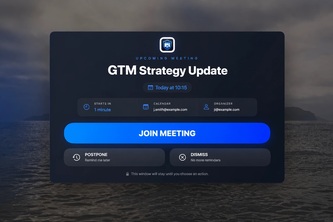
It displays a fullscreen alert shortly before meetings begin, appearing across connected displays, with options for one-click joining or dismissing the alert. The app runs entirely locally without requiring external services, backend infrastructure, or third-party frameworks.
The author notes that it was built using Swift and SwiftUI, leveraging Codex for development assistance, and integrates with Apple's native iCloud key-value storage for preference synchronization between Macs.
Evidence The description explicitly defines MeetGuard as a macOS menu bar app that uses local calendar APIs to detect meetings and display alerts. It does not state whether the app has been released or used beyond its creator’s own use case.
Positioning & Claim Evolution
The author claims that MeetGuard addresses a problem of missing important commitments during deep work, where ordinary notifications are easily overlooked. The product is positioned as a solution that provides an “impossible-to-ignore” alert without sending calendar data to another company or relying on external services.
It emphasizes privacy, stating that it does not require users to create accounts or share calendar data with unknown companies. It also highlights its local-first design, which avoids cloud dependencies and supports energy-efficient operation.
The author mentions a future expansion beyond online meetings, suggesting an evolution toward broader calendar-based reminder functionality.
Inference The positioning appears to be evolving from a niche productivity tool for developers to a more general-purpose meeting/reminder utility with privacy as a key differentiator.
Target Customer & ICP
The description states that MeetGuard targets individuals who experience missing calendar notifications during deep work, particularly those engaged in programming or other demanding tasks.
It is described as a menu bar app, implying it is aimed at users comfortable with macOS native applications and likely tech-savvy. The app’s design suggests it appeals to professionals who value privacy, efficiency, and minimal disruption.
There is no mention of enterprise customers, B2B use cases, or specific industries beyond personal productivity.
Evidence The target customer is inferred from the stated problem: people missing meetings due to deep focus, but no explicit segmentation or persona data is provided.
Business Model & Pricing Evidence
The description does not provide any information about pricing, monetization, or business model. It only describes the app's functionality and technical architecture.
There is no indication of whether MeetGuard will be sold, offered as freemium, subsidized by a larger company, or otherwise monetized.
Evidence Not evidenced.
Technical & Delivery Signals
MeetGuard is built using Swift and SwiftUI, leveraging Apple’s native APIs including EventKit for calendar access and iCloud key-value storage for syncing preferences across Macs.
It uses Codex to accelerate development from architecture through testing and packaging. The app is described as running entirely locally, without backend infrastructure or third-party dependencies.
Key technical features include:
- Fullscreen alert display across multiple displays
- One-click meeting joining
- Cross-Mac sync via iCloud
- Detection of conferencing links in various calendar fields (URL, location, notes, title)
- Prevention of duplicate alerts and consistent dismissal state
Evidence The description provides a clear account of the app’s technical stack and delivery approach, but does not indicate whether it has been released or tested by others.
Traction & Maturity Signals
The project is described as a single-person effort, with no mention of users, customers, or adoption metrics. It was submitted to a hackathon (OpenAI 2026), suggesting it may be in early development or prototype stage.
There is no evidence of revenue, customer feedback, usage data, or product-market fit beyond the author’s own experience.
Evidence Not evidenced.
Competitive Context
The description does not reference any competitors. However, based on its stated functionality — preventing missed meetings via fullscreen alerts and one-click joining — it likely competes with:
- Native macOS calendar apps (e.g., Apple Calendar)
- Third-party meeting notification tools
- Productivity utilities that integrate with calendar services
No specific competitive analysis or differentiation strategy is provided.
Inference The app may be positioned as a lightweight, privacy-focused alternative to existing calendar-based meeting reminder systems, but no comparison data is given.
Open Questions & Risks
- Lack of traction: No evidence of users, customers, or adoption.
- Single-founder development: A single-person team raises concerns about scalability and long-term maintenance.
- No monetization strategy: No indication of how the product will generate revenue.
- Limited scope: While it currently focuses on online meetings, there is no clarity on how or when the expansion to other calendar events will occur.
- Privacy vs. utility trade-off: The local-first approach may limit features or user experience compared to cloud-based alternatives.
Inference These risks are based on the absence of evidence for key business and product indicators.
Questions the description leaves open
- Has MeetGuard been released publicly, and if so, how many users does it have?
- What is the intended monetization model, and has any revenue been generated?
- How does MeetGuard handle edge cases in calendar event formatting (e.g., malformed URLs or ambiguous meeting details)?
- Are there plans to support additional platforms or integrations beyond Zoom, Teams, Webex, and Google Meet?
- What is the timeline for expanding functionality beyond online meetings?
Overall Assessment
The description presents MeetGuard as a conceptual prototype built by one individual, with no evidence of traction, revenue, or customer base. It is described as a privacy-focused, local-first tool that addresses a real pain point but lacks any commercial validation.
There is insufficient evidence to assess whether this represents a viable business opportunity or product-market fit.
Confidence Low — the description is self-reported and unverified, with no external data on adoption, usage, or financials. The project appears to be in early development or pre-launch phase.
User Stories BotA demo video on every pull request
Get a demo video on every new feature
GitHub App that watches your pull requests and records a narrated, captioned demo.
Save time on demo prep and make informed decisions faster with a video walkthrough of every new feature.
Source
Submitted to the OpenAI 2026 hackathon on Devpost. Project home on Devpost. Back to the full gallery on Devpost.
This competitive analysis was produced by top-founders.com (opens in a new tab)
Generated by a language model from this project's public Devpost page — its tagline, the author's own write-up and any built-with tags listed there — as captured in August 2026. Short quotations are the author's words. It is an opinion on the idea as a business, not on the people behind it, and it reflects the description as published then. If the project has moved on, request a correction below. The analysis is not independent research and contains no verified traction, revenue or customer data.
An independent guide by KFG International LLC — not affiliated with, endorsed by, or connected to Devpost or OpenAI.