

Archive position — measured, not model output
0 likes on Devpost
2,263 of the 7,850 archived projects have more likes, and 5,587 share exactly 0 — so this project's #5,163 place in the like-ranked listing is a tie-break inside that group, not a ranking.
Projects (log scale)
Likes on Devpost. ▲ marks this project's group.
Show the figures
| Likes | Projects | Share of archive |
|---|---|---|
| 0 | 5,587 | 71.2% |
| 1 | 1,758 | 22.4% |
| 2 | 284 | 3.6% |
| 3–4 | 132 | 1.7% |
| 5–9 | 75 | 1.0% |
| 10+ | 14 | 0.2% |
 User Stories BotA demo video on every pull request
Get a demo video on every new feature
GitHub App that watches your pull requests and records a narrated, captioned demo.
Save time on demo prep and make informed decisions faster with a video walkthrough of every new feature.
Executive Summary
What the company appears to be
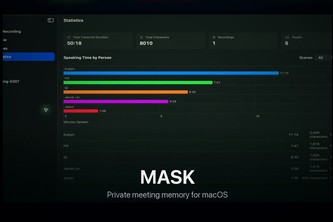
MASK is a macOS-native meeting memory application that records audio locally, performs speaker diarization and voice recognition, and integrates with OpenAI's Codex to provide structured context for follow-on work. It claims to offer privacy-first functionality by keeping audio processing local and allowing users to optionally connect to Codex for summarization or task generation.
What changed
The project is described as a self-contained macOS app built during an OpenAI hackathon, with no evidence of prior existence, funding, or commercial traction. The author states it was developed over a short period (Build Week) and submitted to the 2026 OpenAI hackathon.
Single most important open question
Is there any evidence that MASK has been used beyond the development environment, or that users have adopted its functionality in real-world workflows?
What The Product Actually Is
The description states that MASK is a native macOS meeting-memory app that runs on Apple Silicon. It uses:
- MOSS for transcription and speaker diarization
- Voice embeddings to recognize recurring speakers across meetings
- Manual corrections override automatic identity matches
- Scenes to organize recurring meetings and learn participants from recordings
- Live mode for recording microphone, system audio, or a mixed signal
- A 3D PCA view showing voiceprint clustering in embedding space
- Support for generating meeting minutes, TL;DRs, and per-speaker viewpoint analysis
It also includes:
- An interface available in English and Traditional Chinese
- Integration with Codex via a localhost-based callback system
- Two privacy modes: one using a local 2-bit model (MLX), another optionally connecting to Codex while keeping audio local
- A security mechanism where callbacks use short-lived, unguessable capabilities scoped to individual jobs
Inference The app appears to be a prototype or proof-of-concept built for a hackathon, not yet a commercial product.
Positioning & Claim Evolution
The author positions MASK as:
- A private, durable memory layer on the Mac
- A bridge between human conversation and Codex, enabling structured context for follow-on work
- An alternative to tools that flatten conversations into generic transcripts (e.g., “Speaker 1” and “Speaker 2”)
Inference The positioning implies a shift from meeting tools focused on transcription or recording to ones that add semantic meaning and continuity across meetings. However, the description does not indicate whether this is a new market category or an evolution of existing tools.
Target Customer & ICP
The description states:
- MASK targets users who attend recurring meetings
- It supports macOS users who want structured context from conversations
- The integration with Codex suggests it appeals to those using AI agents for follow-up tasks
Inference The target customer likely includes professionals or teams that rely on meeting notes and decision-making documentation, particularly those already using or interested in tools like Codex.
Business Model & Pricing Evidence
There is no evidence of pricing, monetization strategy, or business model in the description. The author does not mention:
- Subscription plans
- Freemium tiers
- One-time purchases
- Enterprise licensing
- Revenue streams
Inference The project appears to be a prototype with no commercialization plan evident.
Technical & Delivery Signals
The app is built using:
- Swift and SwiftUI for UI
- Core Audio for live capture
- MOSS for transcription and speaker diarization
- MLX for local inference
- GRDB for data persistence
- OpenAI Codex integration via localhost callbacks
- A modular architecture with multiple SPM modules
Inference The technical stack suggests a native macOS app built with modern Apple technologies, with some AI components running locally. The use of MLX and CoreML indicates an emphasis on privacy and performance.
Traction & Maturity Signals
The description states:
- The final release build succeeds
- 80 tests across 23 suites pass
- Coverage includes database migrations, diarization invariants, persistent identity, summary map-reduce, API completeness, and Codex lifecycle management
Inference There is no evidence of user adoption, customer feedback, or real-world usage beyond the development team. The project appears to be a functional prototype but lacks any sign of traction.
Competitive Context
The description does not mention competitors or market positioning relative to existing tools. It implies MASK is distinct from generic meeting recording or transcription tools due to:
- Speaker-aware context
- Cross-meeting memory
- Integration with Codex
Inference MASK may be positioned as a niche tool for users who want more structured and private meeting memory, but there is no indication of how it compares to existing solutions in the market.
Open Questions & Risks
- No evidence of real-world usage or adoption
- No commercialization strategy or revenue model
- Prototype-level functionality with no production deployment
- No third-party validation or user feedback
- Self-reported claims without external corroboration
Inference The project is in a very early stage and lacks any signs of product-market fit or commercial viability.
Questions the description leaves open
- What was the actual scope of development during Build Week?
- Has MASK been tested with real users beyond the development team?
- Are there plans to expand beyond macOS or support other platforms?
- How does the integration with Codex work in practice—what are the limitations or edge cases?
- Is there any plan for monetization or commercial deployment?
Overall Assessment
Not evidenced.
The description provides no evidence of:
- Revenue
- Customers
- Traction
- Market validation
- Commercial viability
This is a self-reported prototype, likely built during a hackathon, with no indication that it has moved beyond the development stage or gained any user adoption.
Confidence: Low.
The analysis is based entirely on self-reported claims and lacks any external validation or evidence of product-market fit or commercial traction.
User Stories BotA demo video on every pull request
Get a demo video on every new feature
GitHub App that watches your pull requests and records a narrated, captioned demo.
Save time on demo prep and make informed decisions faster with a video walkthrough of every new feature.
Source
Submitted to the OpenAI 2026 hackathon on Devpost. Project home on Devpost. Back to the full gallery on Devpost.
This competitive analysis was produced by top-founders.com (opens in a new tab)
Generated by a language model from this project's public Devpost page — its tagline, the author's own write-up and any built-with tags listed there — as captured in August 2026. Short quotations are the author's words. It is an opinion on the idea as a business, not on the people behind it, and it reflects the description as published then. If the project has moved on, request a correction below. The analysis is not independent research and contains no verified traction, revenue or customer data.
An independent guide by KFG International LLC — not affiliated with, endorsed by, or connected to Devpost or OpenAI.