

Archive position — measured, not model output
0 likes on Devpost
2,263 of the 7,850 archived projects have more likes, and 5,587 share exactly 0 — so this project's #5,151 place in the like-ranked listing is a tie-break inside that group, not a ranking.
Projects (log scale)
Likes on Devpost. ▲ marks this project's group.
Show the figures
| Likes | Projects | Share of archive |
|---|---|---|
| 0 | 5,587 | 71.2% |
| 1 | 1,758 | 22.4% |
| 2 | 284 | 3.6% |
| 3–4 | 132 | 1.7% |
| 5–9 | 75 | 1.0% |
| 10+ | 14 | 0.2% |
 User Stories BotA demo video on every pull request
Get a demo video on every new feature
GitHub App that watches your pull requests and records a narrated, captioned demo.
Save time on demo prep and make informed decisions faster with a video walkthrough of every new feature.
Executive Summary
What the company appears to be
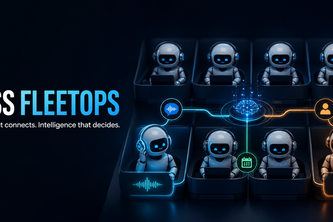
IASS FleetOps, as described by the author, is a self-reported AI-powered voice operations platform for automotive service centers. It supports inbound and outbound call handling, scheduling, safety escalation, and customer engagement through specialized agents powered by GPT-5.6 and integrated with tools like n8n, Google Calendar, WhatsApp, and Twilio.
What changed
The author describes a transition from a local Portuguese prototype to a cloud-hosted English version, using Codex for rapid development and deployment. The platform now includes structured decision-making via GPT-5.6, automated tests, and a browser-based demo experience.
Single most important open question — the commercial due-diligence read
Is there evidence of real-world traction or customer validation beyond the author’s prototype? The description states no revenue, customers, or adoption data exist; all claims are self-reported and unverified.
What The Product Actually Is
The description states that IASS FleetOps is a bilingual AI-powered voice operations center for fleet service, customer care, sales, scheduling, and safety escalation. It includes:
- Inbound and outbound agents that conduct natural conversations
- Agents capable of adapting tone to customer mood and urgency
- Integration with calendar systems (Google Calendar) and messaging platforms (WhatsApp)
- Escalation protocols for safety-critical situations
- A GPT-5.6 supervisor layer that interprets conversation context and recommends actions
The platform is built using technologies such as:
- OpenAI GPT-5.6
- ElevenLabs voice agents
- n8n workflows
- Google Calendar
- Twilio telephony (optional)
- React, Next.js, TypeScript
Not evidenced No actual product demo, customer feedback, or live deployment details are provided.
Positioning & Claim Evolution
The author positions IASS FleetOps as a voice operations platform that connects customers with intelligent automation, aiming to reduce manual labor in automotive service centers while maintaining human oversight where needed.
Key claims:
- The system supports an entire service center through AI voice agents.
- It protects schedules, prevents double bookings, and handles follow-ups automatically.
- It detects safety issues and escalates them to humans.
- It does not aim to eliminate people but to scale human teams with AI support.
Inference The positioning suggests a move from a proof-of-concept tool toward a scalable SaaS or service platform for automotive dealerships, though this is not yet evidenced in the description.
Target Customer & ICP
The author identifies automotive dealerships and service centers as primary users. These entities are described as facing:
- Labor shortages
- High turnover in customer-facing roles
- Repetitive tasks such as scheduling, follow-ups, confirmations, and rescheduling
The platform is intended to help these businesses:
- Grow customer relationships
- Reduce workload on human agents
- Maintain consistent service quality
Not evidenced No specific customer segments, personas, or use cases beyond general automotive service operations are detailed.
Business Model & Pricing Evidence
The description does not contain any information about:
- Revenue model (e.g., subscription, per-agent, per-call)
- Pricing structure
- Monetization strategy
- Customer acquisition plans
Not evidenced No evidence of a business model or pricing framework exists in the provided text.
Technical & Delivery Signals
The platform is described as:
- Fully hosted and cloud-based
- Built with modern tech stack including React, Next.js, TypeScript, OpenAI APIs, ElevenLabs, n8n, Twilio, Google Calendar
- Deployed using Codex for rapid development
- Includes automated tests for safety, scheduling, branding, and secret protection
- Supports synthetic customer scenarios for testing
Inference The architecture separates responsibilities among voice agents, deterministic rules, GPT supervision, and human escalation — suggesting a modular design approach.
Traction & Maturity Signals
There is no evidence of traction or maturity in the description:
- No customers, users, or pilot programs are mentioned
- No revenue data or usage metrics are provided
- No product roadmap beyond “next steps” is detailed
- The project remains a prototype or early-stage tool
Not evidenced No real-world adoption, performance data, or user feedback is available.
Competitive Context
The description does not mention:
- Direct competitors
- Market size or competitive landscape
- Differentiation from existing voice automation tools in automotive or B2B sectors
Not evidenced No competitive analysis or positioning relative to other platforms is included.
Open Questions & Risks
Several risks and open questions are present based on the self-reported nature of the description:
- Unverified claims: All features, functionality, and outcomes are stated by the author without external validation.
- Prototype-only status: The system appears to be a working prototype, not a production-ready product.
- No commercial traction: No evidence of customers, revenue, or adoption exists.
- High technical complexity: Combining voice agents, scheduling, safety protocols, and AI decision-making is complex; lack of real-world testing raises concerns.
- Single-founder project: With only one team member (Alvaro Lima), scalability and execution risk are high.
Questions the description leaves open
- What specific problems have you solved in your local prototype, and how do they map to broader market needs?
- Have you conducted any user testing or feedback sessions with actual automotive dealerships?
- How does the system handle edge cases or unexpected customer behavior?
- Is there a plan for integrating with CRM systems or existing dealership infrastructure?
- What is your go-to-market strategy, and how do you intend to scale beyond the current prototype?
Overall Assessment
Not evidenced.
There is no evidence of:
- Revenue
- Customers
- Product-market fit
- Traction
- Financials or funding history
The project remains a self-reported prototype, built by one person, with no indication of commercial viability or market validation.
This is a highly speculative opportunity based on the author’s vision and technical execution. Any investment or partnership decision would require further due diligence into real-world usage, customer feedback, and product maturity.
User Stories BotA demo video on every pull request
Get a demo video on every new feature
GitHub App that watches your pull requests and records a narrated, captioned demo.
Save time on demo prep and make informed decisions faster with a video walkthrough of every new feature.
Source
Submitted to the OpenAI 2026 hackathon on Devpost. Project home on Devpost. Back to the full gallery on Devpost.
This competitive analysis was produced by top-founders.com (opens in a new tab)
Generated by a language model from this project's public Devpost page — its tagline, the author's own write-up and any built-with tags listed there — as captured in August 2026. Short quotations are the author's words. It is an opinion on the idea as a business, not on the people behind it, and it reflects the description as published then. If the project has moved on, request a correction below. The analysis is not independent research and contains no verified traction, revenue or customer data.
An independent guide by KFG International LLC — not affiliated with, endorsed by, or connected to Devpost or OpenAI.