

Archive position — measured, not model output
0 likes on Devpost
2,263 of the 7,850 archived projects have more likes, and 5,587 share exactly 0 — so this project's #5,152 place in the like-ranked listing is a tie-break inside that group, not a ranking.
Projects (log scale)
Likes on Devpost. ▲ marks this project's group.
Show the figures
| Likes | Projects | Share of archive |
|---|---|---|
| 0 | 5,587 | 71.2% |
| 1 | 1,758 | 22.4% |
| 2 | 284 | 3.6% |
| 3–4 | 132 | 1.7% |
| 5–9 | 75 | 1.0% |
| 10+ | 14 | 0.2% |
 User Stories BotA demo video on every pull request
Get a demo video on every new feature
GitHub App that watches your pull requests and records a narrated, captioned demo.
Save time on demo prep and make informed decisions faster with a video walkthrough of every new feature.
Executive Summary
What the company appears to be
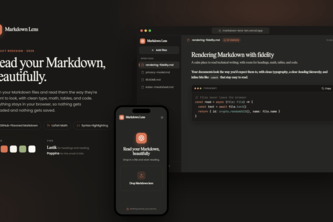
Markdown Lens is a client-side Markdown viewer application built as a single-page React app with no backend. The authors describe it as solving a "typography problem" in Markdown rendering, focusing on clean type, LaTeX support, and proper code blocks. It is designed to be privacy-preserving, with no file upload or storage.
What changed
The project was submitted to the OpenAI 2026 hackathon by two developers (Ayesha Ashfaq and M. Abdullah Butt). The description reflects a self-directed build focused on improving reading experience over parsing capabilities, with an emphasis on design, security, and privacy.
Single most important open question
Is there any evidence of product-market fit or user adoption beyond the authors’ own use case? The description does not include any data about users, revenue, or traction — only a self-reported development narrative.
What The Product Actually Is
The description states that Markdown Lens is:
- A client-only single-page application built with Vite, React 18, and TypeScript.
- It uses react-markdown with a pipeline of remark and rehype plugins for rendering.
- The rendering core includes support for:
- Tables, task lists, strikethrough, autolinks (via remark-gfm)
- Math expressions (via remark-math and rehype-katex)
- Syntax highlighting (via rehype-highlight)
- Raw HTML sanitization (via rehype-raw and rehype-sanitize)
- It has no backend, no file upload, and no data storage.
- The app is built with self-hosted fonts and uses a CSS variable-based theming system for light/dark modes.
Inferred: The product is a browser-based Markdown reader that prioritizes visual fidelity and security over functionality or server-side features.
Positioning & Claim Evolution
The description states:
- The app was built to solve the problem of poor Markdown reading experiences, especially in READMEs.
- The authors claim that rendering Markdown well is not a parsing problem but a typography problem.
- They emphasize that the viewer’s design and spacing are more important than its parser, which they describe as “boring” and “commodity.”
- The app was built with a privacy-first architecture: no files are uploaded or stored, and all processing happens in the browser.
Inferred: The positioning is that of a privacy-preserving, typography-focused Markdown reader for developers and technical users who want clean, readable documentation without server-side dependencies.
Target Customer & ICP
The description states:
- The app was built to improve the reading experience of Markdown files like READMEs, docs, notes, specs, and AI outputs.
- It is aimed at technical users, especially those who write or read a lot of Markdown.
Inferred: The target customer appears to be developers, technical writers, and open-source contributors who value clean documentation rendering and privacy.
Not evidenced:
- No explicit customer segments beyond “technical users.”
- No evidence of personas, user interviews, or market research.
- No indication of whether the app is intended for individual use or team adoption.
Business Model & Pricing Evidence
The description states:
- The app is a client-only viewer, with no backend or server-side components.
- It is built as a static bundle and does not require infrastructure.
- There is no mention of pricing, monetization, or business model.
Inferred: No commercial model is evident. The project appears to be a personal or hackathon effort without any indication of monetization.
Not evidenced:
- No revenue streams, subscriptions, or paid features.
- No evidence of pricing structure or customer acquisition strategy.
Technical & Delivery Signals
The description states:
- Built with Vite, React 18, TypeScript, and strict mode.
- Uses a plugin pipeline via remark and rehype for Markdown processing.
- Implements security through sanitization (allowlist-based HTML parsing).
- Features self-hosted fonts (Lastik, Poppins) to avoid third-party requests.
- Code blocks have:
- Language detection
- Copy buttons
- Unique color accents per language
- Typography is defined via CSS variables for consistent design tokens.
Inferred: The technical stack and delivery approach suggest a modern frontend architecture, with attention to performance, security, and visual polish.
Not evidenced:
- No evidence of scalability, error handling, or long-term maintenance plans.
- No mention of testing, CI/CD, or deployment practices beyond Vercel (mentioned in tech tags).
Traction & Maturity Signals
The description states:
- The project was submitted to the OpenAI 2026 hackathon.
- It is a personal build by two developers.
- No mention of user feedback, adoption, or usage metrics.
Inferred: The product has no demonstrated traction. It is a proof-of-concept or prototype, not yet a mature product in the market.
Not evidenced:
- No customer base, user reviews, or usage data.
- No evidence of product-market fit or iteration history.
- No mention of any public release, downloads, or community engagement.
Competitive Context
The description states:
- The authors note that existing Markdown viewers either look like they were designed in 2013 or upload files to a server.
- They position Markdown Lens as an alternative that does not upload or store files and focuses on typography.
Inferred: The app competes with other Markdown readers, but the description does not name specific competitors or describe how it differentiates from them beyond privacy and design.
Not evidenced:
- No mention of existing products in this space.
- No competitive analysis or positioning against known tools.
- No evidence of market size or competitive landscape.
Open Questions & Risks
The description states:
- The app is a client-only viewer, which may limit its utility for more complex Markdown use cases (e.g., editing, collaboration).
- It is built as a personal project with no clear path to commercialization.
- The authors note that matching typography is harder than matching features, indicating potential for iteration and delays.
Inferred:
- Risk of limited adoption due to lack of features beyond rendering.
- Risk of being a niche tool with low scalability or monetization potential.
- Risk of underestimating the complexity of user needs in a crowded space.
Not evidenced:
- No evidence of technical debt, scalability issues, or long-term roadmap.
- No indication of team capacity for further development or product evolution.
Questions the description leaves open
- What is your definition of success for this project? Is it personal use, community adoption, or commercial viability?
- Have you received any feedback from users beyond yourself and your teammate?
- Are there plans to expand beyond the current feature set (e.g., editing, collaboration, export)?
- How do you plan to monetize or scale this product if at all?
- What are the limitations of the current architecture that might prevent broader adoption?
Overall Assessment
The description states:
- The project is a hackathon submission by two developers.
- It is a client-only viewer, with no backend, and focuses on privacy and typography.
Inferred: This is a pre-product-stage idea or prototype. There is no evidence of traction, revenue, or market validation.
Not evidenced:
- No indication of commercial potential or scalability.
- No evidence of team experience or prior product success.
- No data to support any investment or partnership interest.
Assessment Not evidenced. The project appears to be a personal or hackathon effort, with no demonstrated commercial viability or traction. It is not ready for due diligence or investment consideration without further evidence of user adoption, market demand, or business model development.
User Stories BotA demo video on every pull request
Get a demo video on every new feature
GitHub App that watches your pull requests and records a narrated, captioned demo.
Save time on demo prep and make informed decisions faster with a video walkthrough of every new feature.
Source
Submitted to the OpenAI 2026 hackathon on Devpost. Project home on Devpost. Back to the full gallery on Devpost.
This competitive analysis was produced by top-founders.com (opens in a new tab)
Generated by a language model from this project's public Devpost page — its tagline, the author's own write-up and any built-with tags listed there — as captured in August 2026. Short quotations are the author's words. It is an opinion on the idea as a business, not on the people behind it, and it reflects the description as published then. If the project has moved on, request a correction below. The analysis is not independent research and contains no verified traction, revenue or customer data.
An independent guide by KFG International LLC — not affiliated with, endorsed by, or connected to Devpost or OpenAI.