

Archive position — measured, not model output
1 like on Devpost
505 of the 7,850 archived projects have more likes, and 1,758 share exactly 1 — so this project's #1,227 place in the like-ranked listing is a tie-break inside that group, not a ranking.
Projects (log scale)
Likes on Devpost. ▲ marks this project's group.
Show the figures
| Likes | Projects | Share of archive |
|---|---|---|
| 0 | 5,587 | 71.2% |
| 1 | 1,758 | 22.4% |
| 2 | 284 | 3.6% |
| 3–4 | 132 | 1.7% |
| 5–9 | 75 | 1.0% |
| 10+ | 14 | 0.2% |
 User Stories BotA demo video on every pull request
Get a demo video on every new feature
GitHub App that watches your pull requests and records a narrated, captioned demo.
Save time on demo prep and make informed decisions faster with a video walkthrough of every new feature.
Executive Summary
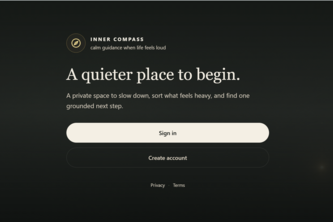
Inner Compass is described as an emotionally intelligent AI companion designed to help people move from overwhelm to clarity through calm reflection, structured thinking, and grounded action. The project was built during the OpenAI 2026 hackathon by one founder, Saureen Patel, using React Native, Supabase, OpenAI GPT models, and other technologies.
The description states that Inner Compass aims to guide users through difficult life decisions by helping them organize thoughts, recognize emotional burdens, separate facts from assumptions, understand trade-offs, and identify practical next steps. It is positioned as an AI tool that supports human judgment rather than replacing it.
Key commercial due-diligence questions include: What is the actual user experience? How does the product differentiate from existing AI decision-support tools? Is there evidence of early traction or user feedback beyond the hackathon submission?
The single most important open question is whether Inner Compass has demonstrated any measurable impact on user decision-making or emotional clarity, beyond its self-reported features and technical implementation.
What The Product Actually Is
The description states that Inner Compass is an AI companion built using:
- React Native with Expo
- Supabase Authentication
- Supabase Edge Functions
- OpenAI GPT models (specifically Codex and GPT-5.6)
- TypeScript
- Vercel
It is described as a tool that helps users navigate difficult life decisions by organizing complex thoughts, recognizing emotional burdens, separating facts from assumptions, understanding trade-offs, and identifying practical next steps.
The product is presented as an emotionally intelligent AI companion that aims to move people from overwhelm to clarity through calm reflection and structured thinking.
Positioning & Claim Evolution
The description states that Inner Compass was created to fill a gap in existing AI tools. It claims that while current AI tools are good at answering questions, they rarely help people slow down, organize their thoughts, and make decisions they can truly stand behind.
The positioning is described as an AI companion that helps people think more clearly by combining emotional awareness with structured reasoning and practical next steps. It explicitly states that the goal is not to decide for the user but to help the user make better decisions for themselves.
The claim evolution shows a shift from general AI assistance to specifically addressing decision-making overwhelm, emphasizing emotional intelligence and structured thinking over generic advice or motivational responses.
Target Customer & ICP
Not evidenced.
The description does not specify target customer segments, user personas, or ideal customer profiles. It only states that the tool is designed for people facing difficult decisions about relationships, careers, finances, family, health, and personal growth.
Business Model & Pricing Evidence
Not evidenced.
There is no information in the description about pricing models, monetization strategies, revenue streams, or business model assumptions. The description focuses entirely on product features and technical implementation.
Technical & Delivery Signals
The description states that Inner Compass was built using:
- React Native with Expo
- Supabase Authentication
- Supabase Edge Functions
- OpenAI GPT models (specifically Codex and GPT-5.6)
- TypeScript
- Vercel
During the OpenAI Build Week, the team focused on improving conversation quality rather than adding features. They used Codex and GPT-5.6 to refine the conversation engine for:
- Reducing repetitive response patterns
- Improving emotional burden recognition
- Better identifying meaningful loss when appropriate
- Producing more grounded insights
- Improving conversation flow
- Strengthening safety while keeping responses practical
The result is described as a calmer, more natural conversation experience.
Traction & Maturity Signals
Not evidenced.
There is no evidence of user traction, customer adoption, revenue, or usage metrics beyond the fact that it was submitted to a hackathon. The description mentions iterative testing and evaluation with real conversation scenarios but does not provide any quantitative or qualitative traction data.
Competitive Context
Not evidenced.
The description does not mention competitors, market positioning relative to existing AI tools, or competitive advantages. It only describes how Inner Compass differs from current AI tools in terms of helping people slow down and organize their thoughts rather than simply answering questions.
Open Questions & Risks
- Single-founder team: The project is built by one person (Saureen Patel), which may indicate limited development capacity or scalability concerns.
- Hackathon origin: The product was developed during a hackathon, suggesting it may be in early stages with minimal market validation or user testing beyond the development process.
- Lack of traction evidence: No data on user adoption, engagement, or revenue is provided, making it difficult to assess commercial viability.
- Unverified claims: All claims about functionality and impact are self-reported without independent verification.
- Technical implementation details: While technical stack is described, there's no indication of how well these components integrate or perform in practice.
Questions the description leaves open
- What specific user feedback have you received during the development process beyond the hackathon?
- How do you plan to validate that users actually experience improved clarity and decision-making with your tool?
- What is your strategy for scaling beyond a single developer?
- How will you ensure consistent safety boundaries while maintaining natural conversation flow?
- What are your plans for long-term memory, personalization, and privacy controls?
- How do you intend to monetize this product if it's not already in production?
Overall Assessment
Not evidenced.
The description provides no information about funding rounds, valuations, or investment status. It also lacks any indication of commercial traction, customer relationships, or market validation that would support an investment or partnership decision. The project is described as a hackathon submission with no evidence of business development beyond the initial concept and technical implementation.
User Stories BotA demo video on every pull request
Get a demo video on every new feature
GitHub App that watches your pull requests and records a narrated, captioned demo.
Save time on demo prep and make informed decisions faster with a video walkthrough of every new feature.
Source
Submitted to the OpenAI 2026 hackathon on Devpost. Project home on Devpost. Back to the full gallery on Devpost.
This competitive analysis was produced by top-founders.com (opens in a new tab)
Generated by a language model from this project's public Devpost page — its tagline, the author's own write-up and any built-with tags listed there — as captured in August 2026. Short quotations are the author's words. It is an opinion on the idea as a business, not on the people behind it, and it reflects the description as published then. If the project has moved on, request a correction below. The analysis is not independent research and contains no verified traction, revenue or customer data.
An independent guide by KFG International LLC — not affiliated with, endorsed by, or connected to Devpost or OpenAI.