

Archive position — measured, not model output
0 likes on Devpost
2,263 of the 7,850 archived projects have more likes, and 5,587 share exactly 0 — so this project's #5,135 place in the like-ranked listing is a tie-break inside that group, not a ranking.
Projects (log scale)
Likes on Devpost. ▲ marks this project's group.
Show the figures
| Likes | Projects | Share of archive |
|---|---|---|
| 0 | 5,587 | 71.2% |
| 1 | 1,758 | 22.4% |
| 2 | 284 | 3.6% |
| 3–4 | 132 | 1.7% |
| 5–9 | 75 | 1.0% |
| 10+ | 14 | 0.2% |
 User Stories BotA demo video on every pull request
Get a demo video on every new feature
GitHub App that watches your pull requests and records a narrated, captioned demo.
Save time on demo prep and make informed decisions faster with a video walkthrough of every new feature.
Executive Summary
What the company appears to be
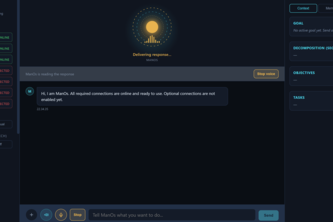
Manos is a voice-first AI executive prototype built around GPT-5.6 and Codex, designed to plan, reason, and execute real-world tasks across apps. It aims to function as an AI Chief of Staff that understands goals, breaks them into subtasks, and orchestrates workflows without requiring manual intervention from the user.
What changed
The project is a self-reported prototype submitted to the OpenAI 2026 hackathon. It represents an attempt to move beyond question-answering chatbots toward autonomous task execution using LLMs and agent architecture.
Single most important open question
Is there evidence of traction, revenue, or customer adoption that would indicate a viable business model or path to product-market fit?
The description is self-reported and unverified. Treat every statement in it as “the author states X”, never as “X is true”. This analysis is based entirely on the information provided by the caller.
What The Product Actually Is
The description states that Manos is a voice-first AI executive built using GPT-5.6 and Codex. It functions as an agent that understands user intent, plans multi-step workflows, determines required tools, generates execution plans, requests approval before sensitive actions, and executes tasks across multiple apps.
It includes components such as:
- Voice Input Layer
- Intent Understanding
- Planning Engine
- Task Decomposition
- Secure Approval Workflow
- Tool Router
- Memory Layer
- Execution Engine
The system is described as focusing on completing objectives rather than responding with text alone.
This is a self-reported product architecture. No evidence of actual deployment, usage, or performance metrics exists beyond the author's account.
Positioning & Claim Evolution
The description states that Manos was built to "transform natural conversations into completed tasks", positioning itself as an alternative to chatbots. It claims to be an AI Chief of Staff capable of understanding goals and driving them toward completion.
It emphasizes:
- Voice-first interaction
- Multi-step autonomous planning
- Secure execution via approval checkpoints
- Orchestration of real-world tools
The project evolved from a desire to move beyond question answering into a more practical AI experience for professionals, with the goal of making AI act as an “AI coworker.”
These are claims about intent and positioning. There is no evidence of market validation or adoption.
Target Customer & ICP
The description states that Manos targets professionals who spend time switching between emails, calendars, documents, messaging apps, browsers, and development tools.
It aims to serve users looking for an AI assistant that can:
- Manage emails
- Create presentations
- Organize files
- Generate documents
- Execute coding tasks
- Plan multi-step projects
The ICP appears to be knowledge workers or professionals seeking automation of routine workflows through voice interaction.
No evidence of specific customer segments, personas, or user research is provided.
Business Model & Pricing Evidence
There is no mention in the description of a business model or pricing strategy. The project is described as a prototype submitted for a hackathon.
Not evidenced.
Technical & Delivery Signals
The project was built using:
- GPT-5.6 and Codex
- FastAPI, React, Node.js, Python, TypeScript
- Docker, PostgreSQL, SQLite, OAuth, WebSockets
- Speech-to-text and text-to-speech technologies
- RAG (Retrieval-Augmented Generation), API integrations
It includes a modular agent architecture with components like:
- Voice Input Layer
- Intent Understanding
- Planning Engine
- Execution Engine
The system is described as having a backend that coordinates multiple tools and services, while maintaining user control through approval checkpoints.
These are technical claims. No evidence of delivery, scalability, or production use exists beyond the prototype stage.
Traction & Maturity Signals
There is no evidence of traction, revenue, customers, or adoption in the description. The project is explicitly described as a prototype submitted to a hackathon.
The authors mention:
- A team size of one member
- No mention of users, customers, or product usage data
- No financials, funding rounds, or headcount
Not evidenced.
Competitive Context
The description does not provide any information about competitors or market positioning. It does not name similar products or describe how Manos compares to existing AI assistants or workflow automation platforms.
Not evidenced.
Open Questions & Risks
- Prototype only: The project is described as a hackathon submission with no evidence of product-market fit, traction, or commercial viability.
- Unverified technology stack: GPT-5.6 and Codex are mentioned but not validated; their availability or performance in this context is unknown.
- Lack of business model clarity: No indication of monetization strategy or target revenue streams.
- Single-person team: A team size of one raises questions about execution capability, scalability, and long-term development capacity.
- No customer data: The absence of any user feedback, adoption metrics, or real-world testing is a major gap.
These are inferences based on the lack of evidence. No actual risks can be confirmed without further data.
Questions the description leaves open
- What specific workflows or use cases have you tested with Manos?
- How do you plan to validate the accuracy and safety of task execution?
- Have you conducted any user testing or gathered feedback from professionals?
- What is your roadmap for transitioning from prototype to a scalable product?
- Are there any existing partnerships, integrations, or early adopters?
- How do you intend to monetize this product?
- What are the key technical challenges that remain unresolved?
These questions aim to uncover gaps in the self-reported narrative.
Overall Assessment
The description presents a self-reported prototype submitted for a hackathon, with no evidence of traction, revenue, or customer adoption. It is unclear whether Manos has moved beyond concept stage or if there is any viable path to commercialization.
Given the lack of data on:
- Customers
- Revenue
- Product-market fit
- Business model
- Team capacity
This project should be considered pre-product-market-fit, with very low confidence in its current readiness for investment or partnership.
This conclusion is based entirely on self-reported claims and lacks corroboration. The absence of evidence is itself a finding.
User Stories BotA demo video on every pull request
Get a demo video on every new feature
GitHub App that watches your pull requests and records a narrated, captioned demo.
Save time on demo prep and make informed decisions faster with a video walkthrough of every new feature.
Source
Submitted to the OpenAI 2026 hackathon on Devpost. Project home on Devpost. Back to the full gallery on Devpost.
This competitive analysis was produced by top-founders.com (opens in a new tab)
Generated by a language model from this project's public Devpost page — its tagline, the author's own write-up and any built-with tags listed there — as captured in August 2026. Short quotations are the author's words. It is an opinion on the idea as a business, not on the people behind it, and it reflects the description as published then. If the project has moved on, request a correction below. The analysis is not independent research and contains no verified traction, revenue or customer data.
An independent guide by KFG International LLC — not affiliated with, endorsed by, or connected to Devpost or OpenAI.